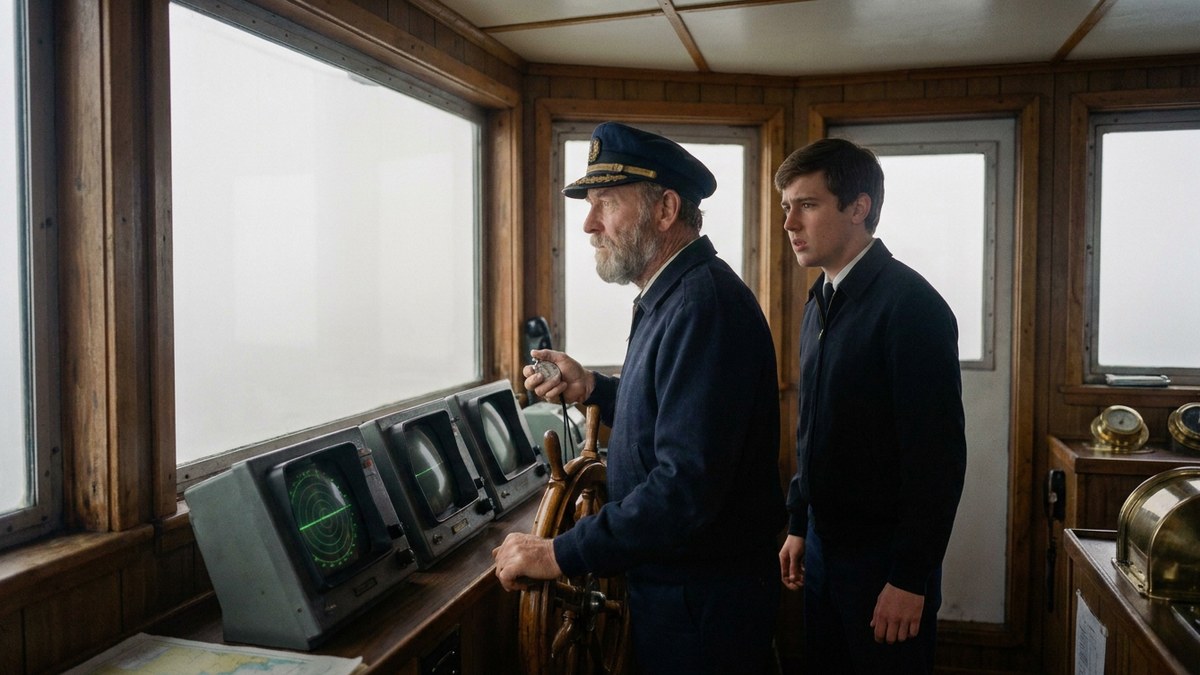
It was supposed to be an easy last week, and on Wednesday the radar went dark.
Gunnar Lund had worked the Kellam Island ferry for fifty-two years. He'd started as a deckhand at eighteen, in 1975, coiling lines for an old Norwegian captain named Arne Haugen who smoked a pipe in the wheelhouse and navigated half the time with his eyes closed. Gunnar had been the captain himself since 1993.
On Friday afternoon, at the end of the 5:40 run, he was going to tie up the Madrona at the Port Dorrance slip for the last time and walk off and go fishing.
That was the plan, anyway.
The Madrona was an old boat, built in 1979. Two hundred and four feet long, fifty-four cars, room for a hundred and fifty passengers. She ran the four miles of cold green water between Kellam Island and the mainland side of Puget Sound eleven times a day, twenty-five minutes each way, rain or shine.
Mostly rain.
Gunnar's mate that spring was Devin Marsh, twenty-six. He was a good kid. Smart, careful, licensed, and better with the electronics than Gunnar would ever be.
He could make the radar and the chart plotter sing. He'd grown up with screens the way Gunnar had grown up with rope.
"Captain," Devin said on Monday, watching Gunnar click a stopwatch as they passed the green buoy in the middle of the channel. "What do you do that for?"
"Habit."
"We've got GPS. It tells you the time to the slip to the second."
"Arne Haugen made me time every crossing for my first five years," Gunnar said. "Buoy to slip. Every tide, every speed. I wrote it all in a notebook. I guess I never stopped."
Devin grinned. "Captain, with respect. That went out with whale oil."
Gunnar grinned back. "Arne did. In 1975."
Wednesday morning, the fog came in.
Puget Sound gets fog in the spring sometimes, when the warm air comes in over the cold water, and this was the thick kind. The kind that sits on the water like cotton batting. From the wheelhouse, Gunnar couldn't see the bow of his own boat.
The 7:10 run left Kellam Island with a hundred and twelve passengers aboard. Commuters.
A couple of contractors in pickups. And a busload of fourth graders from the island school on a field trip to the science center in Seattle, eating breakfast out of paper bags on the passenger deck.
Gunnar slowed to eight knots. He sounded the fog signal, one long blast every two minutes, the way the rules required. Devin had his eyes on the radar, calling out the targets.
A tug and barge, two miles north. A sailboat moving slowly near the mainland side.
At 7:18, they passed the green buoy in the middle of the channel. Gunnar heard the bell on it clang through the fog, and he clicked his stopwatch the way he always did.
At 7:19, the radar went dark.
So did the chart plotter. So did the GPS display, and the depth sounder, and the little screen that showed the other boats around them. Every screen on the console went black at the same moment, with a small electrical pop from somewhere under the floor.
"Captain," Devin said. His voice had gone high. "Captain, I've got nothing. I've got nothing at all."
Gunnar didn't take his hand off the throttle.
"Breaker," he said calmly. "Go check the electronics panel. Take the handheld radio."
Devin went. He was back in two minutes, pale.
"It's not a breaker. Something burned out in the main power supply for the whole electronics bus. I can smell it. There's no fixing it out here."
Gunnar picked up the handheld radio and called the Coast Guard's traffic center in Seattle. He gave them his position as best he knew it, and his course, and his speed, and the number of souls aboard.
The radio crackled back that they had him, and that the tug was holding position to the north. They'd send a boat if he needed one.
"We'll come in slow," Gunnar said. He set the radio down. "Devin, I want you on the bridge wing. Port side. Listen."
"Listen for what?"
"For the horn on Dorrance Point. It sounds every thirty seconds. It's off our port bow now, about a mile. As long as we can hear it, we know where the point is, and where the rocks are."
Devin went out into the fog. Gunnar could just see him, a gray shape at the rail.
The Dorrance Point fog horn sounded, low and mournful, off the port bow. Thirty seconds later, it sounded again.
Then it didn't.
Gunnar waited. Thirty seconds.
Forty. A minute.
Nothing. Only the hiss of the water along the hull and the faraway chatter of fourth graders on the deck below.
"Captain," Devin called from the wing. His voice was shaking now. "Captain, the horn stopped. I can't hear it. I can't hear anything."
Gunnar knew what was under the water off Dorrance Point. Shag Reef.
A long finger of black rock that came out from the point a quarter mile, just under the surface at this stage of the tide. On a flood tide like this one, the current ran north across the channel toward it at almost two knots.
Without the horn and without the radar, every minute they ran blind, the water was setting them a little closer to it.
Then, very faint, somewhere off the port bow, much closer than it had any right to be, Gunnar heard the sound of water breaking on rock.