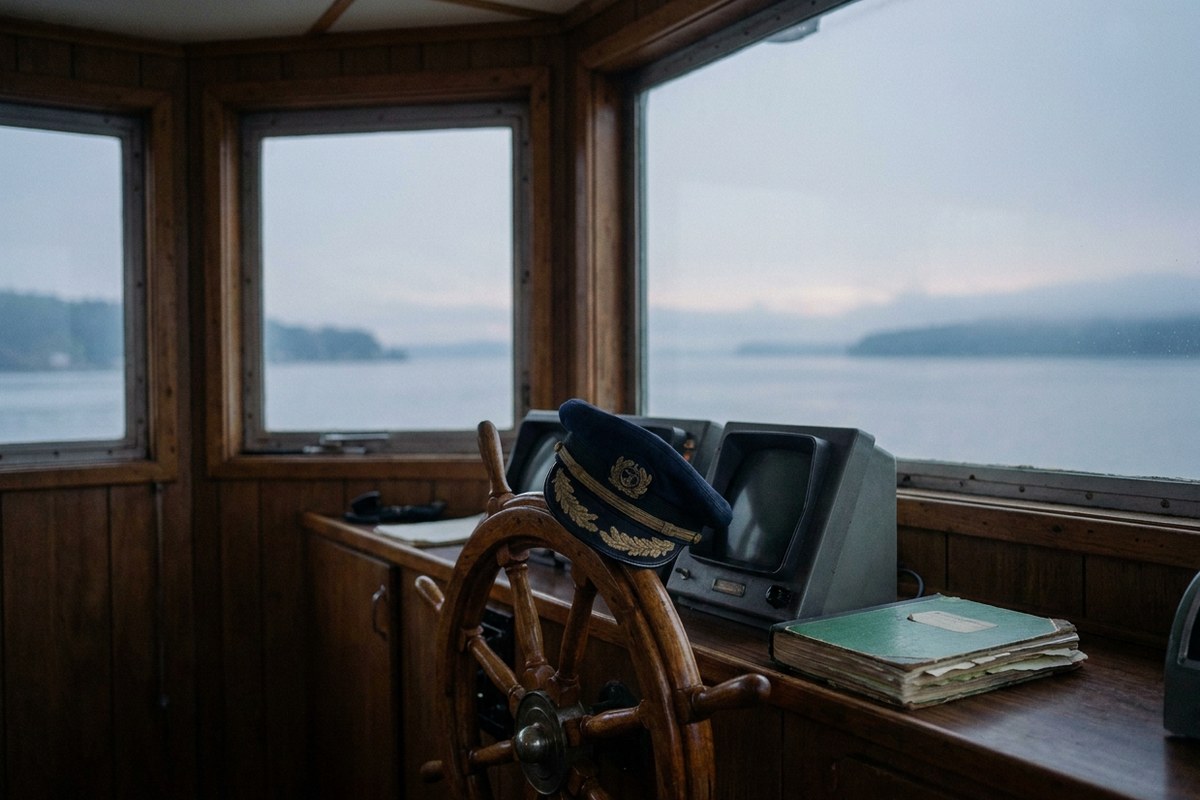
Gunnar pulled the throttle back to dead slow and turned the wheel ten degrees to starboard, away from the sound.
He did it without hurrying. Arne Haugen used to say that a captain who hurries in fog is a captain who's about to find out what's under it.
"Devin," he called. "Come in here. Bring my notebook. It's in the drawer under the chart table."
Devin came in from the wing with his face gray and a battered green notebook in his hand. The cover said MADRONA, 1993, in faded marker. Inside were thirty-four years of Gunnar's crossings in pencil.
Every buoy. Every tide.
Every speed. Every minute and second.
"Find me a flood tide, eight knots, buoy to slip," Gunnar said. "Morning runs in April."
Devin flipped pages with shaking hands. "There's dozens."
"Read me three."
"Twelve minutes forty. Twelve fifty-five. Twelve forty-five."
Gunnar looked at his stopwatch. It read 5:31. Five and a half minutes since the green buoy.
"So we're a little under halfway," he said. "Now. Compass." He tapped the old magnetic compass in its brass binnacle in front of the wheel. It didn't need power. It had never needed power. "We were holding one-oh-five degrees. The flood's been pushing us north at close to two knots for five minutes. That's about a thousand feet north of where we meant to be. Toward the reef."
"How do you know it's two knots?"
"Because it's always two knots on a spring flood at this hour. It says so on page forty-one. I wrote it down in 1996."
Gunnar brought the Madrona's head around to one-two-zero, angling south against the current.
Then he reached up and pulled the cord for the ship's whistle. One short, sharp blast.
"Count," he told Devin. "Out loud. One thousand one, one thousand two."
Devin stared at him. Then he counted.
"One thousand one. One thousand two. One thou."
The echo came back off the fog. A flat, hollow copy of the whistle, bouncing off something big and hard to the northeast.
"Two and a half seconds," Gunnar said. "That's the bluff above Dorrance Point. Sound goes out and comes back about eleven hundred feet a second. Two and a half seconds there and back, that's about fourteen hundred feet." He held the wheel steady. "We're a quarter mile off the bluff. Shag Reef comes out a quarter mile. So it's right there off the port bow, close. That's what you heard."
Devin's mouth was open.
"Again in thirty seconds," Gunnar said. "If the echo gets longer, we're opening the distance. If it gets shorter, I'm doing something wrong."
The next echo came at three seconds. The one after that, three and a half.
"We're clear of it," Gunnar said. "Now we find the slip."
They ran south and east at dead slow, the whistle sounding, Devin counting, the stopwatch ticking. Gunnar listened to the fog the way Arne had taught him.
Not just for echoes. For everything.
A dog barking, off the starboard bow. That was the Pedersens' black Lab, on the waterfront below Harbor Street. The sound of gravel rolling under small waves, off to port.
That was the beach by the old cannery. A truck downshifting on a hill. That was the grade coming down Dorrance Hill Road into town.
At eleven minutes, Gunnar heard the bell.
A slow, uneven clang, off the starboard bow, rising and falling with the swell. The red bell buoy that marked the approach to the Port Dorrance slip.
"There," he said quietly.
At twelve minutes and fifty seconds, the pilings of the Port Dorrance ferry slip came up out of the fog thirty yards dead ahead, black and dripping, with the dock lights glowing yellow through the gray.
Gunnar brought the Madrona into the slip so gently that the fourth graders on the passenger deck didn't even look up from their breakfasts.
The deckhands made her fast. The ramp came down. The cars started to roll off, and the commuters went up the walkway with their coffee, and the bus full of fourth graders pulled out onto Harbor Street on its way to Seattle, and not one of them knew a thing.
Devin stood in the wheelhouse holding the green notebook. He was shaking a little.
"I froze," he said. "When the screens went. I froze up completely."
"You went and checked the panel and came back and told me the truth," Gunnar said. "That's not freezing. Freezing is staying in the chair."
"I didn't know any of that. The echoes. The dog. The beach." Devin looked down at the notebook. "Captain, I didn't know a boat could be driven like that anymore."
"It can't," Gunnar said. "Not by most people. That's why I'm going to teach you before Friday."
They taught him for two days.
The electronics crew came out from Seattle on Wednesday afternoon and replaced the power supply. The Coast Guard fixed the Dorrance Point fog horn the same day. A battery charger had failed after a week of gray skies.
But on every run Thursday and Friday, Gunnar had Devin turn the screens face down and drive by the stopwatch, the compass, and his ears. Devin counted echoes off the bluff.
He learned the Pedersens' dog and the cannery beach and the downshift on Dorrance Hill Road. He started his own notebook, a new green one from the drugstore, and wrote every crossing in pencil.
On Friday, at the end of the 5:40 run, Gunnar tied up the Madrona at the Port Dorrance slip for the last time.
He took off his captain's cap, the old navy one with the faded gold braid that he'd worn since 1993, and set it on top of the wheel. Then he put the green notebook beside it, on top of Devin's new one.
He walked down the ramp with his hands in his pockets and didn't look back. He didn't need to. He could hear the young man behind him in the wheelhouse, clicking a stopwatch.