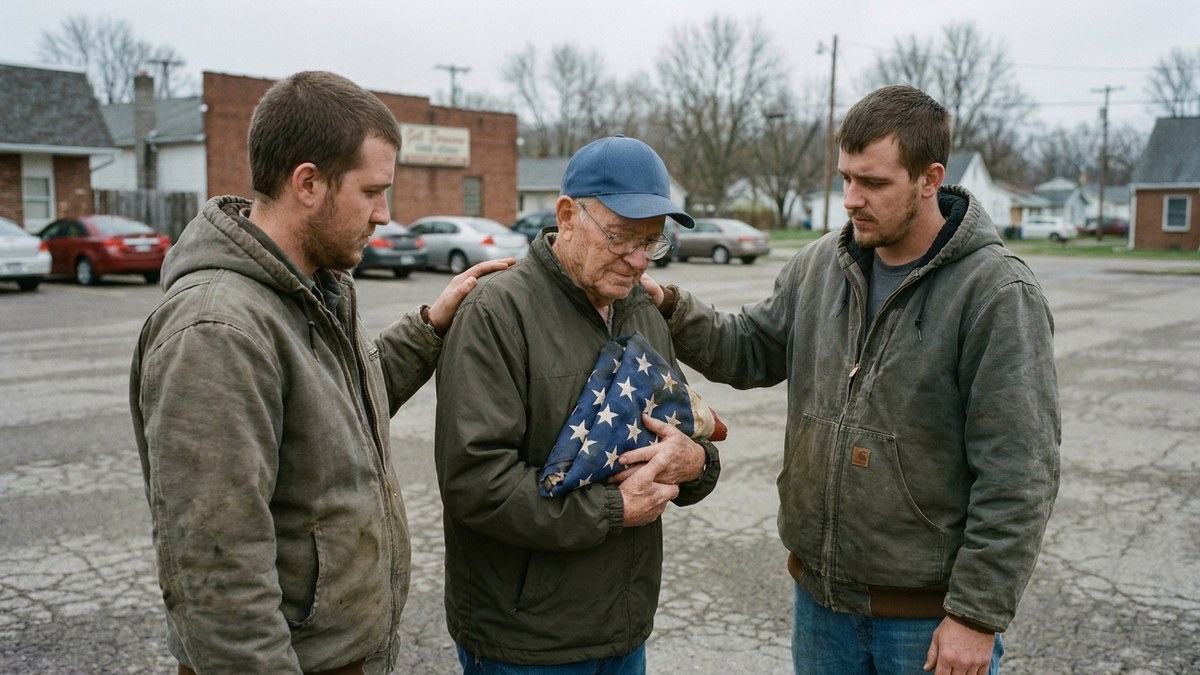
The work order said "dispose of old flag," and Lloyd Hersh folded it in half and put it in his pocket.
"Sir," said the young man from the restoration company, "I need that back. That's my copy."
"You can have it back," Lloyd said, "when it says something else."
He was eighty years old. He'd been commander of VFW Post 4417 in Pine Hollow for nineteen years, and a member for fifty-five, and he stood in the middle of the post hall in his blue VFW cap and his good windbreaker, among the wet carpet and the industrial fans, and he didn't move.
Lloyd had served in the Army from 1966 to 1968, as a supply clerk at a depot in West Germany, and he'd never once claimed to be a hero. But he knew the rules, and he knew them cold.
The young man looked at him. Then he looked at his clipboard. Then he went outside to call his boss.
The roof had gone in the March windstorm.
A big limb off the old sycamore behind the hall had come down through the shingles at two in the morning, and by the time Pastor Sam drove by at six and saw the tarp flapping, the rain had been pouring into the post hall for four hours. It soaked the carpet.
It ruined the pool table and half the folding chairs. It ran down the back wall behind the podium, right over the flag.
The flag had hung on that wall since 1946.
It was an old forty-eight-star flag, hand-sewn, about five feet by eight, mounted on a plain pine board that somebody had painted white a long time ago. It had hung there through Korea and Vietnam and the Gulf and everything after.
Through eighty years of Friday fish fries and Memorial Day breakfasts and funeral lunches and meetings where old men argued about the budget. It had faded to pale pink and soft blue and the color of weak tea.
Now it was soaked through and spotted black with mildew, and the restoration company the insurance had sent was going down the room with a clipboard, item by item.
Item 14. Flag, wall-mounted.
Water and mildew damage, not restorable. Dispose.
The restoration company's owner came out from Marietta at noon. His name was Phil Gorski, and he was reasonable about it.
"Mr. Hersh, I understand. I really do. My dad was a Marine." He held up his hands. "But I've got to clear the room so we can tear out the drywall. That flag's full of mold. We can't hang it back up. We bag it up and take it to the dump with the carpet. That's how it's done."
"That's not how it's done," Lloyd said.
"Sir?"
"There's a law about it. United States Code, Title 4, Section 8, paragraph k. When a flag is in such condition that it is no longer a fitting emblem for display, it should be destroyed in a dignified way, preferably by burning." Lloyd said it all without stopping, the way some men say the Lord's Prayer. "That flag isn't going to the dump in a bag with the carpet, son. It's going to be retired. Properly. By the men it belonged to."
Phil Gorski looked at him for a long moment.
"How long do you need?"
"I'll take it down myself," Lloyd said. "Today. And you can write that on your clipboard."
He took it down that afternoon with Marcus Bell and Danny Ortiz, the two youngest members of the post, who'd come over from Marietta when he called.
They unscrewed the old pine board from the wall. Then they laid it face up on two sawhorses in the parking lot, in the thin April sun, and Lloyd went to work on the tacks.
There were a lot of them. Somebody in 1946 had tacked that flag to that board every four inches, all the way around, with little copper upholstery tacks. Lloyd pulled them out one at a time with a pair of needle-nose pliers.
His hands weren't as steady as they'd been, and it took him two hours. Marcus held the flag up off the board as each side came loose so the wet cloth wouldn't tear.
"You know the ceremony, Commander?" Danny asked.
"Every word."
"You want to do it this week?"
"I want to do it right," Lloyd said. "That's not always the same thing."
When the last tack came out of the top edge, the heading of the flag, where the canvas strip runs along the side that goes up the pole, Lloyd stopped.
The heading had been folded under and tacked down flat against the board. It had been that way for eighty years. The underside of it hadn't seen daylight since the day it went up.
Now, as Marcus lifted the flag free, the heading fell open in Lloyd's hands.
Inside the fold, on the plain white canvas, somebody had stitched a name.
The thread had been red once. It had faded nearly to pink. The letters were small and careful and a little crooked, the stitches of somebody young who was trying very hard to get it right.
Ada L. Age 11. 1946.
Marcus leaned over Lloyd's shoulder and read it.
"Who's Ada L.?" he asked.
Lloyd didn't answer. He stood in the parking lot with the old flag in his arms and the name in front of his eyes, and he realized that in fifty-five years in this post, he had never once asked who'd sewn their flag.