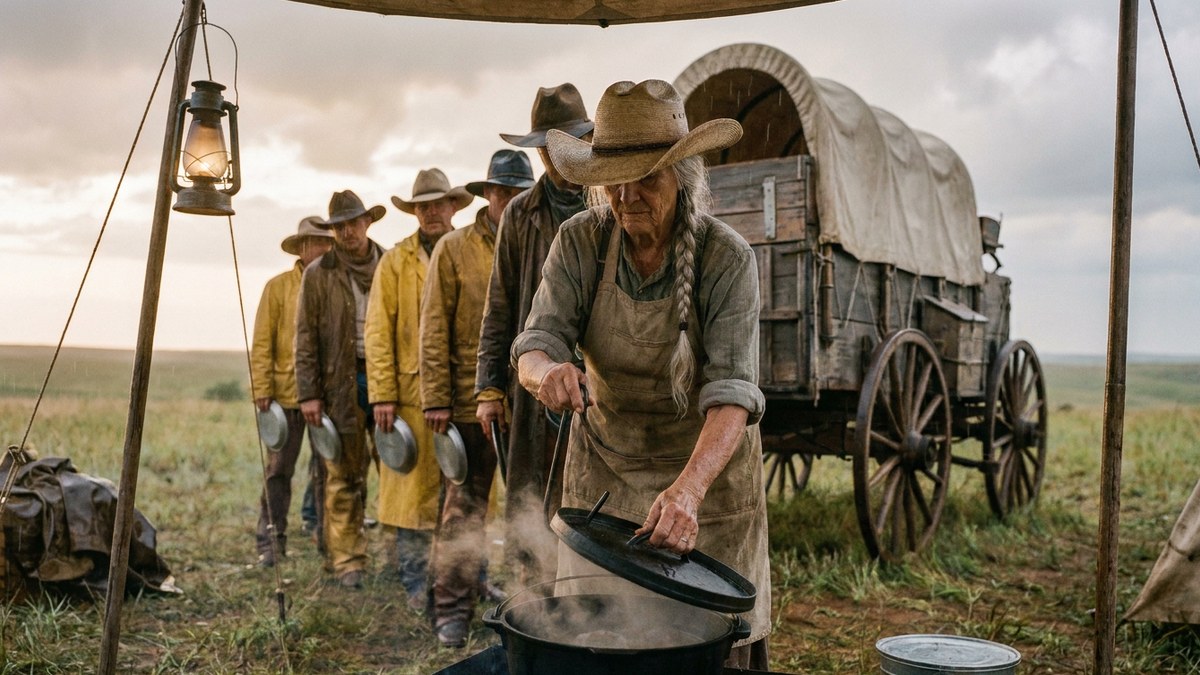
The new event planner called her chuckwagon "a little rustic" and booked a food truck.
She said it nicely. She said it the way you'd tell your grandmother that her Sunday dress was a little old-fashioned. Opal Haney heard it anyway.
"We're so glad you'll be with us, Mrs. Haney," said Madison Price. She was thirty-one, from a company in Oklahoma City called Red Dirt Events, and she had a tablet in a pink case and very clean boots. "The wagon is such a great photo spot. The riders are going to love it. We'd like you to do coffee in the mornings, if that's all right. Maybe some of your cobbler at the evening program."
"And supper?"
"We've booked two food trucks for the meals. Brisket tacos one night, barbecue the next." Madison smiled. "It's a lot easier for two hundred people. Health permits, menus, allergies. You understand."
Opal was seventy-six years old. She'd fed the Cimarron Bend Trail Ride for twenty-nine years.
"I understand," she said.
The Cimarron Bend Trail Ride was three days and forty miles across the ranch country of north-central Oklahoma, following a stretch of the old Chisholm Trail. It started in 1998 as twenty neighbors on horseback with a pot of beans. Now it drew riders from six states, and this year, for the first time, the ride committee had hired a company to run it.
Opal and her late husband, Roy, had cooked for the very first ride.
Roy had found the wagon in a barn near Enid in 1985. It was a Studebaker farm wagon from the 1880s, rotted down to the iron. He'd spent two years rebuilding it, and he'd built the chuck box on the back himself, the way the old trail cooks had them.
A fold-down lid for a work table. Little drawers for salt and coffee and baking powder. A sourdough crock that rode in a nest of flour sacks.
Under the wagon bed hung a cowhide sling, stretched tight between the axles, that the old cooks called a possum belly. Opal kept it full of split, dry firewood.
She always had. Roy used to tease her about it.
"Opal, we're camping on a ranch with a woodpile."
"The woodpile's not under my wagon," she'd say.
Roy had died in 2021. Opal had kept cooking.
The first day of the ride went fine.
Two hundred and twelve riders left the Bar Nine headquarters on Friday morning in the sunshine, with flags flying and a photographer from the Enid paper riding along on a four-wheeler. Opal drove the wagon behind her two old Belgian mares, Dolly and Queenie, on the county road, the way she did every year. Her grandson, Garrett, drove the support truck.
In the back of it, the same as every year, rode a hundred pounds of flour, sixty pounds of pinto beans, forty pounds of slab bacon, two cases of canned peaches, and enough coffee to float a boat. Madison had asked about it on Friday morning.
"For the coffee and cobbler?"
"Habit," Opal said. "Roy always packed one more meal than they told him."
At noon camp, the riders ate box lunches from the event company. At evening camp, on the banks of Plum Creek, the two food trucks were parked side by side with string lights, and the riders lined up for brisket tacos and agreed they were very good.
Opal made coffee in her big graniteware pot and a cobbler in a Dutch oven. Riders took pictures of the wagon.
A little boy asked if it was a real covered wagon, and she said it was better than that. It was a kitchen.
Madison came by at dark with her tablet, looking pleased.
"Day one, a total success," she said. "Tomorrow we cross the creek in the morning, then on to the Reese place for the second night. The trucks will go around by the highway bridge and meet us there."
Opal looked up at the sky to the southwest. It had gone the color of a bruise along the horizon, and the air had that smell, wet and green and heavy.
"I'd make sure those trucks go tonight," she said.
Madison laughed. "The forecast says a thirty percent chance after midnight, Mrs. Haney. Scattered."
"Thirty percent of a storm is a storm," Opal said.
The storm came at two in the morning.
It came the way spring storms come on the Oklahoma plains, all at once, with a wall of wind that flattened the tents and lightning so close and so constant that Opal could read her watch by it. Then the rain.
Not a shower. A cloudburst that went on for four hours.
Opal sat it out in the cab of Garrett's truck. At first light she walked down to the creek.
Plum Creek had been ankle deep at sundown. Now it was a brown, roaring river, forty feet wide and climbing, with whole cedar trees turning in the current. The low-water crossing where the trail went over was six feet under.
The food trucks were on the far side.
They'd parked on high ground across the creek to beat the rush in the morning. Now they sat there in the gray light like boats on the wrong shore, and the drivers stood beside them on their phones. Behind them, the dirt road out to the highway bridge was a long red lake.
Madison came down the bank in a borrowed slicker. Her tablet was gone, and her face was white.
"The trucks can't get across," she said. "And they can't get out the other way. The county says the bridge road won't be passable till tomorrow. Maybe the day after."
Behind them in the camp, two hundred and twelve riders were crawling out of collapsed tents, soaked to the skin, cold, and starting to ask about breakfast.
"I don't have any food," Madison said. "Mrs. Haney, it's all on the trucks. I don't have anything."
Opal looked at the creek. Then she looked back up the bank at her wagon, standing where Roy had always parked it, on the high spot, with its canvas fly tied down tight and the possum belly hanging full and dry under the bed.