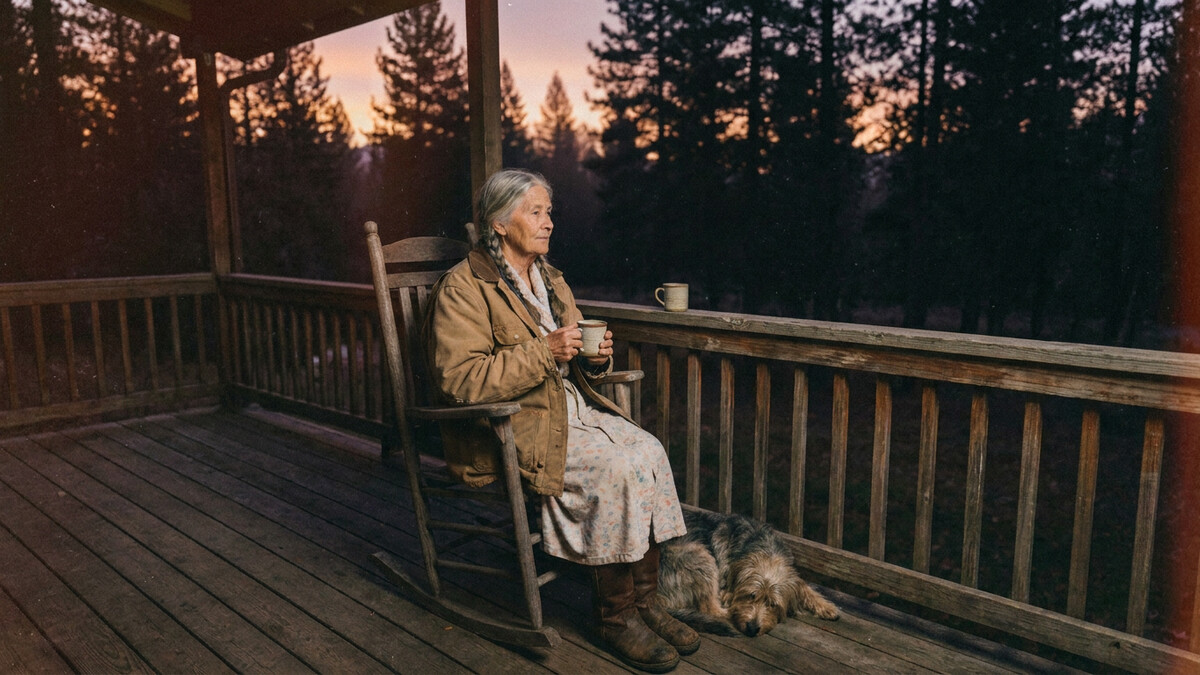
Jimmy Pritchett called his mother on a Tuesday night in November for the first time since her birthday in May, and before she could ask how he was, he asked her for five thousand dollars.
Nell Pritchett sat in her kitchen in the East Texas piney woods, in her late husband's chair, with the phone to her ear and a dish towel in her lap.
"What's it for, son?"
"Does it matter, Mama?"
"It does to me."
A long breath on the line. "Rent. Some bills. I'm a little behind. It's just for a while. I'll pay you back."
Nell looked out the window at the dark pasture and the black line of pines beyond it.
"All right," she said. "Yes."
"Really?" Jimmy sounded surprised. "Thank you, Mama. I'll send you my account number..."
"I'm not done," Nell said. "You can have it. Five thousand dollars. But you're going to come home and earn it. One month. Here on the place. Starting Saturday."
Nell was seventy-six. She had run cattle and pine timber on three hundred acres outside Caddo Springs, Texas, for fifty-two years, the last nine of them alone, since her husband, J.D., died of a stroke in the hay barn. She had a bad hip, a good dog named Rowdy, and a head for numbers that her husband used to say could make a cattle buyer cry.
She had raised two children on this place. Her daughter, Karen, was a schoolteacher in Tyler and called every Sunday.
Jimmy was forty-eight and lived in Houston. He had been a salesman for an oil field supply company until last spring. Then he had not been. Then his wife had left. Then he had stopped calling, except for her birthday, and twice for money.
Nell had sent the money both times. She had not asked any questions.
She was done not asking questions.
He came on Saturday afternoon in a silver pickup with Harris County plates and a cracked windshield. He got out slowly. He was thinner than she remembered, with dark circles under his eyes.
"Hey, Mama."
"Hey, son." She hugged him on the porch. He smelled like cigarettes and gas station coffee. "Supper's at six. You're in your old room. Chores start at five-thirty in the morning."
"Five-thirty?"
"Your daddy started at five," Nell said. "I'm giving you a half hour because you're out of practice."
The first week was hard on both of them.
She put him on J.D.'s old routine, the one she had kept going alone for nine years. Feed the cows round bales from the tractor at daylight. Check the water troughs. Ride the fence line on the four-wheeler and fix what the deer and the wind had knocked down. Haul firewood. Feed the dog. In the afternoon, cut and pile the brush the summer storm had knocked down along the creek.
He was slow. He was sore. On the second day, he drove the tractor into the gatepost. On the third day, he slept through the alarm and Nell fed the cows herself and did not say a word about it at breakfast, which was worse than if she had.
He did not complain. But he sat on the porch at night with his phone, his thumb moving fast, his jaw tight. Sometimes he sat in his truck with the doors closed and talked to somebody in a low voice.
Nell watched him the way J.D. used to watch a new bull. Not saying anything. Just watching how he moved.
It took her until the second week to understand what she was seeing.
She came in early from the barn on a Thursday and found him at the kitchen table with his phone. He did not hear her. On the screen, she saw a football game, and beside it, a column of numbers in red and green, and a button that said PLACE BET.
His thumb was on the button.
Nell stood in the doorway for a long time. Jimmy did not notice her. He pressed the button. He watched the screen. He put his face in his hands.
She went back out to the barn and stood with her hand on a cow's warm side until she could breathe.
Then she went back in and made supper.
"How much do you owe, son?" she asked that night, after the dishes.
Jimmy looked up from the porch steps. The dog was lying beside him. He did not answer for a long time.
"You saw," he said.
"I saw."
"Thirty-one thousand dollars," he said. "Give or take. Credit cards. A loan from a man in Pasadena. My truck's two months behind." He laughed a little. It was an awful sound. "The rent's real. I'm getting evicted on the first. That part was true."
"And the five thousand?"
"I was going to win it back," Jimmy said. "That was the plan, Mama. That's always the plan. Win it back."
Nell sat down on the porch step beside him.
She did not lecture him. She had thought about it all afternoon in the barn, and she had decided a lecture never once in the history of the world got a man to put down a bottle or a deck of cards or a phone. J.D. had been a drinker for the first ten years they were married, before he quit. She had tried lecturing. It had not worked.
What had worked was something else.
"Son," she said. "On Saturday, I'm taking twenty head of steers to the sale barn in Center. They'll bring about twenty-four thousand dollars. I want you to haul them."
He stared at her.
"You'll get paid in a check," Nell said. "I'll deposit it Monday. That's money for the property taxes and the hay and the whole winter. It's all the money I've got this year."
"Mama, why are you telling me this?"
"Because I trust you," Nell said. "I want you to know that."
On Saturday, Jimmy hauled the steers. He loaded them himself in the dark at five in the morning and drove them to the sale barn in Center, and Nell rode along in the passenger seat with Rowdy between them. The steers brought twenty-three thousand eight hundred dollars.
The check was made out to Nell Pritchett.
But there was something else. The sale barn paid the hauling and the yardage fees in cash, the old way, the way they always had. Twelve hundred dollars in an envelope.
Nell put the envelope on the kitchen table when they got home. She did not put it away.
She went to bed at nine.
At two in the morning, Rowdy woke her up barking.
She got out of bed and went to the window. Down in the yard, in the light from the barn, she saw taillights.
Jimmy's silver pickup was pulling out of the driveway onto the county road.
She went into the kitchen in her robe and turned on the light.
The envelope was gone.