Marlene took the roll of bills and didn't count it.
She sat down on the low bench in the coat closet, the one the little ones used to pull on their boots, so she was eye level with him. Her knees told her about it.
"Jayden," she said. "I'm not going to ask you if you took the money."
He looked at her, startled.
"I'm going to ask you something else instead," Marlene said. "When you came in this morning, you went straight to the cabinet and looked at the floor. Down at the bottom, by the wall. What were you looking for?"
Jayden's mouth opened. Nothing came out.
"You can show me," she said. "You don't have to say it."
He took her back down the hall to the classroom. The other children had gone downstairs for doughnuts. The room was empty.
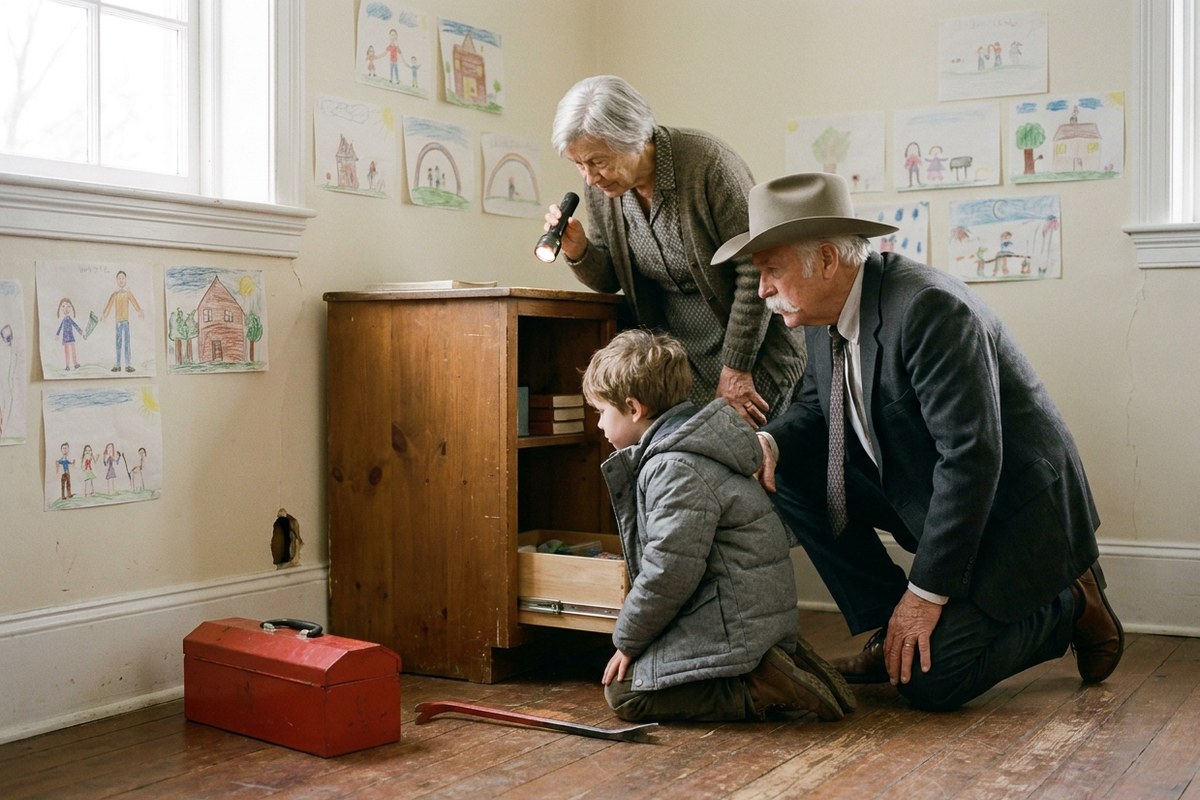
Jayden walked to the supply cabinet, knelt down, and pointed to the gap between the bottom of the cabinet and the baseboard. It was about an inch.
Marlene got down on her knees beside him. She took the little flashlight off her key ring and shined it into the gap.
Back in the dark, along the baseboard, was a hole in the plaster about the size of a quarter. Around the edge of it, caught on the rough plaster, were bits of paper. Green paper.
Marlene looked at the tiny scraps still in her other hand, the ones she'd brushed off the shelf that morning. Then she held them under the flashlight.
They weren't from the envelope. One of them had part of a number printed on it. A five.
"Oh, my goodness," Marlene said.
It came out of Jayden in pieces after that, quietly, sitting on the classroom floor with his back against the cabinet.
On Wednesday night at choir practice, he'd gone to the bathroom. On the way back he'd heard a scratching in the Sunday school room, and the door was open a crack because the custodian was inside setting traps. When the custodian went downstairs, Jayden looked in.
A mouse was on the top shelf of the cabinet. It was halfway inside the coffee can, pulling at something. When Jayden came closer, it ran down the back of the cabinet and disappeared, and it had a strip of green paper in its mouth.
"It was eating the money," Jayden said. "The coat money. So I got it out before it could eat any more."
"And you were going to give it to me today."
He nodded at the floor.
"Why didn't you?" Marlene asked gently.
Jayden didn't answer for a long time. When he did, his voice was so small she had to lean in.
"Because who'd believe me? It was a mouse. At my old school, a kid's phone went missing, and they searched my backpack first. Every time something's gone, they look at me first." He pulled at his coat sleeve. "I thought if I just held on to it, maybe somebody else would find the hole. And then I'd never have to tell anybody I touched it."
Clay came up the stairs twenty minutes later with his toolbox and a pry bar, still in his church clothes, because Marlene had sent one of the children down to get him.
He listened to the whole thing without a word. Then he knelt down in front of the cabinet beside Jayden, which took him a while, with his hip.
"Well, I'll be," Clay said. "Let's see what we've got."
He moved the cabinet. He pried off two feet of baseboard. Behind it, packed into the space inside the wall, was a mouse nest the size of a softball.
It was lined with money.
Shredded fives and tens and ones, chewed into strips and soft little scraps, woven in with insulation and bits of hymnal. Jayden stared at it with his mouth open.
"Your mouse was building himself a mighty expensive house," Clay said.
He looked over at the boy. He looked for a long time, the way he looked at a skittish colt at the sale barn, reading how it held itself.
"You did right, son," Clay said. "Taking what was left out of there. You saved every dollar that rascal hadn't got to yet. That's a fair day's work."
Pastor Sam made a few phone calls that afternoon.
It turned out the United States Treasury had an office for exactly this. The Bureau of Engraving and Printing would examine damaged money, chewed and burned and soaked, and replace what they could identify.
It would take a few months. Marlene packed the whole nest into a shoebox and mailed it to Washington, D.C., with a letter in her best handwriting.
In the meantime, the church board voted to advance the coat drive the full four hundred and twelve dollars.
The head of the trustees was Harold Fenn, Caden's grandfather. He moved to approve it. Then, before the vote, he stood up and cleared his throat and said he'd been wrong about something at Sunday school, and he'd like to put an extra hundred dollars in personally.
He didn't say what he'd been wrong about. He didn't have to.
The next Sunday, Caden Fenn walked up to Jayden at the coat hooks and said he was sorry. Jayden said okay. By the end of the lesson, they were arguing about whether a mouse could eat a whole twenty-dollar bill.
On the first Saturday in February, Marlene drove to the farm store in Marietta to buy the coats. She took Jayden with her. She said she needed someone to help her pick.
He was very serious about it. He held each coat up to the light and checked the zippers and the stitching and the pockets. He knew exactly which ones were warm and which ones only looked warm, because he'd worn both kinds.
They came home with twenty-three coats in the back of Clay's pickup.
That night, at Marlene's kitchen table, they counted out the receipts together and wrote the total on a piece of paper to show the class.
At the bottom of the bag was one more coat, a dark blue one with a fleece lining, in a boys' size ten. Marlene had paid for it separately, out of her egg money, and she slid it across the table to him.