Part 2
"Bring them in," Clara said. "All of them. Now."
The Reverend carried the smallest boy. His wife, Lydia, pushed the two girls ahead of her. The cold came in with them like a fourth child, and Clara shut the door on it with her shoulder.
Nobody spoke about the sermon. Clara did not even think about it until much later.
The little boy was named Samuel, and he was four, and he had stopped shivering. Clara knew that was worse than shivering. She took him out of his father's arms and sat him on her lap on a chair near the stove, not too near, and wrapped him in the quilt off her own bed.
"Greta," she said. "Warm water. Not hot. From the reservoir."
Greta ran. The Reverend stood in the middle of the kitchen with snow melting off his hat onto her clean floor and did not seem to know where to put his hands.
"Josiah," Lydia said quietly. "See to the horse."
He went. Clara heard him fighting the wind to the shed, and then nothing but the wind.
By eight o'clock there were twelve people in one room.
Clara had hung quilts over both doors and stuffed rags in the cracks of the north wall. She had six children of her own on the floor in a nest of coats, and three more of the Reverend's beside them. Samuel had begun to shiver again. She took that as a good sign and said so to his mother, who put both hands over her mouth and nodded.
The wind made the whole house shudder. Through the walls came the high thin whistle of snow moving across the yard.
A house with twelve people in it needed more heat than a house with eight. Clara did the sums without wanting to. Tonight would burn three days of corn. Maybe four.
She went to the lean-to and filled the basket anyway.
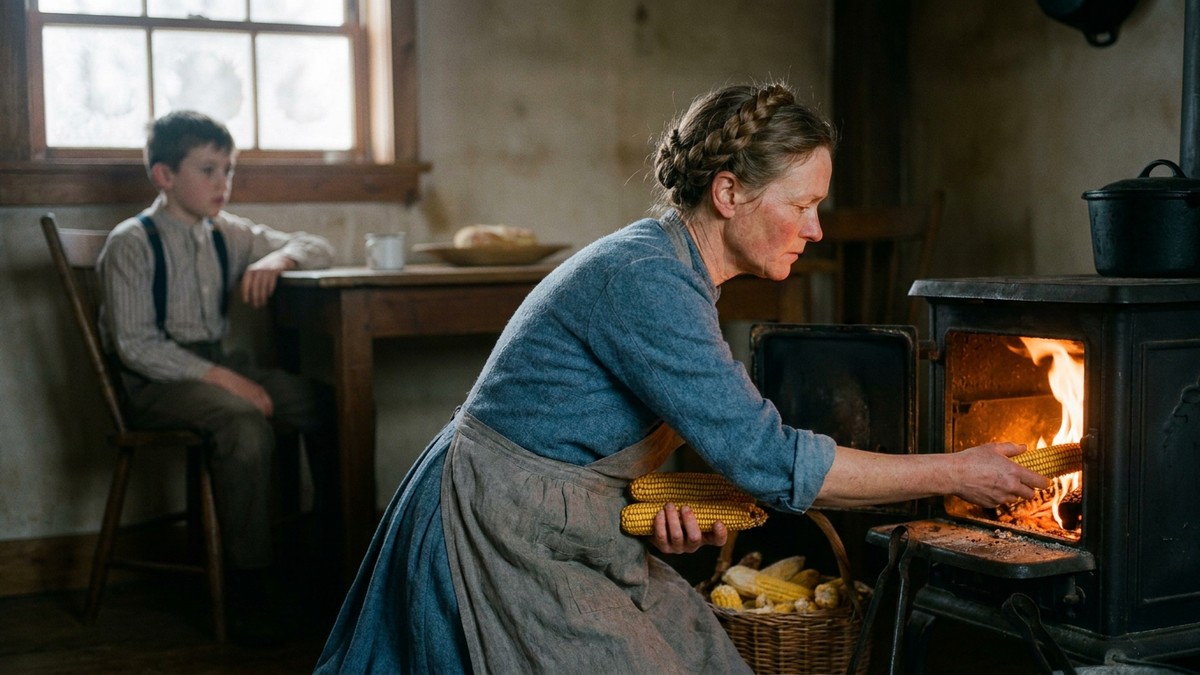
When she came back, the Reverend was kneeling at the stove.
He had the firebox door open and the basket she had left there was nearly empty. He had packed the firebox full of ears, tight as kindling in a box, and he was reaching for another.
"There," he said. "That'll warm them."
The stove top had already gone from black to a dull, angry red. Under the iron, Clara heard it. A small dry ticking, like a clock in the next room.
She put the basket down.
She did not run, because running scared children. She took the tongs from beside the stove and pulled the ears out one at a time, burning, and dropped them in the ash bucket. They hissed and smoked. The kitchen filled with the smell of scorched corn. She shut the damper down to a crack.
The red went out of the iron slowly, from the edges in. The ticking stopped.
Clara laid three ears back in the firebox and closed the door.
"Three at a time," she said.
The Reverend looked at the stove, and then at the ash bucket full of smoking ears, and then at his hands. He sat down on the woodbox.
"I have never built a fire with corn in my life," he said.
"I know," Clara said. "Neither had I, once."
Nobody slept much.
Near three in the morning, Clara got up to feed the stove. The Reverend was awake, sitting on the woodbox with Samuel asleep against his chest. The boy's cheeks had color in them now, two bright spots like a doll's.
"We were three miles out when it hit," the Reverend said, low. "Coming back from preaching at the Dry Valley schoolhouse. I lost the road inside of ten minutes. I thought I'd find the Linstrom place by the windbreak, but there wasn't any windbreak. There wasn't anything."
Clara laid three ears on the coals and shut the door.
"Then Lydia heard a bell," he said. "Over and over. Every little while. She said, Josiah, somebody's ringing for us." He looked at the window, where the lamp still burned. "And then I smelled your fire. Half a mile off, I'd guess. It smelled like popcorn."
He stopped there. Clara saw him close his mouth on whatever he had meant to say next.
She took the coffee pot off the back of the stove and poured him a cup. He held it in one hand and kept the other on his son.
The storm blew itself out by Monday noon. Henry came home Tuesday, frozen to the eyebrows, and found the parson's horse in his shed eating his hay. He stood in the doorway with snow on his shoulders and counted twelve people around his table.
"I see we had company," he said.
"We did," Clara said.
That afternoon Henry measured the crib. Seventy-one bushels. They were behind.
"We'll make it," Henry said. "I'll sell the spotted sow."
Clara did not argue.
The next Sunday the coal car still had not come, and the church was cold again.
Clara took her six children in and lined them up on the pew, tallest to smallest. She did not look at the pulpit. She looked at the hymnal.
The Reverend Ambler stood up. He did not open his Bible.
"Two Sundays ago I stood here and spoke against one of you," he said. "I did not use her name. I did not need to. I said she was burning the Lord's harvest." He put his hand flat on the pulpit. "Last Sunday night that harvest kept my children alive. She took us in and fed us and never said one word about it. So I will say it, from the same place I said the other. I was wrong, and I ask her pardon."
He sat down. No one moved for a moment.
Then Clara turned and nodded once to Emil.
Emil went out to the wagon. He came back carrying a feed sack, heavy and lumpy, and walked it up the aisle to the cold stove at the front of the church. He set it down at the Reverend's feet.
The Reverend looked down at the sack. Then he got up, slow, and opened it.
He knelt at the stove. He laid in a handful of dry cobs from the top of the sack and lit them. When they caught, he took out three ears of corn, only three, and laid them on the fire.
Then he shut the door, and turned the damper almost all the way down, and waited.