Part 1
Martha Kell had carried the flyer for three months, and the paper had gone as soft as a handkerchief.
She unfolded it again on the train east from Dodge City. It was April 13, 1886. Outside the window, western Kansas rolled by brown and bare, and here and there in the draws the last gray drifts of January still lay melting.
THE ITALY OF AMERICA, the flyer said across the top. Below that, in smaller type: Winters so mild that cattle need no shelter. Come to Kansas.
Martha ran her thumb across the big letters, the way her father had taught her to check a proof.
She had grown up over a print shop in Zanesville, Ohio. By ten she could set type faster than the hired boy. By twelve she could tell you which letter in a case was worn, which was cracked, and which should have gone in the hell box years ago.
The capital K in KANSAS had a hairline crack through its lower leg. It showed every time the word was printed. A small white thread through the ink.
Her father would have thrown that letter out the day he saw it.
In her bag, folded inside her Bible, was a receipt. Two hundred dollars, paid March 3, 1885, to the Sunrise Land and Immigration Company, Kansas Avenue, Topeka. Signed J. Lawton, agent.
August had paid it in their parlor in Ohio. He was fifty-eight that spring, and he had rented other men's land his whole life. He had wanted a quarter section with his own name on the deed before he got too old to plow it.
The neighbors out at Tenmile had told her to let it go. The land was paid for. The company had not made the weather.
Martha had listened to them politely, and then she had bought a train ticket.
She was not proud of what she wanted. She wanted to stand in front of J. Lawton and watch his face when she told him.
The office on Kansas Avenue was empty.
Dust lay on the floor in the shape of a desk that was gone. A card in the window said the room was for rent.
The harness maker next door leaned in his doorway, wiping his hands on a rag. The shop smelled of neatsfoot oil and leather.
"The Sunrise boys?" he said. "Cleared out right after the big storms. Nobody's seen them since February."
Martha stood on the board sidewalk with her bag in both hands. The wind off the street was cold and tasted of dust.
"But there's a new outfit holding a meeting tonight," the harness maker said. "Up at the hotel. Meadowlark Colony, they call it. Selling land out your way, I hear." He looked at her black dress, then looked away. "Same kind of talk."
The hotel parlor was warm and crowded and smelled of cigars and wet wool.
A dozen families sat on borrowed chairs in front of a table with a lamp and a big map of western Kansas. Most of them had come in on the morning train from Ohio and Indiana. Martha could tell by their boots, which were still black.
The agent was a pleasant man in his forties with a good gray suit and a soft voice. He introduced himself as Lucius Pell.
"I won't tell you it's paradise," Mr. Pell said, and they laughed, because that was what he was about to tell them. "I'll only tell you what the professors say. Every furrow you plow brings the rain closer. Rain follows the plow, friends. Out there, it's a second Italy."
On the table lay a stack of new flyers. Martha took one to fan herself, because the room was close. The ink was fresh enough to smell. She folded it once and put it in her bag without reading it.
In the front row, a young woman held a baby against her shoulder.
"Mr. Pell," she said. "What about the winters? My mother read in the paper about a storm."
"Mrs. Dwyer, isn't it?" Mr. Pell smiled at her. "I've heard there was a little snow out there in January. The Eastern papers make a great deal of it. Snow on the plains melts in a day."
Martha's hands had begun to shake. She put them flat on her knees.
"Fifty dollars down tonight holds your quarter," Mr. Pell said. "Deeds are signed tomorrow morning at ten, right here. The noon train takes you west."
The young husband, Tom Dwyer, was already counting bills out of an envelope.
Martha stood up.
She walked to the front of the room. Her knees ached from the train. Every chair creaked as people turned.
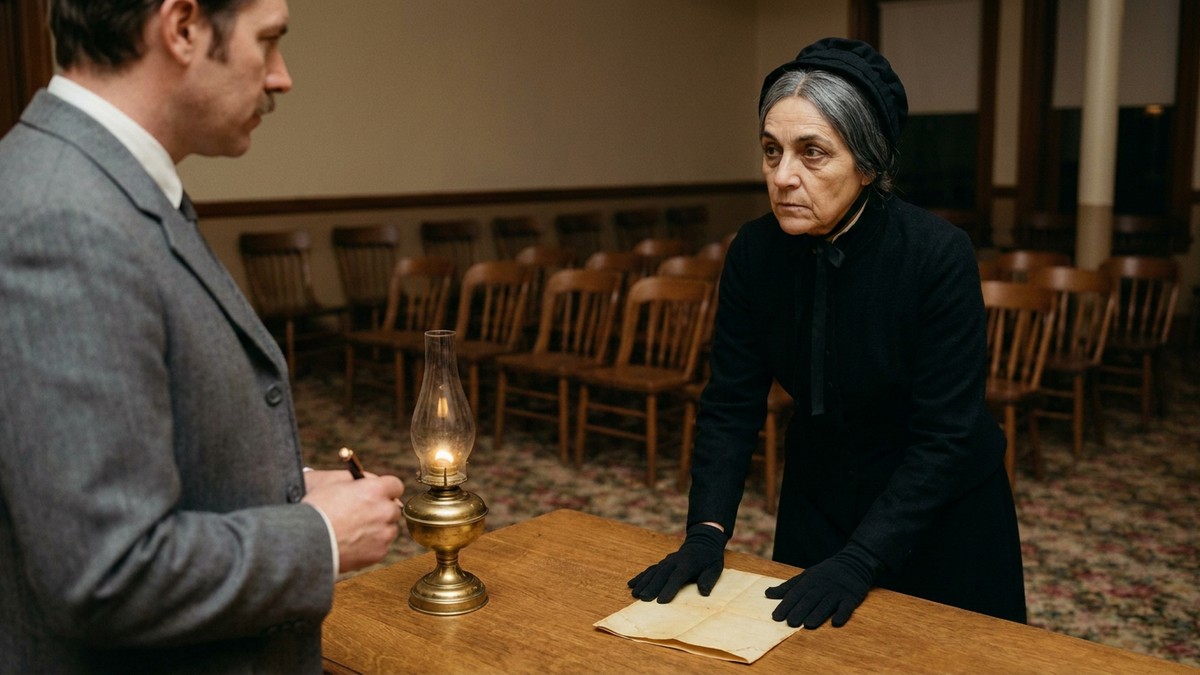
She unfolded August's flyer and laid it on the table, on top of the map, so the lamp shone on it.
"My husband carried this in his coat," she said. Her voice came out steadier than she expected. "They found it in his pocket on the eighth of January. A quarter mile from our door. He'd gone out to the stable on the night of the sixth and never got back."
The room went still.
Mr. Pell looked down at the flyer. He read it all the way through. Then he looked up at her, and his face was kind, and that was worse than anything.
"Mrs. Kell, I am truly sorry for your loss," he said. "But I have never seen this paper in my life. And I have never worked for the Sunrise Company."
Somebody behind her said, "Poor woman."
"Ma'am," Tom Dwyer said gently, "maybe you'd better sit down."
Martha looked at the faces. Pity, all of them. She had come three hundred miles to say her piece, and she had said it to the wrong man.
Mr. Pell slid her flyer back across the table to her. Then he dipped his pen.
"Now," he said. "Who'd like to be first?"