Part 2
Martha did sit down. She sat in the last chair by the door with August's flyer in her lap and listened to the pen scratch.
Tom Dwyer signed first. Then a farmer from Indiana. Then two brothers who had sold a mill to come west.
She had wanted a face to put it on, and she had grabbed the first face in the room. August would have told her so. August had always said she ran ahead of her proof.
Her proof.
Martha opened her bag and took out the new flyer, the one she had folded without reading. She smoothed it on her knee beside the old one.
THE MEADOWLARK COLONY. A Second Italy. Come to Kansas.
She leaned toward the lamp on the wall.
The capital K in KANSAS had a hairline crack through its lower leg. A small white thread through the ink.
She looked at August's flyer. The same thread, in the same place.
One letter, from one case of type. Two companies. Ten months apart.
Martha put both flyers back in her Bible, stood up, and went out into the night.
Kansas Avenue was dark except for the saloons and the lamps along the sidewalk. Her shoes rang on the boards.
The first print shop was closed. At the second, a young foreman with ink to the elbows laughed when she asked to see his type cases, and shut the door.
The third shop was down a side street, with a light still burning in the back. Through the window she saw an old man feeding paper into a press, one sheet at a time, by hand. The sound reached her through the glass. Clack, and a breath, and clack.
She knocked.
His name was Otto Haas, and he was older than her father would have been. She showed him the two flyers under his lamp and put her fingernail on the K.
He did not need a glass. He went to a case by the window, pulled out a drawer, and lifted a single wooden letter between two fingers. He turned it to the light. The crack ran through its lower leg.
"I have been meaning to throw it out for two years," he said. His accent was from somewhere near the Rhine. "Every time, I think, one more job."
"Who ordered these?"
He did not answer right away. He took down a long canvas-bound job book and opened it on the counter. His finger went down the columns.
March 1885. Sunrise Land and Immigration Co. Five thousand flyers. Copy furnished by L. Pell.
February 1886. Meadowlark Colony. Five thousand flyers. Copy furnished by L. Pell.
"He writes the words," Mr. Haas said. "I set them. I never asked if they were true." He closed the book. "A printer is not supposed to ask."
"My father asked," Martha said.
The old man looked at her for a breath. Then he took his coat off the hook.
"What time do they sign?" he said.
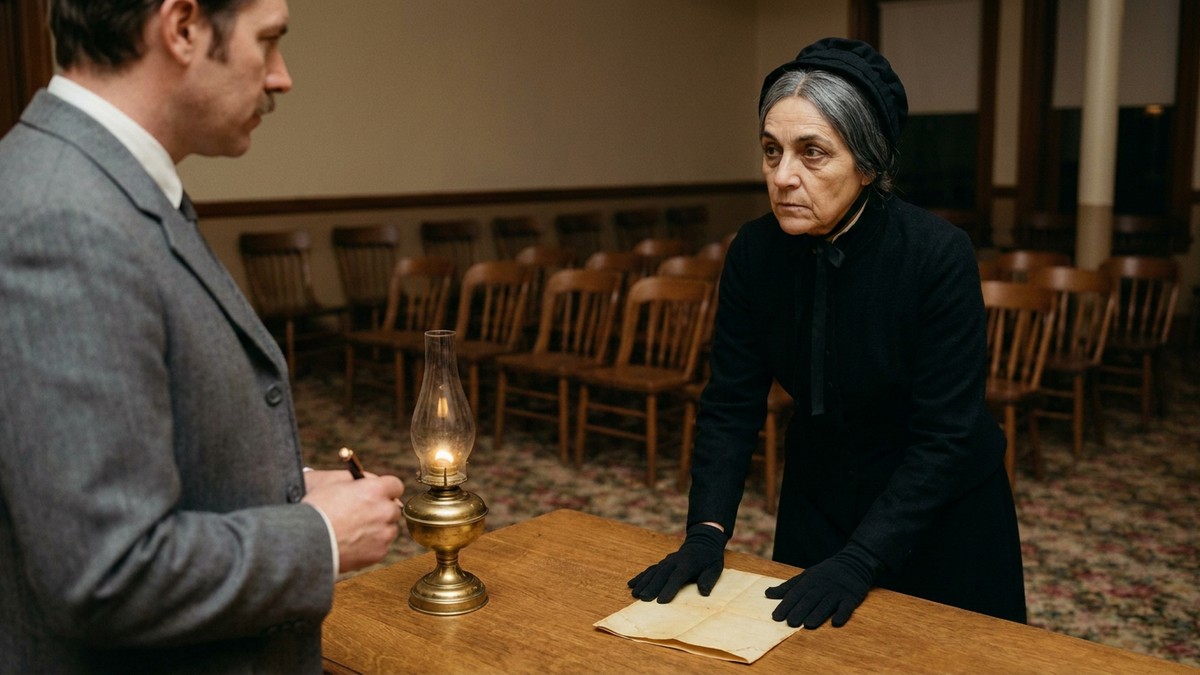
At ten the next morning the hotel parlor was full again. The deeds lay in a stack on the table, and Mr. Pell stood beside them with his pen.
He saw Martha come in. He saw who was with her. Something went out of his shoulders.
Martha walked to the table. She laid the two flyers side by side under the lamp, and Mr. Haas set the job book open between them.
She did not make a speech. She put one finger on the cracked K on the left, and one on the cracked K on the right, and waited while the families came up one by one to look.
Tom Dwyer read the job book twice.
"Copy furnished by L. Pell," he said. He looked up. "You told her you'd never seen this paper."
Mr. Pell put the pen down.
"I said I never worked for the Sunrise Company, and I didn't. They paid me by the job." He rubbed his eyes. "Yes. I wrote those words, Mrs. Kell. I believed them. I still half believe them. Every man in Topeka with a degree says the rain will come with the plow. I have a quarter section in Ford County myself."
"Have you spent a winter on it?" Martha said.
He did not answer.
"August went out to the stable at dusk," she said. "To check the team. The wind came up while he was in there. The stable was forty steps from the house. He'd walked it a thousand times."
She stopped. Her hand was on the edge of the table. She looked at it.
"They found him in the morning, going the wrong way. He had his mittens on. He had the flyer in his pocket. That's all."
Mrs. Dwyer's baby made a small sound and was hushed.
Mr. Pell opened the tin cash box at his elbow. Nobody asked him to. He took out an envelope with DWYER written on it and handed it across the table to Tom. Then the next. Then the next. He did it slowly, one family at a time, and he looked each man in the face when he did it.
Tom Dwyer took his envelope and stepped toward the table, red to the ears.
Martha put a hand on his arm. She did not say anything. He stopped.
When the box was empty, Mr. Pell reached inside his own coat and took out a wallet. He counted two hundred dollars onto the table in front of Martha.
"That's not mine," she said. "That's the Sunrise Company's debt."
"Those were my words," Mr. Pell said. "Take it. Please."
Martha looked down at the money. Then she folded it into her Bible, beside the receipt.
The Dwyers took the noon train west anyway. Tom said they had sold everything to come and could not go back. But at the depot Martha watched him carry a secondhand buffalo coat and a coil of rope onto the car, and Nora had a list in her hand, written in Martha's own square letters.
Sod house, not boards. Rope from the door to the stable. Coal before the first of December.
Martha did not take the train until the next day.
That afternoon she walked back down the side street to Otto Haas's shop. The press was quiet. He was setting a wedding invitation, letter by letter, from a case of clean new type.
He saw her and went to the case by the window. He pulled the drawer and took out the cracked K and held it out to her on his palm.
Martha picked it up. It weighed almost nothing.
The hell box sat under the counter, half full of broken letters and worn rules. She dropped the K in.
It made a small, bright sound, like a nail falling into a pail.