Part 1
The letter from the land office said that Ole Nygaard's sod house was standing on another man's homestead.
Ole brought it across the section line to Bertha Halvorsen on the last day of May, 1885, in Beadle County, Dakota Territory. He held it out to her in both hands, the way a boy holds out a broken plate.
"You read English better," he said in Norwegian.
"I read it slower," Bertha said. "That's not the same."
She put on her spectacles and read it at the table while the coffee boiled. The words were long and the meaning was short. A man named Jesse Pike had filed on the southwest quarter of Section 14. He swore he had settled there on March 20 and built a house. Ole had settled there on April 2 and filed a week after Pike.
There would be a hearing before the Register and the Receiver at Huron. Thursday, June 11, at one o'clock.
"I built that house with my hands," Ole said. "Kari and the baby sleep in it. There was no house there. There was nothing."
"I know," Bertha said. "I walk past it every morning."
She did. She was sixty-one, and she had walked the lines of her own quarter every morning at sunrise for four years, since Lars died. Her cow walked with her, because the cow liked company.
As a girl in the mountains above Voss, Bertha had herded goats for her uncle. You learned to see what was out of place. A stone turned over. A track that had not been there yesterday. A smell on the wind that meant a fox.
So she knew the Dakota prairie the way she had known those slopes. She knew where the prairie chickens boomed in April and where the badger had his hole. She knew every survey stake from her door to the creek.
In March there had been nothing on the southwest quarter of Section 14. No wagon track. No smoke. No man.
Only once, on a frosty morning near the end of the month, she had found something by the corner stake. A little house made of cigar box wood, no bigger than a bread loaf, with one tiny window cut in the side and a roof of shingles split from a shake.
She had picked it up and turned it over in her cold hands. Some child had lost it, she thought. But the nearest child was the Nygaard baby, and the Nygaards had not come yet.
She had carried it home and set it on the shelf over her bed, for whoever came looking.
Nobody had come.
On Thursday she put on her black dress and rode to Huron with the Nygaards in Ole's wagon. Twelve miles. The wagon smelled of axle grease and last year's grass, and the baby slept on Kari's lap with a cloth over her face against the dust. Ole did not say a word the whole way. He kept touching the letter in his pocket.
The land office was a narrow frame building with a crowd outside it. Men waiting to file, men waiting to argue, men waiting to sell. Inside, it smelled of hot pine boards and ink and too many people.
A man in a fawn-colored vest was standing by the door. He tipped his hat to Kari and not to Ole.
"Dorsey Kincaid," Ole whispered. "He sells town lots. And claims."
Kincaid heard him. He smiled.
"I don't make the law, Nygaard," he said, friendly enough. "Out here the land goes to whoever reaches the office first. I just reach it first more often than most."
The Register sat behind a long table with his sleeves rolled up. The Receiver sat beside him writing everything down. The room was hot, and a fly kept bumping against the window glass.
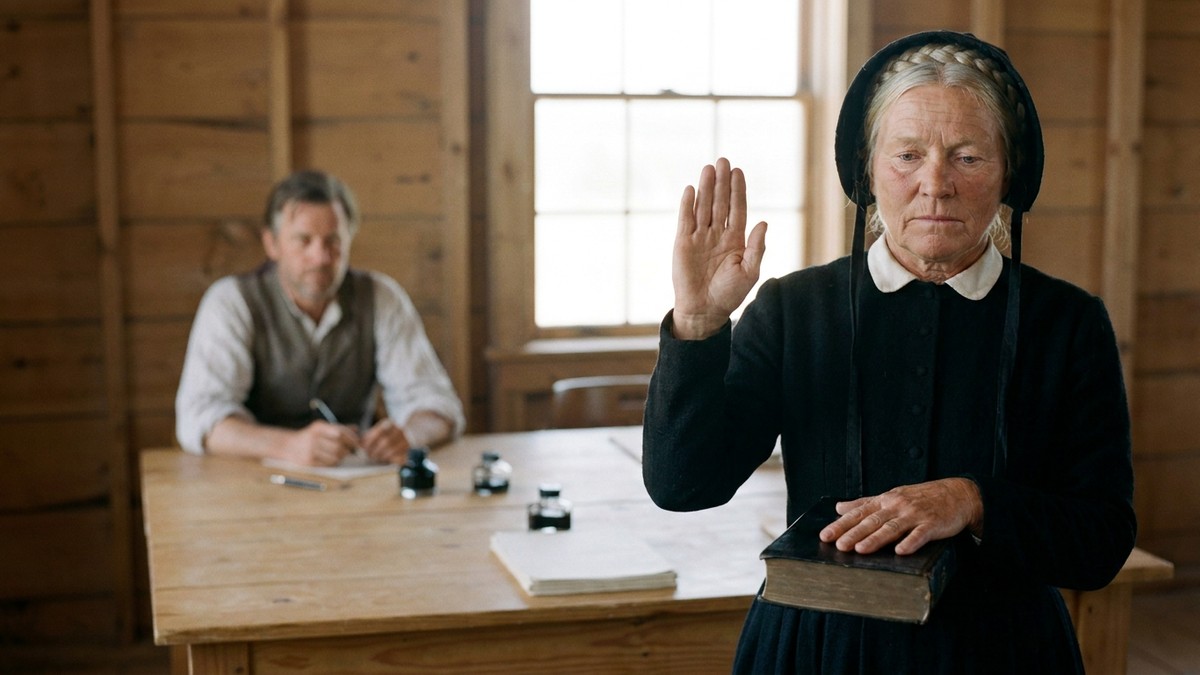
Jesse Pike took the oath first.
He was young, nineteen or twenty, with a thin neck and a coat that had belonged to a bigger man. He did not look at Ole. He did not look at anybody.
"Tell us about your improvements," the Register said.
"I settled the twentieth of March," Jesse said. His voice was flat, like he had learned the words off a paper. "I built a house. Board house, twelve by fourteen. One window. Shingle roof."
"Twelve by fourteen," the Register said, and the Receiver wrote it down.
Bertha sat on the bench by the wall with her hands folded. The room was so warm she felt half asleep. Without thinking about it, her thumb and finger measured a little square on the black cloth of her lap, as if measuring yarn.
Ole testified next. His English was poor and he grew red trying. The Register was patient, but Bertha could see him tiring.
Then it was her turn.
Mr. Kincaid had a lawyer, a young man with a voice like a church bell. He walked up close to her.
"Mrs. Halvorsen. You live on the adjoining quarter."
"Ja. Yes."
"And you say you walk past that quarter every morning."
"Yes."
"So you would know if a house stood there in March."
"Yes."
The lawyer smiled at the Register, then turned back to her.
"Mrs. Halvorsen. You are under oath. In March of this year, did you see a house on the southwest quarter of Section 14?"
Bertha opened her mouth. The English words would not line up. She saw the little house on her shelf, the tiny window, the split shingles.
"Ja," she said. "I saw a house."
The Receiver's pen scratched.
Ole made a sound beside her like he had been kicked. Kari put her hand over her mouth. At the back of the room, Dorsey Kincaid folded his arms and looked at the ceiling, pleased.
"Thank you, Mrs. Halvorsen," the lawyer said. "That will be all."