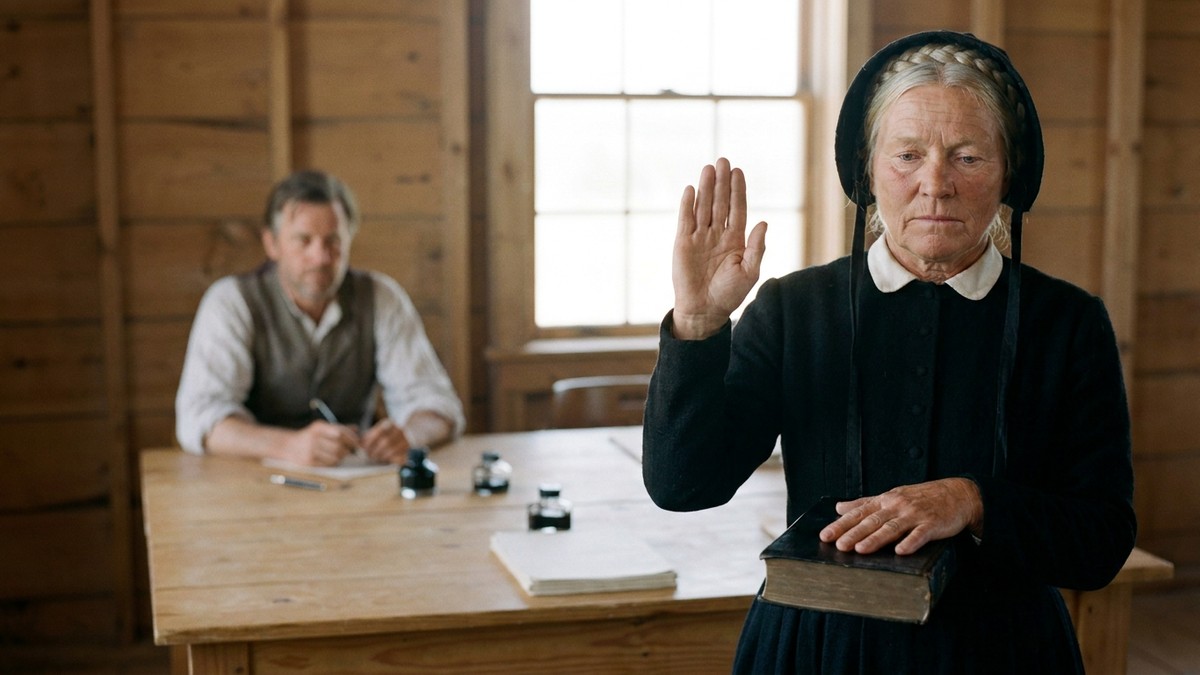
Part 2
Bertha stood up.
"I am not finished," she said.
The lawyer had already turned away. He turned back, surprised. The Register lifted his head.
"Mrs. Halvorsen, you answered the question."
"I answered it in the wrong English." Her face was hot. Her hands were cold. She made herself go slowly. "I said I saw a house. That is true. But I did not say what house."
The lawyer laughed a little. "A house is a house, ma'am."
"No," Bertha said. "It is not."
The Register studied her. He was a tired man in a hot room with forty more cases behind this one. He rubbed the bridge of his nose.
"Washington has written this office three times since April about false swearing," he said. "Three times. So I'll ask you plain, Mrs. Halvorsen. Can you show me what you mean?"
"Not today."
"Then tomorrow. Nine o'clock." He put down his pen. "Bring it, whatever it is."
Across the room, Dorsey Kincaid was not looking at the ceiling anymore.
They left Kari and the baby at the boardinghouse. Ole drove. The sun went down red behind them, and the team settled into a walk that would not be hurried.
Bertha's hip had begun to ache by the third mile. By the sixth it burned. She did not say so.
Frogs sang in every slough they passed. Once a coyote crossed the road ahead of them, gray in the last light, and stopped to look, and went on. The lantern on the wagon swung and creaked and threw their shadows out long across the grass.
"You could tell me," Ole said, in Norwegian, somewhere past the ninth mile.
"I could," Bertha said. "But you would laugh, and I am too tired to be laughed at tonight."
They reached her claim shanty a little before midnight. She lit the lamp with stiff fingers and went to the shelf over her bed.
It was there. Dust lay around it in a neat ring. Nobody had touched it since March.
She wrapped it in her good apron and held it on her lap all the way back to Huron. The stars turned. Toward four in the morning the sky in the east went pale, and the meadowlarks started, one and then a dozen, and Ole began to whistle under his breath for the first time in two weeks.
At nine o'clock the room was full. Word had gone around the boardinghouses. Men stood along the back wall with their hats in their hands.
Bertha walked to the Register's table. Her legs did not want to carry her. She made them.
She unwrapped the apron.
She set the little house down on the table in front of him. Cigar box wood. One window, cut with a knife. A roof of split shingles, each one no bigger than her thumbnail.
"This is the house I saw," she said. "On the corner stake. In March."
The room was very quiet.
"Twelve by fourteen," Bertha said.
The Register looked at the house. Then he reached into his drawer and took out a folding rule, the kind carpenters carried, and opened it, and laid it along one side.
"Twelve inches," he said.
He turned the house. He laid the rule along the other side.
"Fourteen."
Someone at the back of the room laughed out loud. Then another. Bertha did not laugh. She was looking at Jesse Pike.
The boy sat on the bench with his big borrowed coat around him, and he was staring at the little house like it was something he had dropped in the road and run over.
"Mr. Pike," the Register said. "Is this your house?"
Jesse did not answer.
Bertha took one step toward him. Her hip almost gave, and she put a hand on the table.
"The window," she said gently. "Did you cut it yourself?"
The boy's chin shook. He nodded.
"With my pocketknife," he said. "He gave me the box. He gave me twenty-five dollars. He said twelve by fourteen is the truth, so long as nobody asks twelve by fourteen what." He looked at the floor. "Nobody ever asks."
The Register wrote for a long minute. Then he looked up at the back wall.
Dorsey Kincaid was gone. Nobody had seen him go.
The Register ruled for Ole Nygaard that afternoon. Washington would have the last word, he said, as Washington always did. But he did not think Washington would argue with a cigar box.
Jesse Pike was another matter.
"Swearing false to the government is a crime, Mrs. Halvorsen," the Register said, when the room had cleared. "I'll have to send his name to the special agent."
"Send Mr. Kincaid's name first," Bertha said. "The boy is nineteen. He was hungry, and a man with a good vest fed him." She tied her bonnet strings. "I need ten acres broke before the end of June. I would pay him for it. If the agent allows."
The Register looked at her for a moment over his spectacles.
"I'll write down that you asked," he said.
The special agent came out from Washington in August. He wanted Dorsey Kincaid very much, and he wanted Jesse Pike as a witness, and a witness was more use to him outside a jail than in one.
So by September there were ten new acres broken on the Halvorsen claim, black and straight, and the boy who broke them ate his supper at Bertha's table every night and said grace in English while she said it in Norwegian.
On the first Sunday of October, Bertha walked across the section line to the Nygaard soddy with a loaf of bread under her arm.
The door stood open to the warm afternoon. Inside, on the earth floor, the baby sat in a square of sunlight with a little wooden house in both hands.
She had chewed one corner of the roof clean off.