Part 1
The rainmaker's wagon rolled into Willow Bend, Kansas, on July 24, 1893, and the dust it raised hung over Main Street for an hour.
Hester Combs watched it settle on her shoulders from the bench outside the mercantile. It had not rained since the ninth of June. She knew the date because she had written it down.
On the wagon, in red and gold paint, it said PROFESSOR A. TILLEY, SCIENTIFIC RAIN. The man driving it wore a linen duster and a tall gray hat, and he lifted the hat to every woman on the street.
"Friends," he called, "your corn is curling. I can hear it from here."
People laughed. Nobody laughed very hard. Every farmer within twenty miles had walked his rows that morning and heard the same dry rattle.
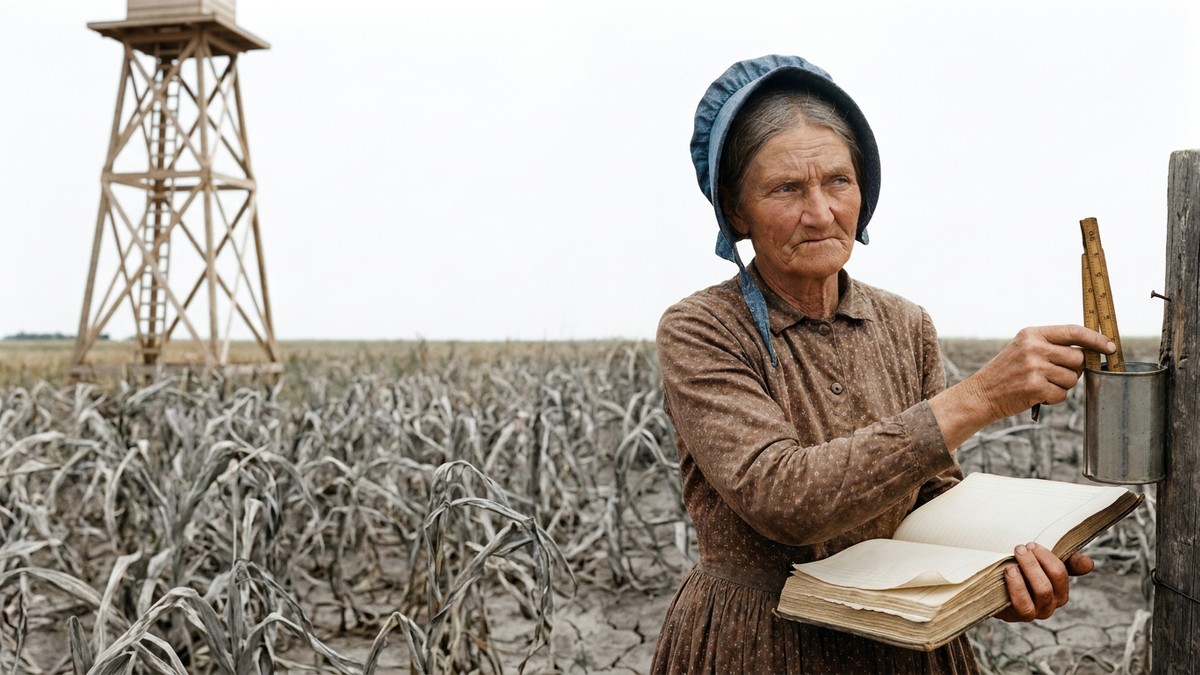
Hester had kept the ledger for thirty years.
It had started in May of 1863, the spring she and Amos came out from Illinois. Amos had nailed a straight-sided tin can to the top of a fence post, and every morning after rain she had pushed his carpenter's rule down into it and read the water off the marks.
She wrote it all in a ledger book from the land office. The date. The inches. The wind. The sky. Thirty years of it now, in four books, kept in the flour bin where the mice could not reach.
Some people kept Bibles. Some kept diaries. Hester kept rain.
That evening the township met in the schoolhouse. It was hot inside, and the lamps drew moths through the open windows, and the whole room smelled of sweat and lamp oil and dust.
Professor Tilley stood at the teacher's desk.
"I won't trouble you with chemistry," he said. "My method releases certain gases into the upper air. The gases draw the moisture together. The moisture comes down." He spread his hands. "My terms are simple. Four hundred dollars for half an inch of rain at your depot, within ten days of the day I begin. If I fail, you owe me nothing."
"Nothing at all?" said Gus Lindahl.
"Not one cent, sir."
The room began to murmur. Hester heard the money in it. Four hundred dollars was every spare dollar in the township, and some that were not spare.
Her son Walter stood up beside her. He was forty-five, with Amos's long jaw.
"I'll put in thirty," he said.
Hester touched his sleeve. He sat down and leaned close.
"Mother, don't."
"I only want to ask him something."
"Mother. Please. Not like '81."
In 1881 she had stood up in this same schoolhouse and told the whole township, from her ledger, that the creek would flood that spring. Half of them had moved their stock to high ground. The creek had stayed in its banks all year. For years after, men had tipped their hats to her and asked if she'd like them to move the stock.
Hester folded her hands in her lap.
By ten o'clock there were four hundred and ninety dollars in a cigar box on the teacher's desk. The banker locked it in his safe.
The Professor did not begin the next day.
"The upper air is not ready," he said, from the porch of the hotel. "To begin too early wastes the chemicals. I will know the hour."
He did not begin the day after, either. On the third day, the township agreed to pay him ten dollars a day to stay and wait, because a wagon had come through from Ellsworth saying another town wanted him. The ten dollars came out of the cigar box.
He built his tower behind the depot. It was three stories of raw pine with a platform on top and a ladder up the side, and when the sun hit it, the pine smelled sweet as a lumberyard. Children climbed the bottom rungs until their mothers called them down.
Each morning the Professor walked down to the depot in his duster.
On Saturday, Hester went to the depot for a crate of canning jars. While the agent found her crate, the telegraph key clattered behind the window. The operator wrote on a yellow slip and handed it out to the grain buyer, the way he did every morning. Then he wrote another and handed it to Professor Tilley.
The Professor read it. He looked west, toward the bare white sky. He folded the slip and tucked it into his vest pocket, and he tipped his hat to Hester.
"Mrs. Combs," he said. "I hear you keep the weather."
"I keep track of it," she said. "That's not the same."
He smiled at that, as if she had told a joke only the two of them understood.
Every morning she wrote a zero in the ledger. July 25, nothing. July 26, nothing. Wind south, hot. Sky brass.
By the second of August, the township had paid the Professor eighty dollars for waiting. The corn in Walter's north field had gone gray at the tips.
That Wednesday night the schoolhouse was full again. Men stood along the walls. Women fanned themselves with hymnal pages.
Professor Tilley stood up at the desk.
"Friends," he said, "the air is ready. Tomorrow at sunrise, I begin. Ten days. Half an inch at your depot, or not one cent."
The room let out its breath all at once, like a bellows.
Hester sat very still. She had brought the ledger in her basket, though she had told herself she would not open it. Now she opened it on her knees. She turned back, past this July, past last August, back and back, her finger moving down the columns.
The Professor saw her doing it. He smiled across the room, warm and easy.
"Unless Mrs. Combs," he said, "would like to make it rain herself."
The whole schoolhouse laughed.