Part 2
Hester let them laugh. She had been laughed at in this room before. It did not kill you.
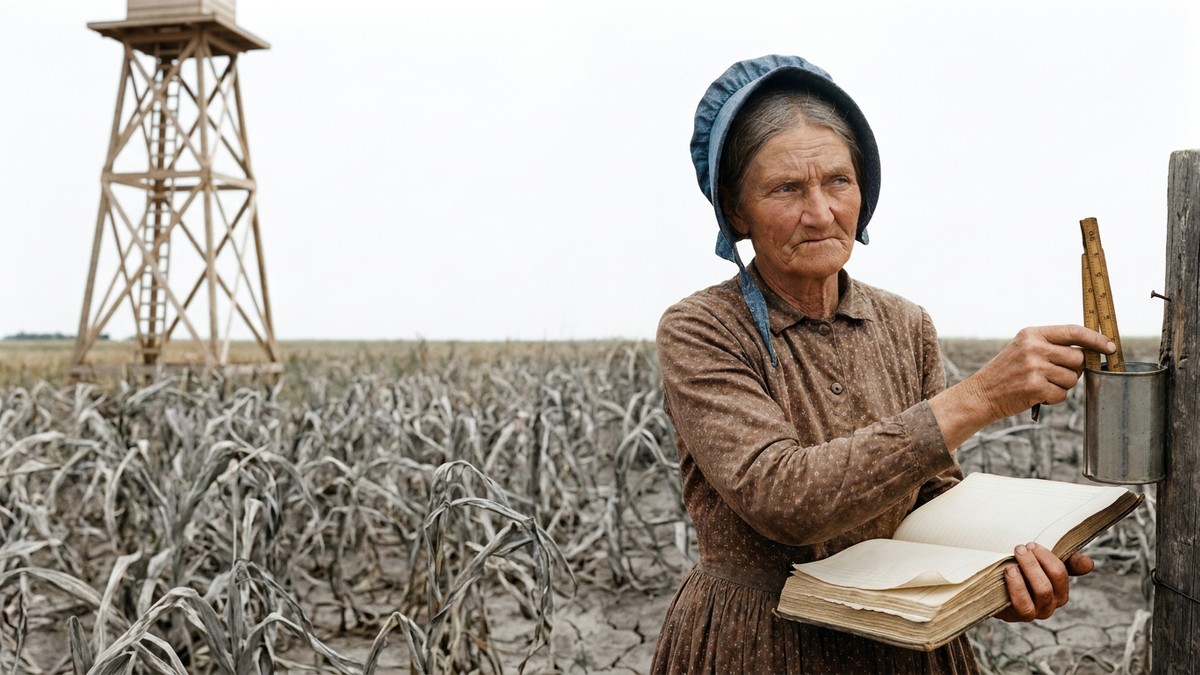
When it died down, she stood up with the ledger open in her hands.
Walter said, "Mother," very low. She did not look at him.
"Henry Ott," she said. "What year did you come to Willow Bend?"
Henry Ott blinked at her from the wall. He was seventy and had the farm next to the creek. "Sixty-eight. You know that, Hester."
She turned the pages until she found it. She read it the way she would read a grocery list.
"August of 1868. Dry from the last day of June. Rain on the seventh of August. One inch and a quarter. Wind southwest."
Henry Ott's mouth opened a little. "That was the night the creek came up over the ford. I lost my hat in it."
"Gus Lindahl," Hester said. "You came in seventy-four."
"The grasshopper year," Gus said.
"Dry from the middle of July. Rain the ninth of August. Seven-tenths of an inch." She turned a page. "Sam Teague. Eighty-six. Rain the fourth of August, after five weeks dry."
The room had stopped fanning.
Hester closed the book on her finger.
"I have thirty years in here," she said. "Thirty Augusts. In twenty-two of them, when July was dry, the first good rain came between the third and the twelfth of August." She looked at the desk. "He begins tomorrow, on the third. He gives himself ten days."
She had more to say, and she made herself say it.
"I was wrong about the creek in '81. I'll be wrong again. The book is not a promise. But it is thirty years, and it was there before he was." She sat down. Her knees were shaking under her skirt, and she pressed her hands on them until they stopped.
Professor Tilley did not argue. That surprised her more than anything.
He stood at the desk with his hat in his hand. When he spoke, his voice was quieter than before, and she believed it more.
"Mrs. Combs, I never told these people I was a saint," he said. "Their corn has been dying for six weeks. For ten days I give them something to watch besides their corn. If the rain comes, they'll call it cheap at four hundred dollars. If it doesn't, they've lost nothing." He turned the hat in his hands. "What did the bank give them this year? What did the railroad?"
Some of the men along the wall nodded. Hester saw them do it.
The banker cleared his throat. "Then I suppose we ought to vote."
They voted. It was close, closer than Hester liked. But at the end of it the cigar box stayed in the safe, and the Professor was owed eighty dollars for his waiting and nothing more.
Then Gus Lindahl said what some of them were thinking.
"I say we see him to the edge of the county. All the way to the edge."
There was a mutter in the room that Hester did not like at all.
She stood up again.
"I'll buy his ticket," she said. "On the morning train east. Out of my own egg money." She looked at Gus until Gus looked at the floor. "That's how far to the edge of the county I'll see him."
The morning was white and hot. She found him on the depot platform with one carpetbag. The wagon and the tower he had sold to the lumberyard for eleven dollars.
She handed him the ticket. He turned it over once, then put it inside his duster.
"You saw the slips," he said.
"Every morning."
He nodded slowly. "The Weather Bureau sends them out over the wire. Forecast for the next day and a half. Most folks never read them." He looked down the empty track. "I read them for a living, once. Eleven years. I was a sergeant in the Signal Service, Mrs. Combs, at Dodge City and two other stations. I kept the weather the way you do."
Hester said nothing. A grasshopper ticked against the platform boards and was still.
"When the Army handed the weather over to the Agriculture men in '91, they wanted younger clerks. I'd been reading the sky for the government half my life, and then I was reading it for nobody." He gave a short laugh. "This pays better. It's not something I'd want told."
"I don't tell things," Hester said.
The train came in with its long tired whistle, and the cinders blew across the platform and stung her face. He climbed up. At the top of the step he turned and lifted his tall gray hat to her, the way he had to every woman on Main Street the day he came.
"The fifth or the sixth," he said. "Southwest. Watch for it."
It came the night of the fifth.
Hester heard it first on the roof, a few big drops like someone tossing pebbles. Then a smell came in through the window, wet dust and green, and she sat up in bed and listened to it settle into a steady sound that did not stop.
In the morning there was water in the tin can on the fence post. She pushed Amos's old rule down into it and read the marks.
At church on Sunday, Gus Lindahl said the fake had lost his nerve and run off two days early, and if he had only stayed, he would have claimed it. The men laughed and shook their heads. Walter looked at his mother. Hester looked at her hymnal.
That night she sat down at the kitchen table with the ledger and the lamp.
August 5, 1893. One inch and one tenth.
Then, as she had for thirty years, she wrote the wind. Southwest.