Casey called the police first thing Monday morning. He'd read somewhere that you were supposed to, with found money, and he wanted to do it right.
A young officer came out to the house on Elm Street that afternoon. She sat at the kitchen table in her coat, because the oven was the only heat, and wrote down everything in a report.
She photographed the envelopes and the handwriting on the back. Then she looked at the old couple sitting across from her, and at the space heaters, and at Irma buttoned up in her coat, and she put down her pen.
"Mr. Wojcik," she said, "do you know how many people would have kept this?"
"I don't want to know," said Casey.
The officer drove with them to St. Hedwig's that same afternoon.
The thrift shop was run by a volunteer named Mrs. Kaminski, who was eighty-four and had kept the donation book in the same green binder since 1991. She ran her finger down the page for the first week of October.
"Here," she said. "The rose couch. Donated by a Karen Nowicki, on Tilden Avenue. Cleaning out her mother's house." She looked up over her glasses. "Stella Nowicki. Her husband Bernie died last year. Lovely man. He used to fix the radiators here for nothing."
They drove to Tilden Avenue on Saturday morning.
It was a small brick house with a FOR SALE sign on the lawn and a dumpster in the driveway. Casey carried the shoebox.
Irma had put all twenty envelopes in it, in order, with the two from the back on top. She'd wrapped it in a dish towel.
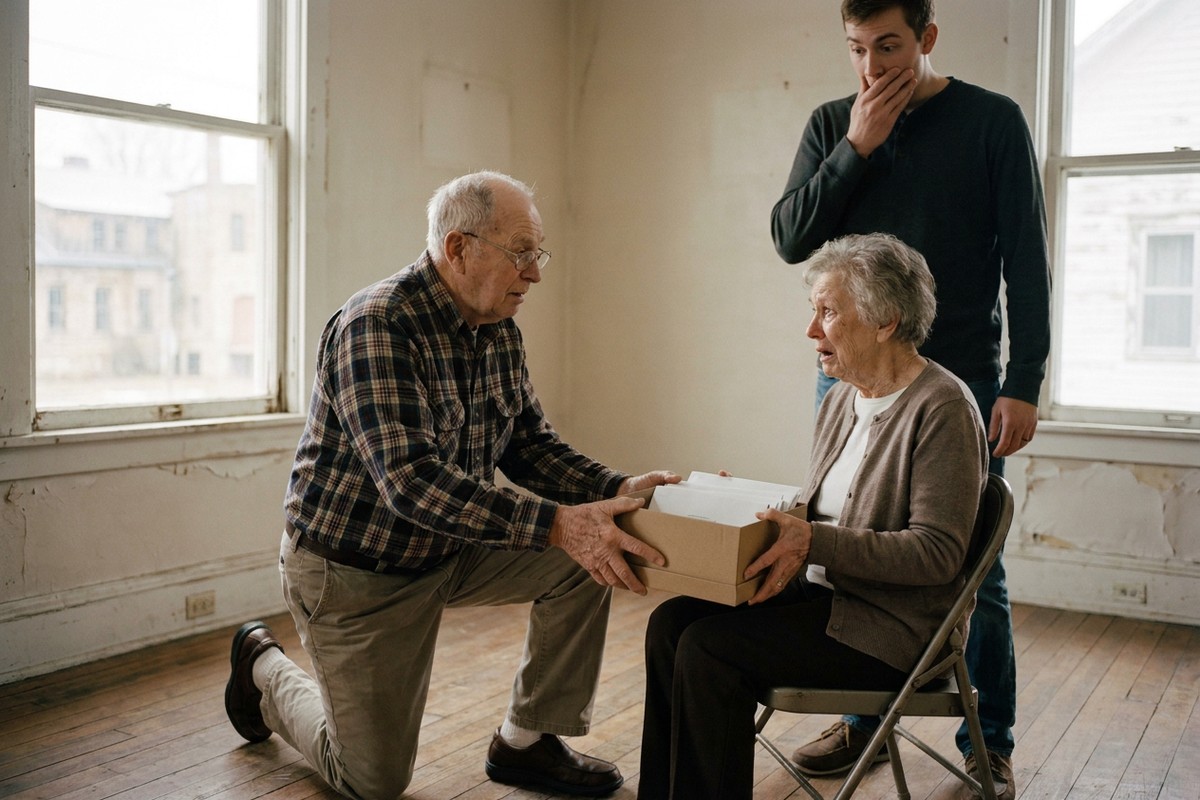
A woman of about fifty answered the door. Behind her, in the empty front room, an old woman sat in a folding chair surrounded by boxes, with a cane across her knees.
"Mrs. Nowicki?" Casey said. "Stella Nowicki?"
The old woman looked up. "Yes?"
"My name is Casey Wojcik," he said. "This is my wife, Irma. We bought your couch at St. Hedwig's. The one with the roses."
Stella Nowicki's face changed. "Oh," she said. "Is something wrong with it?"
Casey stepped into the front room. He knelt down in front of her chair, slowly, the way you kneel at church when your knees are eighty years old. Then he set the shoebox in her lap and took off the dish towel.
"I believe this belongs to you," he said.
She didn't understand at first. She lifted the lid and looked at the white envelopes. Then she picked up the top one and turned it over, and saw her own handwriting on the back.
For Nathan's college. Love, Grandma and Grandpa.
Stella Nowicki began to shake.
"Bernie," she whispered. "Oh, Bernie. You stubborn, stubborn man."
It came out in pieces, while her daughter knelt beside her with an arm around her shoulders.
Bernie Nowicki had grown up hearing his father talk about the banks that failed in 1933. He'd never trusted one in his life. For forty years, every time he got a little extra, he'd cashed it and put it away.
He'd started the college fund the day their grandson was born. Stella wrote on the envelopes.
Bernie hid them. That was the deal, and Stella never asked where.
Then last October, Bernie had a stroke in the garden. He never woke up.
"He'd told me a hundred times," Stella said. "Don't worry, the money for Nathan's school is in the house. Safe." She pressed her hand to her mouth. "We looked everywhere. The basement. The attic. The freezer. We tore up the floor in his workshop. A whole year. We thought maybe he'd spent it. Or maybe he'd only thought he saved it, at the end."
Behind them, in the doorway to the kitchen, a tall young man had come in from the backyard with a box of tools in his arms. He was about eighteen, broad and quiet, with Bernie's square jaw, and he was standing very still.
"Gram?" he said.
"Nathan," Stella said. "Nathan, come here."
He set down the tools. He came and looked into the shoebox. He saw his own name on the back of an envelope in his grandmother's handwriting.
He put his hand over his mouth.
"I quit," he said, through his fingers. "In the spring. I was going to do nursing at Mohawk Valley. I got in. But Mom couldn't swing it, and I didn't want to take out all those loans, so I took a job at the warehouse." He looked at Casey. "You found this? In the couch?"
"Under the springs," Casey said. "Your grandpa did a nice careful job. Slit the cambric on the bottom and taped it back. I'd have hired him."
The young man laughed. Then he started to cry, and he didn't try to hide it.
They stayed for coffee. Stella's daughter made it in the one coffee pot that wasn't packed.
When Stella found out about the furnace, she wouldn't hear another word.
"Mr. Wojcik," she said, with her cane planted on the floor like a flagpole. "My husband fixed radiators at St. Hedwig's for thirty years and never took a dime. If I let you go home to a cold house after this, Bernie Nowicki will come back and haunt me, and he was a very loud man."
Casey tried to say no. Irma kicked him gently in the ankle.
The new furnace went in the following Tuesday. Stella paid for it with a check from the money Bernie had saved for a rainy day, which she'd finally found, she said with a sniff, taped under a drawer in his workbench, in an envelope that said RAINY DAY in his own terrible handwriting.
Nathan started nursing school at Mohawk Valley Community College in January.
That winter, a tall young man in a college sweatshirt showed up on Elm Street every Saturday morning to shovel the Wojciks' walk. In the spring, he mowed their little front lawn.
They tried to pay him. He refused every time.
"My grandpa would want me to," he said. "He always said you take care of the people who take care of you."
Irma made him pierogi every Saturday anyway. He never once refused those.