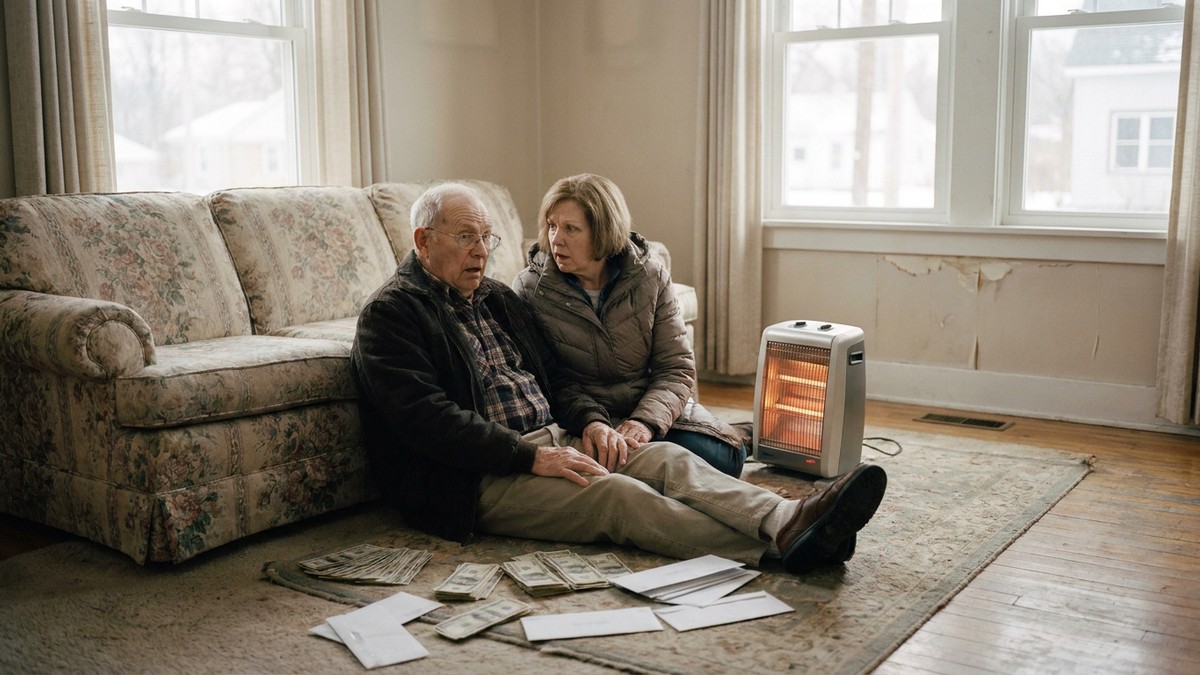
The couch cost twenty dollars, and the first envelope Casey Wojcik pulled out of the cushion had two thousand in it.
He didn't count it right away. He just sat there on the floor of his living room, holding a fat white envelope that had been stuck down in the crack between the seat cushion and the arm, and looked at the edge of a stack of hundred-dollar bills.
"Irma," he called toward the kitchen. His voice came out funny. "You better come in here."
They'd bought the couch that morning at the thrift shop in the basement of St. Hedwig's, on the east side of Utica, New York. It was a big, heavy, old-fashioned sofa, upholstered in faded green and pink roses, with carved wooden feet and three thick cushions.
It looked like it had been in somebody's front room for fifty years. It probably had.
Their own couch had finally given out in September. The springs had gone in the middle cushion, and Irma said sitting on it was like sitting in a canoe.
They couldn't afford a new one. Not that fall.
Casey was eighty. He'd been a machinist at the old Chicago Pneumatic plant in Utica for thirty-four years, until it closed in 1993, and then at a tool and die shop in Whitesboro until he was seventy. Irma was seventy-eight.
She'd worked in the school cafeteria. They'd been married fifty-six years, in the same narrow two-family house on Elm Street, renting out the upstairs.
They had Social Security, and Casey's small pension, and the rent from upstairs. It was enough. Usually.
But two weeks earlier, the furnace had died.
The repairman had come and looked at it and shaken his head. Forty years old. Cracked heat exchanger.
Not safe to run. A new one would be sixty-eight hundred dollars, installed. And it was the second week of October in Utica, and the nights were already down in the thirties, and in a month there'd be snow.
They'd been heating the house with two space heaters and the oven door open. Irma had been sleeping in her coat.
They'd called their son in North Carolina, who'd said he could send something at the end of the month, maybe. They'd called the county about the heating assistance program, and filled out the forms, and been put on a list.
So when Irma saw the rose couch at the St. Hedwig's thrift shop for twenty dollars, with a little handwritten sign that said DONATED, NEEDS GOOD HOME, she'd said, "Well, Casey, at least we'll be warm on the couch."
Irma came in from the kitchen drying her hands. She saw her husband sitting on the floor with the envelope. She stopped.
"Casey," she said. "What is that?"
He opened it and fanned the bills out on the carpet.
Twenty hundred-dollar bills. Old ones, the kind with the small picture of Ben Franklin in the oval. Two thousand dollars.
Irma sat down on the arm of the rose couch very slowly.
"Is there more?" she whispered.
Casey got up on his knees. He pulled the first cushion off the couch, and then the second, and then the third. He ran his big machinist's hands down into the deep crack along the back where the seat met the frame.
There was more.
He pulled them out one at a time. Plain white envelopes, sealed, each one flat and fat, pushed far down into the frame where you'd never find them unless you went looking.
Then he turned the couch over on its back, and saw where the cambric cloth on the bottom had been carefully slit along one side and taped back up. There were more envelopes inside, tucked between the springs.
When he was done, there were twenty envelopes on the living room floor.
They counted it together at the kitchen table, with the oven door open for heat. Twice, the way Casey had been taught to count parts.
Forty thousand dollars.
Irma sat at the table and didn't say anything for a long time. Casey didn't either.
Forty thousand dollars. The furnace was sixty-eight hundred. There would be thirty-three thousand left over.
A new car to replace the 2006 Buick. The dentist Irma had been putting off.
A trip to North Carolina to see the grandchildren. Money in the bank, for the first time in years, for when something else broke.
The thrift shop sign had said only DONATED. There hadn't been a name on it. They could have kept every dollar, and the world would never have known.
Casey looked at his wife across the kitchen table, at her coat buttoned up to her chin and her breath showing a little in the cold air.
"Irma," he said.
"I know," Irma said. "I know, Casey. It isn't ours."
"It isn't ours."
She nodded. Her eyes were wet. She reached across the table and took his hand.
"Somebody hid this," she said. "Somebody saved this a long time. Look at those old bills. Somebody didn't trust banks." She shook her head. "And somebody gave the couch away without knowing it was there. Some family is missing forty thousand dollars right now and doesn't even know it."
Casey was quiet for a moment. Then he started putting the bills back in their envelopes, carefully, twenty to an envelope, the way they'd come.
He was on the nineteenth envelope when he turned it over and stopped.
On the back, there was writing. Faded blue ink, in a woman's neat, slanting hand, the kind they taught in Catholic schools in the 1950s.
For Nathan's college. Love, Grandma and Grandpa.
Casey turned over the twentieth envelope. The same handwriting.
For Nathan. So he can be whatever he wants.