Lyman sat at the stop sign for a long time with the engine running and the rain coming down.
He didn't touch the radio. He couldn't have said why. He let the song play all the way through to the end, the strings and the last long note, and when it was over, the station went to static, and he reached over and turned it off.
Then he put his hand flat on the passenger seat.
It was wet. Cold and wet, all the way through the old vinyl, the way a seat would be if somebody had sat on it in a soaked wool coat.
He drove home at twenty miles an hour.
Bev was still up, in her robe at the kitchen table, doing the crossword. She'd been married to him for fifty-four years, and she took one look at his face when he came in the door and put her pencil down.
"Lyman," she said. "What happened? Did you hit a deer?"
"No."
"You look like you've seen a ghost."
He sat down across from her. He sat there with his cap in his hands, smelling of catfish and rain, and he looked at her for a long while, and she waited. She'd always been good at waiting.
"I had a sister," he said.
Bev's eyebrows went up. She'd known that, of course. It was in the family Bible.
She'd seen the little stone in the Burkhart plot at the Bridgeton cemetery. She'd asked him about it once, early on, in 1973, and he'd gotten up from the table and walked out to the barn, and she'd never asked again.
"Her name was Rose Ellen," Lyman said.
And then he told her. All of it, for the first time in his life. The high water and the sticks and the cap.
The mud giving way. The blue ribbon sliding through his fingers like it was nothing. Seventy-six years of driving over that bridge and knowing he should have held on.
Then he told her about the girl in the wool coat.
When he was finished, the kitchen was very quiet. The rain had let up outside. Bev reached across the table and put her hand over his.
She didn't tell him he was imagining things. She didn't tell him he wasn't. She was a practical woman, a retired school secretary, and she'd been to the Bridgeton Methodist Church every Sunday of her life, and she'd never once believed in ghosts.
"Lyman," she said gently, "you were six years old."
"I know it."
"No," Bev said. "I don't think you do. I don't think you ever have."
He didn't sleep. At first light, he got up and dressed, and left Bev a note on the counter, and drove back out to the Weaver's Ford Bridge.
The rain had moved off in the night. A heavy white fog lay over the Sugar Creek bottoms, so thick he could barely see the red bridge until he was on top of it. He parked on the gravel at the near end, where the festival crowds would park later in the morning, and stood for a while looking at the creek.
It was low. It had been a dry fall, one night of rain hadn't changed much, and the creek was running quiet and clear over the gravel, lower than he'd seen it in years. Along the bank under the bridge, the water had pulled back from the roots of an old sycamore, and the roots stood out bare and white from the mud like the ribs of a boat.
He hadn't been down that bank since 1951.
He went down it now, slowly, an old man with bad knees, holding on to the saplings. At the bottom, he stood at the edge of the water, right where the mud had given way under his sister's feet seventy-six years ago. He looked at the sycamore roots.
Something was tangled in them. Something small and pale, caught low in a knot of roots, where the water had been until a few weeks ago.
He knelt down in the mud and worked it loose with his fingers.
It was a ribbon. A strip of satin, about a foot long.
It had been blue once. Now it was faded so pale it was almost white, and the edges were frayed, and it was stiff with silt.
Lyman held it in his hand and couldn't move.
It could have been anybody's. He knew that. He'd worked the festival for forty years, and every October, a hundred children lost a hundred hair ribbons and mittens and caps along Sugar Creek.
It could have blown down off the bridge last week. It could have come from anywhere.
He knelt in the mud and held it anyway, and for the first time in seventy-six years, Lyman Burkhart cried for his sister.
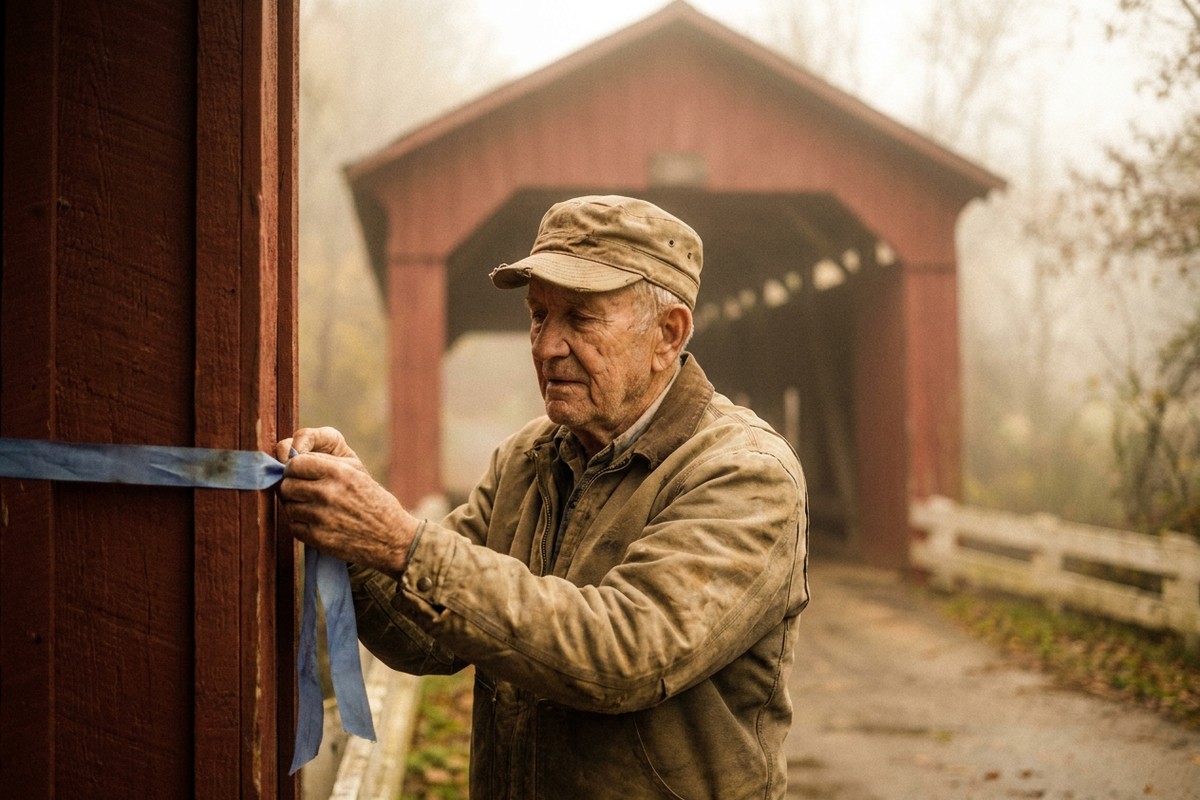
He climbed back up the bank. He walked into the mouth of the bridge, out of the fog, to the first big timber of the arch where the girl had been standing the night before. He'd replaced the floor planks under it in 1988.
He tied the ribbon around the beam with a square knot, the way his father had taught him. He pulled it tight.
Then he stood back and looked at it, a small pale bow on the old red wood.
"It wasn't your fault, Rose Ellen," he said out loud. "You were only trying to get my cap."
And after a while, he said the rest of it, the thing he'd needed somebody to tell him for seventy-six years. The thing he'd never been able to say to himself.
"And it wasn't mine, either. I was six."
The words hung there in the fog. He waited for them to feel like a lie.
They didn't.
When he got home, Bev had coffee on and his breakfast in the oven. She looked up when he came in.
She looked at his muddy knees, and his wet cuffs, and his face, and she didn't ask him anything at all. She just got up and hugged him, there in the kitchen, for a long time.
He never saw the girl again. He drove over the Weaver's Ford Bridge most days for the rest of his life, in all kinds of weather, and he never minded the rain.
Bev asked him once, years later, whether he really believed it had been Rose Ellen in his truck that night.
Lyman thought about it for a long time.
"I believe I gave a little girl a ride home in the rain," he said finally. "And I believe she got there."
The ribbon stayed on the beam of the Weaver's Ford Bridge for years. The tourists asked about it every October. The bridge crew never took it down.