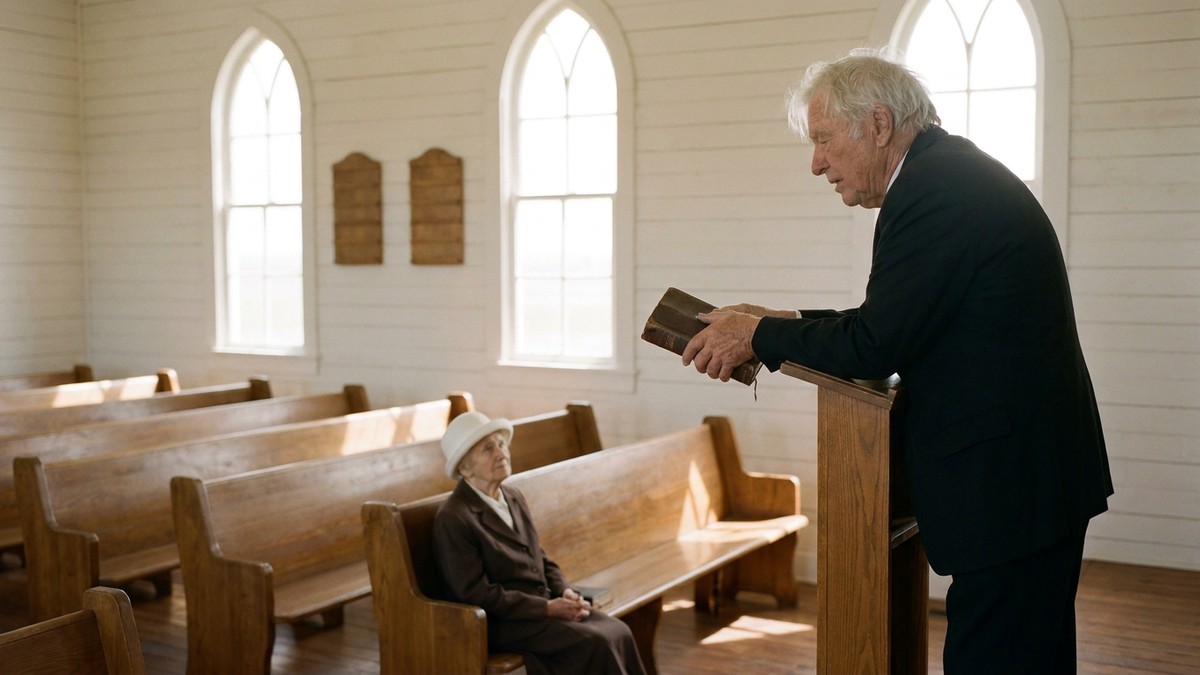
Rev. Otis Varner had preached to eleven hundred people on Easter Sunday of 1985, and on this Sunday, he preached to one.
She sat where she'd always sat, in the third pew on the left, under the window with the lamb in it. She was ninety-six years old and wore a navy blue dress and a little white hat with a pin in it, and she held her hymnal open on her knees, though she'd known every word in it since 1940.
Her name was Inga Solberg. She was the last member of Zion Lutheran Church.
"The Lord be with you," said Otis, from the pulpit.
"And also with you," said Inga, firmly, from the third pew.
The wind went around the little white church and rattled the windows, and outside, the wheat stubble ran gold and empty to the edge of the sky.
Zion Lutheran stood alone on a rise twelve miles north of the nearest town in western North Dakota, at the corner of two gravel roads. Norwegian homesteaders had built it in 1911 out of lumber they'd hauled by wagon from the railroad. It had a steeple and a bell and eight tall windows, and a cemetery out back with a wire fence around it to keep the cattle out.
In 1950, it had a hundred and forty members. In 1985, it had sixty.
The farms got bigger and the families got smaller, and the children went off to Bismarck and Minneapolis and Seattle and didn't come back. One by one, the old members were buried out back under the prairie grass.
Two springs ago, there were three. By last fall, there was Inga.
Otis had been a pastor for fifty-one years. He'd served a big church in Fargo for most of them, and he'd been the one preaching to all those people on Easter of 1985.
He'd retired at seventy and moved back west to Dickinson, where he'd grown up, to be near his daughter. Two years later, the synod had asked if he'd fill in at a little country church for a few months, until they could sort out what to do about it.
That had been seven years ago.
Every Sunday morning, he got up at six, put on his black suit, drove forty miles of two-lane highway and gravel, unlocked the church, turned up the furnace, and preached.
"You don't have to keep coming, Pastor," Inga had told him, the first Sunday it was only her.
"Do you want me to stop?"
She'd thought about that for a while. "No," she said. "I was baptized in this church. Confirmed in it. Married in it. I buried Arne out back and both my boys. I'd like to be buried out of it, too, if it's still standing."
"Then I'll keep coming," said Otis.
"It's just me now. One old woman."
"Matthew says where two or three are gathered," Otis said. "You and me make two. That's enough for the Lord. It's enough for me."
So every Sunday, it was the two of them. He preached a real sermon, not a short one. She sang the hymns in a high, thin, steady voice, and he sang along with her, and the old pump organ stayed quiet in the corner because the last organist had died in 2019.
Afterward, he shook her hand at the door, the way he'd shaken eleven hundred hands on Easter. Then he drove her home to her farmhouse three miles down the road, and she gave him a plate of lefse wrapped in wax paper, and he drove the forty miles back.
His daughter, Corinne, thought he was wearing himself out.
"Dad, you're seventy-nine. You're driving eighty miles every Sunday in the winter. For one person."
"Yes," said Otis.
"Doesn't that seem a little crazy?"
"Probably," said Otis. "The shepherd left the ninety-nine to go find the one. Seemed crazy then, too."
Corinne didn't have an answer for that. She just made him promise to keep a blanket and a candle in the trunk.
The letter came on a Thursday in the middle of October. It was from the synod office, on good paper, and it was kind. Otis could tell it had been written by someone who'd thought hard about how to say it.
It said that the synod council had prayerfully reviewed the situation at Zion Lutheran. It said that a congregation of one member could not continue to meet its obligations under the constitution. It thanked Pastor Varner, warmly and at some length, for his faithful service.
It said that a service of closing would be held at Zion on the first Sunday in November. An assistant to the bishop would come out to lead it. Afterward, the building would be closed, and the bell and the altar furnishings would be offered to other churches in the synod.
Otis read it twice, standing at his kitchen counter. Then he folded it carefully and put it back in its envelope and sat down.
He wasn't angry. He'd been a pastor too long to be angry at a synod council doing what synod councils have to do. He'd sat on one himself, in Fargo, and voted to close two churches.
He just didn't know how he was going to tell Inga.
He never had to.
On Saturday morning, his phone rang. It was Inga's neighbor, Arlo Ostby, who checked on her every day.
"Pastor," Arlo said, "I found Inga on her kitchen floor this morning. She fell sometime in the night. She's in the hospital in Dickinson. They think it's her hip."
Otis was in his car in five minutes.
She was in a room on the third floor, small and white in a big white bed, with an IV in her arm. Her hat was on the nightstand.
Her eyes were closed. A young nurse with a dark ponytail was checking her monitor.
"Are you family?" the nurse asked.
"I'm her pastor," Otis said.
Inga's eyes opened. She looked at him, and then she looked at the window, where the sun was coming up over the parking lot.
"Pastor," she said, "what day is it?"
"It's Saturday, Inga."
She closed her eyes again. Her hand found the edge of the blanket and held on.
"Then I'm going to miss church tomorrow," she said. "Aren't I?"
The letter was still in his coat pocket. Otis could feel it there, folded, against his chest.
The first Sunday in November was two weeks away. She'd have to miss that one, too.