"No," said Otis. "You're not."
He came back the next morning at nine, in his black suit, carrying a canvas grocery bag.
Inga had had surgery on Saturday afternoon. They'd put a pin in her hip. She was pale and tired and propped up on pillows, but she was awake, and somebody had helped her put her white hat back on.
The young nurse with the ponytail was named Brianna Reinke. She watched from the doorway as Otis unpacked the bag onto the rolling bedside table. A white linen cloth.
Two brass candlesticks, unlit, because it was a hospital. A silver chalice and paten wrapped in a dish towel. Wine and wafers.
A hymnal. And the old leather-bound Bible from the pulpit at Zion, which he'd unlocked the church at seven that morning to get.
"What's all this?" Brianna asked.
"It's Sunday," said Otis.
He spread the cloth over the bedside table and set out the chalice. He stood at the foot of the bed, straightened his collar, and opened the Bible.
"The Lord be with you," he said.
"And also with you," said Inga from the bed, in a voice that was thin but perfectly firm.
He did the whole service. He read the lessons for the day, and the psalm, and the Gospel, and he preached the sermon he'd written for Zion that week, on the widow who gave her two small coins. He preached it to an audience of one old woman in a hospital bed and one young nurse in the doorway who'd meant to step out a while ago and somehow hadn't.
Then he opened the hymnal.
"What would you like to sing, Inga?"
She didn't have to think. "Children of the Heavenly Father," she said.
It was a Swedish hymn, very old, the one every Scandinavian Lutheran child on the prairie learned before they could read. Otis started it, and Inga came in on the second line, high and thin and sure. "Children of the heavenly Father safely in His bosom gather."
Halfway through the first verse, a third voice joined them from the doorway.
Brianna Reinke had grown up Lutheran in Mandan. She hadn't been to church in six years. She still knew every word.
When the hymn was done, Otis gave Inga communion. Then he turned around, holding the paten, and looked at the nurse.
Brianna hesitated. Then she came in from the doorway and held out her hands.
Afterward, on her break, she asked Inga if she could share a picture. Just one, she said. Just of the hymnal and the candlesticks and the pastor's hands.
No faces. Inga said she didn't see why not.
Brianna posted it that night with a few lines underneath. She wrote that she'd worked at the hospital for four years, and she'd seen a lot of visitors, but she'd never seen anything like this. A 79-year-old pastor had driven out to an empty country church at seven in the morning to get the pulpit Bible, so the last member of his congregation wouldn't miss Sunday.
She wrote that she didn't know the name of the church. She wrote that it had made her want to go back.
By Tuesday, it had been shared eleven thousand times.
By Wednesday, people had figured out the name of the church.
The phone calls started on Thursday. Otis didn't know half the people calling, and then he realized he did know them, in a way. He knew their names from the stones out back.
A woman in Bismarck said her grandmother had been confirmed at Zion in 1938. A man in Billings said his great-grandfather had hauled the lumber.
A couple in Minneapolis said they'd been married there in 1979. A retired schoolteacher in Williston said her whole family was buried out back, and she hadn't visited in fifteen years.
They all asked the same thing. Was the closing service really this Sunday? Could they come?
"It's a public service," Otis said, every time. "All are welcome."
He didn't know what else to say. He didn't think it would change anything.
On the first Sunday in November, he drove out to Zion at six in the morning, the way he always did, and unlocked the door, and turned up the furnace.
At 9:00, the first car came over the rise.
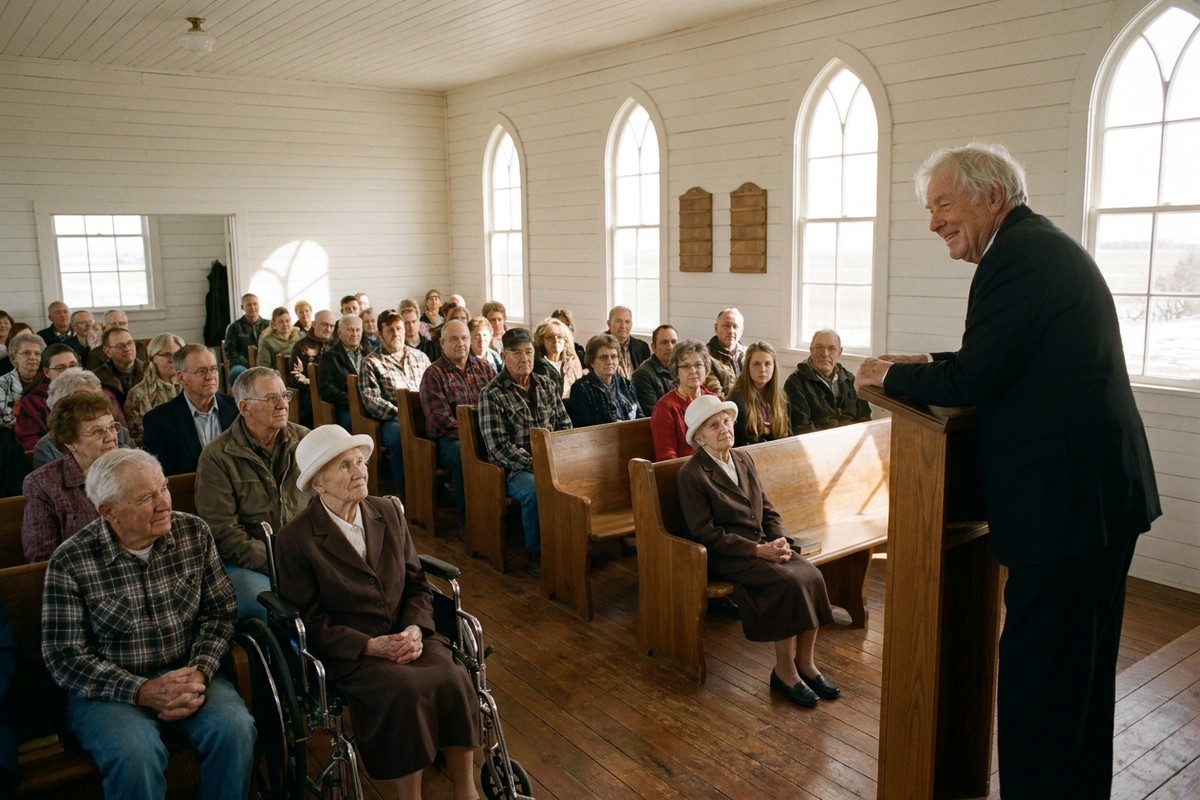
By 10:00, there were cars parked along both gravel roads for half a mile in each direction. There were license plates from North Dakota and Montana and Minnesota and South Dakota.
There was a church bus from Watford City. There were people standing in the aisle, and in the back, and out on the steps, because the eight pews on each side were full.
The assistant to the bishop, a tall, gentle woman named Pastor Joanna Hagen, stood in the doorway with her closing liturgy in her hands and looked at it all for a long time.
And at 10:20, a wheelchair van from the rehab center in Dickinson pulled up to the front steps. Arlo Ostby and two other men lifted out a wheelchair, and in it, wrapped in a quilt, with her white hat pinned firmly on, was Inga Solberg. Her doctor had said one hour, no more.
Brianna Reinke had volunteered to ride along on her day off. Brianna was holding the quilt.
They carried Inga up the steps and wheeled her down the crowded aisle, and the people stood back to let her through, and she took her place in the third pew on the left, under the window with the lamb in it.
Otis climbed into the pulpit. He looked out at them for a long time. It was the first time in years he'd had to clear his throat to start.
"The Lord be with you," he said.
The answer came back from three hundred voices, so loud it shook the windows, and the loudest one was in the third pew on the left.
Pastor Joanna Hagen never opened her closing liturgy. She sat in a folding chair by the old pump organ, and when the hymn came, she sang.
Afterward, she found Otis on the front steps, shaking hands. "I'm going to have to take this back to the synod council," she said quietly.
"I know," said Otis.
"I'm going to tell them what I saw." She looked out at the cars lined up along the gravel roads. "I don't think a congregation of one is what we've got here, Pastor."
The council met in December. It took them one meeting. Zion Lutheran would stay open as a worship site of the synod, with a service on the first Sunday of every month.
The bell would stay in the steeple. The pulpit Bible would stay in the pulpit. A retired pastor in Dickinson had already said he'd preach.
On the first Sunday in January, it was eight below zero, and the cars came anyway.
Inga Solberg came home from rehab two days before, walking with a cane. She sat in the third pew on the left, under the window with the lamb in it, in her navy dress and her white hat.
Brianna Reinke sat next to her. A woman from Williston had brought her mother's old hymnal and played the pump organ, a little out of tune.
After the service, Inga shook Otis's hand at the door, the way she'd done every Sunday for seven years.
"You told me two was enough, Pastor," she said.
"I did," said Otis.
Inga looked back over her shoulder at the full pews, the winter sun on the tall windows, the wheat stubble white with snow out to the edge of the sky.
"Well," she said. "This is nice, too."