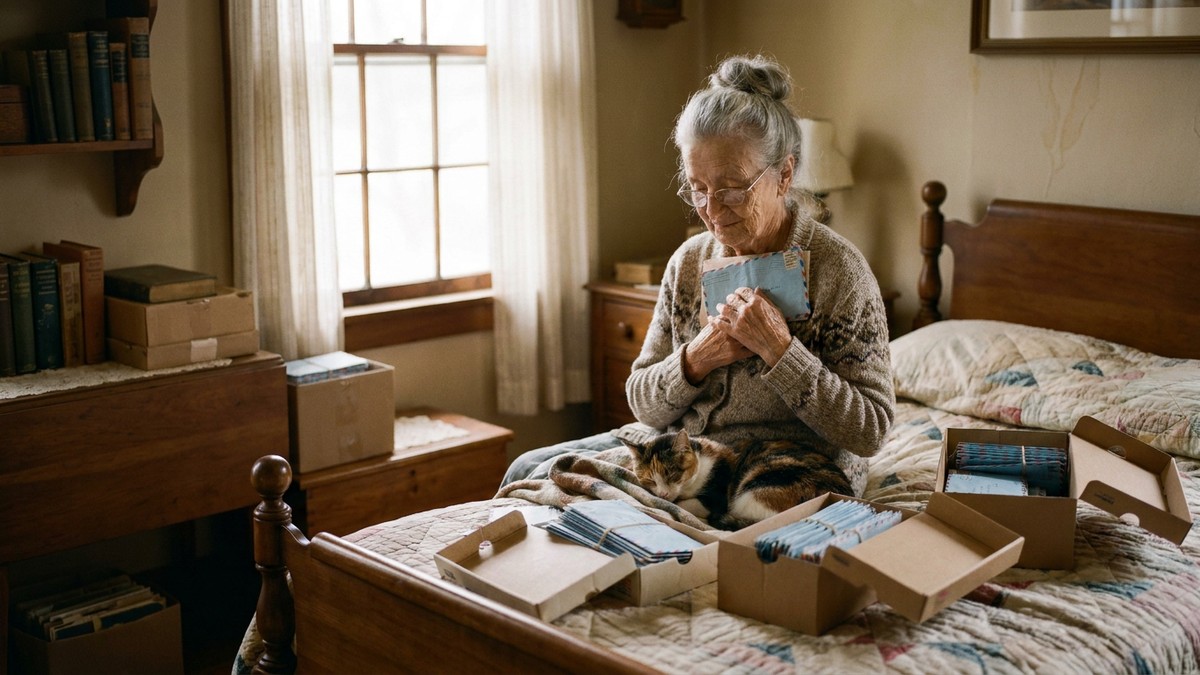
Eleanor Gilchrist had eight hundred and forty letters from Scotland in shoeboxes under her bed, and she'd never heard Fiona's voice.
Seven shoeboxes. One for each decade. She'd labeled them in black marker.
1957 to 1966. 1967 to 1976. All the way to the last one, which wasn't full yet, and which said 2017 to.
Eleanor had left the second date blank on purpose. She'd never once thought she'd have to fill it in.
She was eighty-two. She'd been the librarian in Ashby Corner, New Hampshire, a town of fourteen hundred people in the hills west of Concord, for forty-four years.
She'd never married. She lived alone in the white farmhouse on Mill Road where she'd been born, with a cat named Mr. Darcy and a garden full of phlox.
She'd never been on an airplane. She'd never been out of New England, except once, to her cousin's wedding in Albany, which she'd found more than exciting enough.
But she'd been to Scotland eight hundred and forty times.
It had started in the fall of 1957, in the seventh grade, at the Ashby Corner school.
Their teacher, Miss Thurston, had signed up the class for a pen pal program run through a magazine. Each child got the name and address of a child in another country. Most of Eleanor's classmates wrote twice and quit.
Eleanor got Fiona MacLeod. Age twelve. Edinburgh, Scotland.
Fiona's first letter came on blue airmail paper so thin you could see through it, folded into its own envelope, with a stamp showing the young Queen Elizabeth. Eleanor still had it. It was the first letter in the first shoebox.
Dear Eleanor, it began. My name is Fiona and I am twelve and I have red hair and three brothers who are horrible.
I live in a flat above a shoe shop. I would like to know if you have ever seen a cowboy.
Eleanor had written back that same night, four pages. She'd never seen a cowboy. But she had seen a moose.
They wrote every month after that. For seventy years.
They wrote about school, and boys, and books. They wrote about Fiona's brothers, who remained horrible, and Eleanor's father, who died in 1971.
They wrote about Fiona's wedding in 1967, and her three children, and her husband Duncan, who drove a city bus and sang in a choir. They wrote about Eleanor's library, and her garden, and the long New Hampshire winters, and the man she almost married in 1974 and didn't.
They told each other things they never told anyone else. Fiona was the first person Eleanor told when her mother died. Eleanor was the first person Fiona told when Duncan got sick.
They never met. They never even talked on the phone. In 1957, an international phone call was a fortune.
By the time it wasn't, they'd decided, without ever quite saying so, that they didn't want to. The letters were the friendship. They were afraid that anything else might change it.
Fiona's handwriting got shakier over the years. So did Eleanor's. But on the fifteenth of every month, give or take, a thin blue envelope from Edinburgh arrived in the mailbox on Mill Road.
Until March.
In March, there was no letter.
Eleanor waited. Sometimes the mail was slow. She wrote her April letter anyway, a little worried, and mailed it.
In April, there was no letter.
In May, there was no letter.
Eleanor sat at her kitchen table on the fifteenth of May and looked at the empty mailbox through the window for a long time. Seventy years. Fiona had never missed.
Not when her babies were born. Not when Duncan died. Not once.
She didn't have Fiona's phone number. She didn't have an email address.
She'd never needed one. She had a street address in Edinburgh, written on eight hundred and forty envelopes, and that was all.
Eleanor's niece, who lived in Concord, tried searching online. She found nothing. Fiona MacLeod was a very common name in Scotland.
"Aunt Ellie," the niece said gently, at the kitchen table. "She's eighty-two too. You have to think about the possibility."
"I've thought about it," said Eleanor.
She'd thought about nothing else for three months.
On the first of June, she went to the travel agent in Concord. There was still one, in a little office next to the hardware store, run by a woman who'd been booking cruises for forty years.
"I'd like to go to Edinburgh," Eleanor said. "In Scotland."
"Lovely," said the travel agent. "When?"
"As soon as possible."
The travel agent looked at her over her glasses. "Have you flown before, Miss Gilchrist?"
"No," said Eleanor. "Never." She folded her hands on her purse. "I'm terrified of it. I've been terrified of it for eighty-two years." She took a breath. "Please book me a window seat."
She flew out of Boston on a Tuesday night in June, with her niece's old suitcase and a cane and a bundle of airmail letters tied with string in her carry-on bag. She held the armrests for the entire takeoff with her eyes squeezed shut. Then she opened them and looked out the window and saw Boston turning into a glittering map below her, and she forgot to be afraid for almost a minute.
She landed in Edinburgh at nine the next morning, in a soft gray rain.
A taxi took her across the city, past the castle on its black rock and the long stone terraces, to the address she'd written on every envelope since 1968. A tall, narrow stone townhouse on a quiet street near the Water of Leith, with a red door and window boxes full of geraniums.
Eleanor climbed the four steps with her cane. She stood at the red door for a long time with her heart going like a drum.
Then she knocked.
The door opened. A young man stood there, about twenty-five, with red hair and freckles and a cup of tea in his hand. He looked at the little old woman on the step with her suitcase and her cane and the bundle of blue envelopes.
"Can I help you?" he said, in a soft Scottish voice.
"I'm looking for Fiona MacLeod," Eleanor said. "Fiona Grant MacLeod. She lives here."
The young man's face changed.
"I'm sorry," he said slowly. "My grandmother doesn't live here anymore."