Eleanor didn't move. She stood on the step in the soft gray rain with her hand on her cane.
"Is she," she began, and couldn't finish it.
"Oh, no," the young man said quickly. "No, no. She's alive. I'm sorry, I said that badly." He set his tea down on the hall table. "She had a stroke. In February. She's in a care home now, in Portobello, by the sea." He looked at the blue envelopes in her hand, and then at her face, and something dawned on him. "Wait. You're not. Are you Eleanor? From New Hampshire?"
Eleanor nodded. She couldn't speak.
"Oh my word," he said softly. "You came. You actually came." He stepped back and held the door wide. "Please. Please come in out of the rain. I'm Callum. I'm her grandson. I'm living in the house now."
He made her a cup of tea in Fiona's kitchen, and sat across from her at Fiona's table, and told her.
The stroke had come in the middle of the night, in February. Fiona had been in the hospital for six weeks. She was better now, in many ways.
She could understand everything. She could walk a little, with a frame.
But the stroke had damaged the part of her brain that put words together. The doctors called it aphasia.
"She can't really talk," Callum said quietly. "A few words, sometimes. Yes and no. Our names, on a good day. And she can't write at all. Her right hand doesn't work properly anymore."
Eleanor put down her teacup.
"Your letters kept coming," Callum said. "In March, and April, and May. I didn't know what to do. I knew who you were. Gran talked about you my whole life. Her American. Her Ellie." He rubbed his face. "I wrote you a letter, finally, last week. To tell you. It must still be on its way."
"It's probably sitting in my mailbox right now," said Eleanor, "in New Hampshire."
They looked at each other across the table. Then, in spite of everything, they both started to laugh.
The care home was a big Victorian house on the promenade in Portobello, with a garden and a view of the gray North Sea. Callum drove her there that afternoon.
Fiona was sitting in an armchair by the window in the sunroom, with a blanket over her knees, looking out at the water. Her red hair had gone white and soft.
She was small and frail. Her right hand lay curled in her lap.
Eleanor had seen pictures. Fiona had sent one every Christmas for seventy years.
But she'd never seen her move. She'd never seen her turn her head.
Fiona turned her head now. She saw Callum in the doorway and smiled. Then she saw the little old American woman beside him, with a cane and a bundle of blue envelopes tied with string.
She stopped smiling.
She looked at Eleanor for a long, long time. Her eyes went very wide.
Then her good hand came up off the blanket and pressed flat against her mouth.
"Fiona," Eleanor said. Her voice broke. "It's me. It's Ellie."
They didn't say anything for a while. They couldn't, either of them, for different reasons.
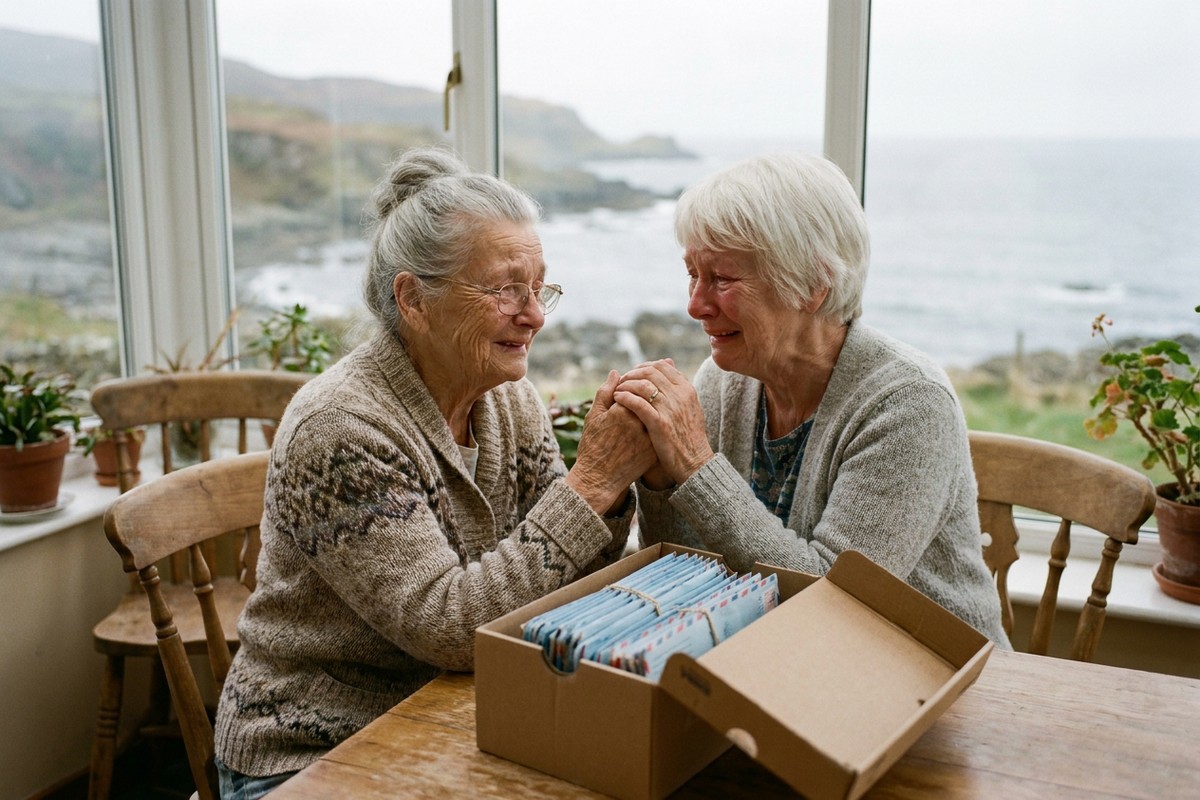
Eleanor sat down in the chair beside her. Fiona reached out with her good hand and took hold of Eleanor's hand and held it so hard it hurt. They sat like that by the window, looking at each other, both of them crying, two old women who had known each other for seventy years and had never once been in the same room.
Finally Eleanor wiped her eyes. She untied the string around the bundle of envelopes in her lap.
"I brought something," she said. "I thought you might like to hear them."
She'd brought the first year. Twelve letters, from the first shoebox.
1957 to 1958. Fiona's letters, written in a twelve-year-old's careful, round hand on blue airmail paper.
Eleanor unfolded the first one.
"Dear Eleanor," she read aloud. "My name is Fiona and I am twelve and I have red hair and three brothers who are horrible."
Fiona made a sound. It took Eleanor a moment to recognize it. She was laughing.
"I live in a flat above a shoe shop," Eleanor read. "I would like to know if you have ever seen a cowboy."
Fiona laughed so hard her shoulders shook. She squeezed Eleanor's hand. She pointed at herself with her good hand, then shook her head and rolled her eyes, the way you would at something foolish you'd done when you were twelve.
Eleanor laughed too.
She stayed in Edinburgh for nine days. She'd booked a room at a guesthouse near the care home. Every morning, Callum drove her to Portobello, and every morning she sat by the window in the sunroom with Fiona and read her letters aloud.
She'd brought seventy-two of them, the most she could fit in her carry-on. She read them in order. The boys at the Saturday dances.
The first job at the bank. Duncan, the bus driver, who asked Fiona out three times before she said yes. The wedding, the babies, the brothers, who apparently became much less horrible with age.
Fiona laughed at all the right parts. She cried at the right parts too. Sometimes, when Eleanor got to a part that mattered, Fiona would squeeze her hand and say one word, slowly and carefully, with enormous effort.
Yes.
On the last morning, Eleanor read her the letter Fiona had written in January, the last one before the stroke. It was about the snow in Edinburgh, and a robin in the garden, and how much she was looking forward to spring.
When Eleanor finished it, Fiona was quiet for a long time. Then she looked at Eleanor, and her mouth worked, and she found a word.
"Ellie," she said.
It was the first time in seventy years Eleanor had heard her voice say her name.
Callum set up the video calls before Eleanor flew home. A tablet for Fiona, propped on a stand by her armchair. A tablet for Eleanor, which her niece taught her to use at the kitchen table on Mill Road.
They talk every Sunday afternoon now. Eleanor reads. Fiona listens, and laughs, and sometimes finds a word.
Eleanor still writes, too, on the fifteenth of every month. Callum reads the letters aloud to his grandmother by the window.
On the last morning in Portobello, Callum took a picture with his phone. It's taped now to the side of the shoebox marked 2017 to.
Two old women holding hands in a sunroom by the sea, with gray light coming in the window. On the table beside them, open, a shoebox full of blue airmail envelopes.
Eleanor has filled in the second date on that box, finally, in black marker.
It says: Still writing.