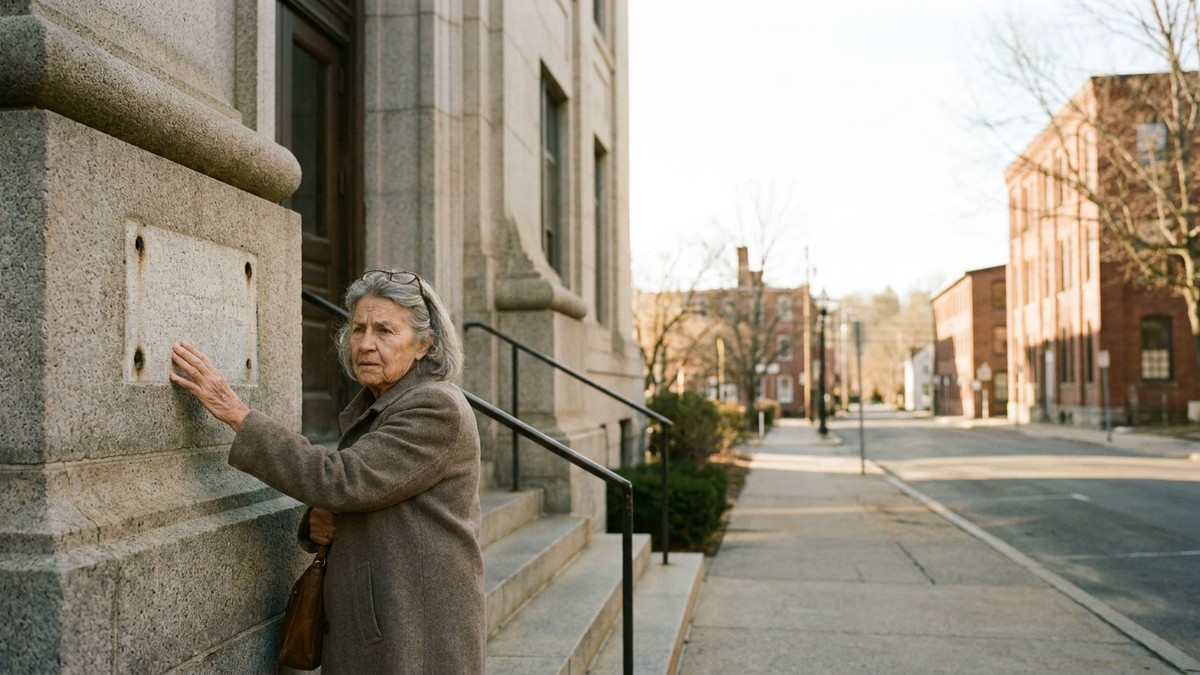
The bronze plaque with Millie Fontaine's grandfather's name on it had hung outside the town library for a hundred and six years, until Tuesday.
On Tuesday morning, there were four empty bolt holes in the granite.
Millie stood in front of them on the library steps at 9:15, with her purse on her arm and her reading glasses pushed up on her head, and looked at the pale rectangle on the stone where the plaque had been. Somebody had pried it off in the night. You could see the scratches from the crowbar.
"Well," said Millie. "That's just about enough of that."
The plaque had been put up in 1921, on the front of the Dunmore Free Library in North Hadley, Connecticut, by the town and the American Legion. It was three feet tall and two feet wide, solid bronze, with an eagle at the top and a wreath at the bottom. In the middle, in raised letters, were the names of the nineteen men from North Hadley who had died in the Great War.
The eleventh name was Pvt. Henri J. Fontaine.
He'd been twenty-two years old. He'd worked in the thread mill on the river, like most of the young men in town. He'd died in the Argonne Forest in France on October 12, 1918, a month before the war ended.
His wife had been pregnant with Millie's father. He'd never seen his son.
Millie had touched that name every time she walked into the library since she was five years old. She'd taken her own children to see it. On Memorial Day, she put a small flag beside it.
She was eighty-three. She'd been the secretary at First Congregational Church for forty-one years, and in all that time, she'd never once lost a file, missed a deadline, or let a minister forget a funeral. She was small and brisk and organized, with short white hair and a will like a steel filing cabinet.
She went straight to the police.
North Hadley didn't have its own police department. It had a resident state trooper, a nice young man named Trooper Delgado, who worked out of a little office in the back of town hall and covered three towns.
He took the report. He was sympathetic. He was also realistic.
"Mrs. Fontaine," he said, "I'm sorry. There's been a lot of this. Thieves steal bronze plaques and copper pipe and cemetery vases and sell them to scrapyards by the pound. Bronze is going for almost three dollars a pound right now." He sighed. "That plaque was probably in a melting pot by Wednesday night. I'll put it in the system. But I wouldn't get my hopes up."
Millie thanked him politely. She went home and did not get her hopes up.
She got organized instead.
Every Tuesday morning, the North Hadley Senior Center ran a little white fourteen-passenger bus. It went to the supermarket in Willimantic, and the outlet mall, and the casino twice a year.
The regulars called themselves the Tuesday Bus Club. They had matching navy windbreakers with the club's name on the back, which Millie had ordered in 2019.
There were five of them who never missed a Tuesday.
Millie, who ran things. Gus Lemieux, eighty-five, a retired Navy chief and the only one with any criminal tendencies, mostly in poker. Harriet Bloom, eighty-one, a retired high school drama teacher who could cry on command.
Phil Tomasso, seventy-nine, a retired accountant who'd figured out the internet better than all of them. And Morty Cohen, eighty, who drove the bus.
On Wednesday morning, the five of them met at Millie's kitchen table instead of going to the supermarket.
"Phil," Millie said, "find me that plaque."
Phil found it on Thursday afternoon.
He'd spent two days going through every scrapyard website and online marketplace listing in eastern Connecticut and Rhode Island. Most of the scrapyards didn't advertise anything but prices. But one of them, a place called Rocco's Salvage and Metals, out on Route 6 near the Rhode Island line, had a page where it sold antique and architectural pieces to collectors.
And on that page, posted Wednesday night, with three blurry photos, was a listing.
Antique bronze WWI memorial plaque, 1921. Eagle and wreath. Excellent condition.
Rare. Serious collectors only. Make offer.
Phil turned his laptop around on Millie's kitchen table. The five of them leaned in.
There was the eagle. There was the wreath. And there, in the middle of the second photo, slightly blurry, the eleventh name.
Pvt. Henri J. Fontaine.
Harriet started to cry, and she wasn't acting.
Millie called Trooper Delgado. He was excited and then, quickly, careful.
"I'll go look," he said. "But Mrs. Fontaine, I need to be honest with you. If the owner says he bought it from somebody who seemed legitimate and had paperwork, and I can't prove he knew it was stolen, it gets complicated. Scrapyards are supposed to keep records of who sells them metal. Some of them do. Some of them don't."
He went out on Friday morning.
He called Millie that afternoon. He sounded frustrated.
The owner, a man named Rocco Pellini, had been very polite. He'd said he'd bought the plaque from a man who walked in off the street, an antiques dealer, with a bill of sale. He'd shown the trooper a receipt book, but the page for that day was missing, and he said it must have gotten wet.
He said he'd paid good money for it. He said he had a buyer interested in Texas.
"I can't seize it without probable cause he knew it was stolen," the trooper said. "Not yet. I'm working on it."
But on Saturday morning, Millie got a phone call of her own.
It was Rocco Pellini. He'd gotten her number off the police report, somehow. His voice was friendly and oily.
"Mrs. Fontaine," he said. "I understand your grandfather's on that plaque. I feel terrible. I really do." He paused. "Now, I paid good money for it, fair and square. But I'd be willing to sell it back to the town. As a courtesy. Eight thousand dollars. Cash. By Friday." Another pause. "Or it goes to Texas."