Millie hung up the phone. She sat very still at her kitchen table for a minute.
Then she called the Tuesday Bus Club.
"Emergency meeting," she said. "My kitchen. One hour. Gus, bring your lucky deck. Harriet, wear something with pockets."
"We can't pay him," Phil said. "And if we do, we tell every thief in Connecticut that it works."
"We're not paying him," said Millie.
"Then what?"
Millie folded her hands on the table.
"The trooper says he needs proof that Mr. Pellini knew it was stolen," she said. "Mr. Pellini told the trooper he bought it from an antiques dealer with a bill of sale. He said the page in his receipt book got wet. I was a church secretary for forty-one years. There is always a piece of paper."
"Where?" said Gus.
"In his office," Millie said. "And we're going to go look at it. Not a break-in, Harriet, before you ask. We're going to get lost."
At 10:40 on Tuesday morning, the little white North Hadley Senior Center bus pulled off Route 6 and rolled slowly through the open gate of Rocco's Salvage and Metals.
It was a big gravel yard full of crushed cars and copper wire, with a truck scale by the gate and a low cinderblock office. A sign on the office door said ALL SELLERS MUST SHOW PHOTO ID.
Morty parked the bus right in front of the office, across two spaces, and left the engine running.
Five elderly people in matching navy windbreakers climbed slowly down the bus steps.
The door to the office opened. A heavy man of about fifty came out, wiping his hands on a rag.
He had a gold chain and a careful smile. Rocco Pellini.
"Help you folks?"
"Oh, thank goodness," said Morty, who had practiced this. "We're lost. Completely lost. We're supposed to be at the outlet mall in Westbrook, and I took a wrong turn somewhere around Brooklyn, and now my GPS is talking to me in Spanish."
Rocco blinked. "Westbrook's an hour south of here."
"An hour," cried Harriet, and put her hand to her chest. Then she swayed.
Harriet Bloom had taught high school drama for thirty-four years, and she swayed like a willow in a storm. Then she sat down on the bumper of the bus with her eyes half closed and said, in a faint, trembling voice, "I'm all right, dear. I'm all right. It's just my blood sugar. If I could just have some water, and sit somewhere cool."
Rocco Pellini looked at the old woman on his bumper, and at the bus blocking his scale.
"Come inside," he said. "There's AC."
They all came inside.
The office was small and cluttered. A metal desk, a counter, a cooler of soda, a calendar of fish. And against the back wall, on a wooden pallet, leaning against a filing cabinet, with an orange sales tag hanging from one of its bolt holes, a three-foot bronze plaque with an eagle at the top and a wreath at the bottom.
Millie didn't look at it. Not once. She'd decided that in her kitchen.
Harriet was installed in Rocco's own desk chair, under the air conditioner, with a can of ginger ale and a paper towel on her forehead. She asked for crackers.
Gus leaned on the counter.
"Say," he said, "while I've got you. You buy bronze propellers? My brother had a boat. Twenty-four-foot Chris-Craft. Big bronze prop. He passed in the spring, and I've got it in my garage. What's a thing like that worth?"
Rocco's eyes lit up a little. "Depends on the weight. Bring it in, I'll put it on the scale."
"Well, what's bronze going for? And is it different if it's manganese bronze? Because I think it's manganese bronze."
Gus Lemieux had been a chief petty officer in the Navy for twenty-four years. He could ask a question about boat propellers for forty-five minutes without drawing breath.
And while he did, Phil asked the young clerk a long, confusing question about senior discounts.
Millie Fontaine, eighty-three years old, five foot one, in a navy windbreaker, wandered over to look at the fishing calendar.
Old women are invisible. Millie had counted on it.
The fishing calendar hung on the wall right beside the end of the counter. And on the end of the counter, half under a coffee mug, was a black clipboard with the scrapyard's scale tickets on it. The carbon copies, the ones the state says a scrap dealer has to keep, with the date and time and weight and price of every load the yard bought.
Millie looked at the calendar. She took out her phone and held it up as if she were taking a picture of the bass. Then she lowered it a few inches and flipped the clipboard's pages with one finger.
It took her nine seconds to find it.
Tuesday. 6:52 a.m. Bronze, plaque, 1 pc.
112 lbs. $2.10/lb. Paid cash, $235.20.
And at the bottom of the ticket, in the box marked Seller ID, there was nothing written at all.
But in the margin, in ballpoint, in a different hand, someone had scribbled a note.
WWI. Do not melt. List online. R.
Millie took four pictures. Then she put the phone back in her tote bag and went over to admire the cooler of sodas.
"Well," said Harriet, rising from the desk chair, "I feel much better, thank you, dear. You've been so kind."
Morty asked for directions to Westbrook and wrote them on his hand.
They climbed back onto the bus very slowly, one at a time, the way old people do.
Morty pulled out of the gate. He drove a quarter mile down Route 6 and pulled into the parking lot of a Dunkin' Donuts.
Then all five of them screamed like teenagers.
Millie emailed the four pictures to Trooper Delgado from the Dunkin' Donuts parking lot, with Phil's help.
He called her back eleven minutes later.
"Mrs. Fontaine," he said, and his voice was strange, "where did you get these?"
"They were lying on the counter," Millie said, "in plain view, under a coffee mug, next to a calendar of fish."
There was a long pause. "Do me a favor, and never do this again." Another pause. "And thank you."
It was the time stamp that did it. And the empty box for the seller's ID. And the note in the margin.
Under Connecticut law, a scrap dealer couldn't buy a memorial plaque at all. He had to record the seller's ID for every purchase. The ticket proved he knew exactly what he'd bought.
The trooper had a warrant by four that afternoon.
The plaque was back in North Hadley that night, in the evidence room behind town hall. Rocco Pellini was charged with receiving stolen property. A gas station camera helped find the two young men who'd pried it off the library.
The rededication was held on Veterans Day, on the steps of the Dunmore Free Library, in a cold, clear November sunshine.
The Legion color guard came, and the high school band, and Trooper Delgado stood at the back trying not to smile.
The plaque was back on the granite wall, with four new bolts.
Millie stood in front of it with her hand on the eleventh name. Pvt. Henri J. Fontaine. The bronze was cold under her fingers, the way it had been when she was five.
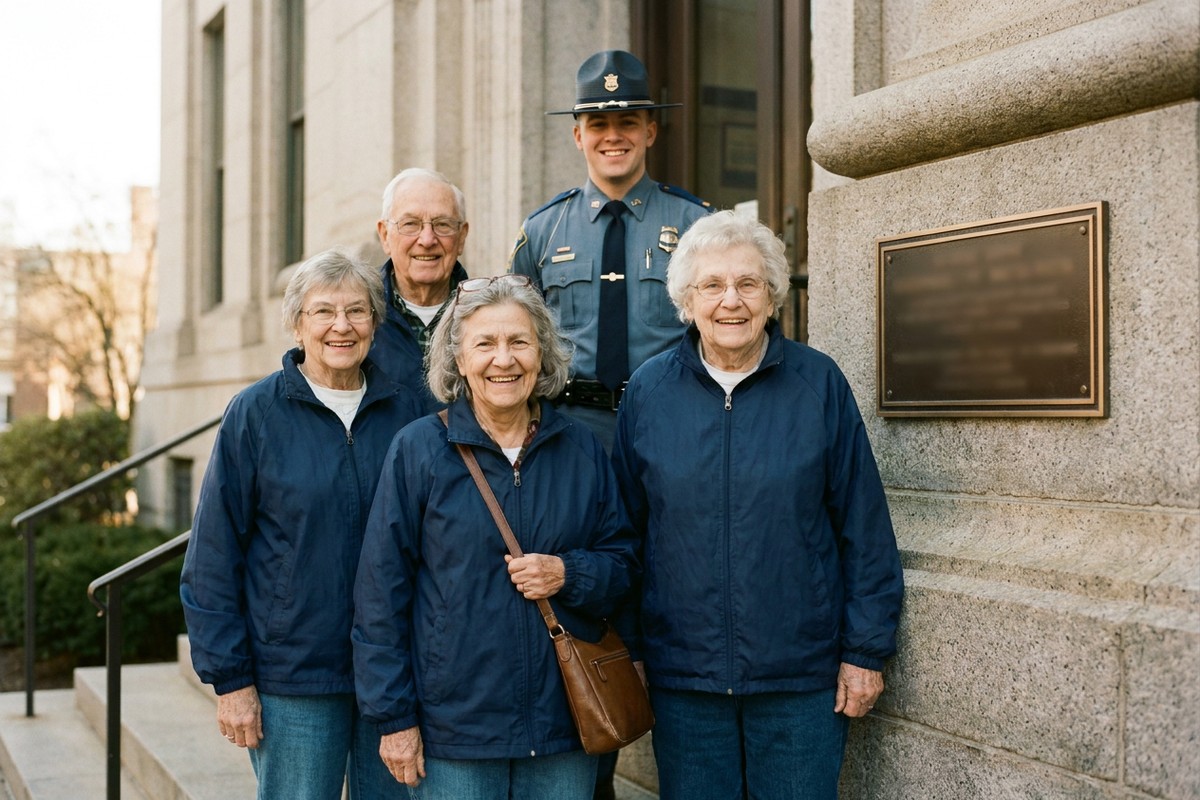
Then she stepped back, and four old people in matching navy windbreakers stepped up beside her on the library steps. Morty still had the directions to Westbrook faintly written on his hand.
The newspaper photographer asked them to smile.
They did. All five of them. Like people who had gotten away with something.