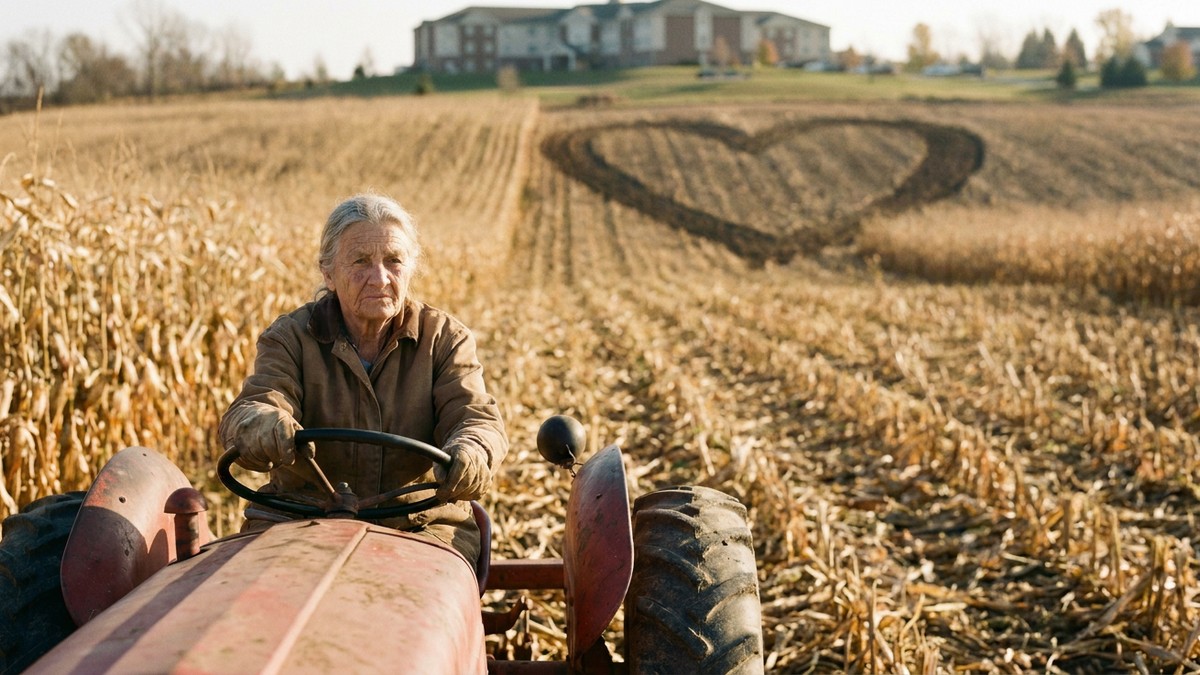
Cal Fennimore had plowed a heart into the back forty on the morning of their wedding in 1968, and fifty-nine years later, he didn't remember her name.
Most days, he called her "the nice lady." Some days, he called her Ruthie, which had been his sister's name. Once, in the spring, he'd asked her very politely if she'd come about the seed corn.
Margie Fennimore always said yes, she had. Then she sat down and held his hand anyway.
She was seventy-seven. He was eighty. They'd farmed six hundred acres of corn and beans outside Harlan Grove, Illinois, for fifty-five years, and raised two boys, and buried a daughter, and never once spent a night apart until the night two years ago when she found him at three in the morning in his pajamas, walking down the middle of the county road toward a farm he'd sold in 1990.
The doctor had used the word Alzheimer's. The boys had used the word "safe." By that winter, Cal was living in the memory care wing at Prairie View, at the edge of town, and Margie was living alone in the farmhouse with a dog and a kitchen table that was too big.
She drove in every day at ten and stayed until supper.
His room was on the second floor, at the end of the hall. It had a bed and a chair and a dresser with photographs on it that he didn't always recognize. And it had a big window that looked out to the west, across a parking lot and a line of young maples, onto eighty acres of open farmland running flat to the sky.
He liked that window. He stood at it for hours.
The nurses said he watched the field the way some of the other residents watched television. He'd watched the beans come up in May, and turn yellow in September, and he'd stood with his hand on the glass the whole afternoon the combine came through.
"He's checking the crop," Margie told the nurses. "He's been checking crops since he was six."
It was the second week of October when she had the idea. She was sitting in the chair by his bed, watching him watch the field, and the combine had just finished the last strip of soybeans. The ground lay bare and pale with stubble.
She looked at it for a long time. Then she went home and got down the photo album.
The picture was on the first page. It was black and white, a little blurry, taken from the back seat of a little Piper Cub by Cal's best friend, Lonnie Albers, on the morning of October 19, 1968.
It showed a pale field of corn stubble, and cut right into the middle of it, in dark plowed furrows, a heart a hundred yards across. Inside the heart were two letters and a plus sign.
M + C.
Cal had gotten up at four that morning, on his wedding day, and plowed it with his father's Farmall 560. He'd been twenty-one.
He'd laid it out with string and fence stakes in the dark. He'd gotten mud on his good shoes and been eleven minutes late to the church, and when Margie came down the aisle and saw the mud, she'd almost started laughing.
The Harlan Grove Herald had printed Lonnie's picture on the front page that week. Margie had kept the clipping in the album for fifty-nine years.
She sat at the kitchen table and looked at the photograph until it was dark outside.
The field outside Prairie View belonged to a farmer named Merle Brinkmann. She called him the next morning.
"I want to rent your field," she said. "For one day."
There was a long pause on the line.
"Mrs. Fennimore," Merle said carefully, "are you feeling all right?"
She told him why. When she was done, there was another long pause, and then Merle cleared his throat.
"You don't need to rent it," he said. "I was going to chisel it this fall anyway. You go on ahead. Just tell me when, and I'll keep my boys out of the way."
Her son Greg, who farmed the home place now, thought she'd lost her mind.
"Mom, you haven't been on a tractor in four years."
"I drove a tractor for fifty years before that," Margie said. "It's like a bicycle. Is the old Farmall still running?"
"The 560? It's sixty-five years old."
"So it runs."
It ran. Greg changed the oil and put on new plugs and hooked up the old four-bottom plow that had been sitting behind the machine shed since the Reagan administration.
He muttered the whole time. Margie spent two evenings at the kitchen table with graph paper and a ruler, measuring Lonnie's photograph and working out the curves of the heart in paces and stakes.
On Thursday morning, she drove the Farmall into town on the shoulder of the county road at twelve miles an hour, with Greg behind her in the pickup with his flashers on.
It took her all day.
She laid the heart out the way Cal had, with string and stakes and a little orange flag at each point of the curve. She plowed it slowly, one furrow at a time, looking back over her shoulder at the line, the way he'd taught her when she was nineteen.
The M was the hardest. She had to plow it three times before it looked right.
She didn't look up at the windows of Prairie View once. She didn't want to know if he was watching. She just plowed.
By sunset, it was done. A heart a hundred yards across, cut dark into the pale stubble. Inside it, two letters and a plus sign.
Margie drove the Farmall home in the dark with Greg behind her, and went to bed without supper, and slept like she hadn't slept in two years.
The phone rang at 8:15 the next morning. It was Sherry, the head nurse on Cal's wing.
"Margie," she said. "You'd better come in."
Margie sat straight up in bed. "Is he all right?"
"I don't know how to tell you this," Sherry said, and her voice wasn't steady. "He's been standing at that window for an hour. He won't sit down. He won't eat his breakfast."
She took a breath.
"Margie, he's crying."