She didn't remember the drive into town. She remembered the parking lot, and the elevator, and the long hallway, and Sherry standing outside his door with her hand pressed flat against her chest.
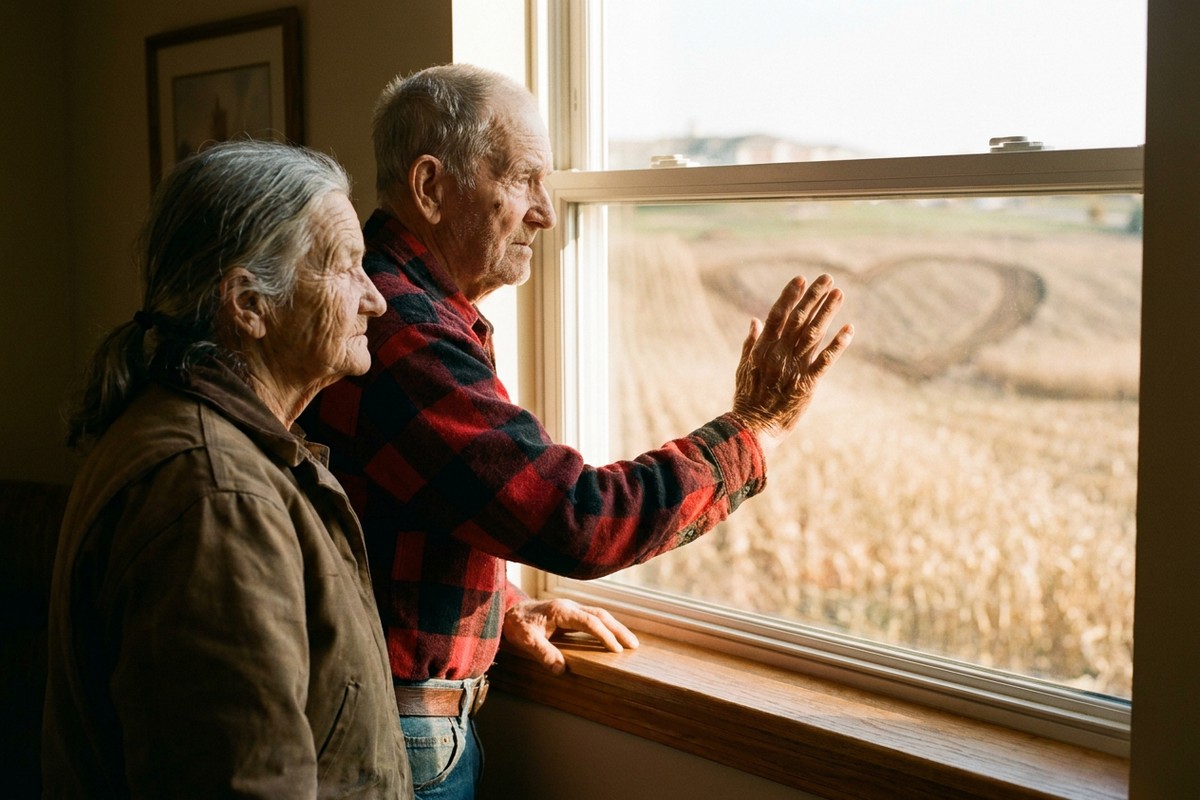
Cal was at the window.
He was in his flannel shirt and his house slippers, and he had both hands on the glass. Outside, in the low morning sun, the heart lay across the field like something drawn by a giant. Dark furrows in pale stubble.
Two letters and a plus sign. A flock of blackbirds was working the fresh dirt along the curve of the M.
His shoulders were shaking.
Margie stood in the doorway. She didn't know what to do. In two years, she'd learned not to say "Do you remember," because it frightened him. She'd learned not to say "It's me," because he'd look at her so politely, trying.
So she didn't say anything. She just came and stood next to him at the window.
After a while, Cal turned his head and looked at her. His face was wet. His eyes were the clear light blue they'd been at twenty-one.
"Margie," he said.
She held on to the windowsill.
"Margie," he said again, as if he were trying out the word to make sure it still worked. Then he pointed through the glass with one big, shaking finger. "Somebody plowed our field."
"I know," she said. Her voice came out very small. "I did."
He looked at her for a long moment. Then he started to laugh, the way he used to laugh, low and helpless, with his whole chest.
"You crooked the M," he said.
He was clear all afternoon.
The nurses said afterward that they'd seen it before, now and then, a good day that comes out of nowhere. The doctors couldn't say why. Margie didn't care why.
He knew her. He knew the boys when Greg drove in at noon, and he asked Greg whether he'd gotten the beans off the north eighty, and Greg had to go stand in the hallway for a minute.
He asked about the dog by name. He asked where his good shoes were.
And he told the story. He told it to Sherry and to the two young aides and to the man across the hall who didn't say much anymore. He sat in his chair by the window with Margie's hand in his and told them about October 19, 1968, like it was last week.
"I got up at four," he said. "Pitch dark. Dad thought I'd lost my mind. I laid it out with binder twine and fence stakes and a flashlight in my teeth. Lonnie Albers flew over at seven in his Cub and took the picture, and I about put the Farmall in the ditch waving at him."
"He was eleven minutes late to the church," Margie said.
"Twelve," said Cal.
"Eleven. I was there."
"I had mud on my shoes," Cal told the aides, very seriously, as if it were important that they know. "Clear to the ankle. Her mother never forgave me. But you should've seen her face when she came down that aisle." He shook his head slowly. "She took one look at my shoes and like to bust out laughing in front of the whole Methodist church."
The aides were laughing. Sherry was crying again, a little.
"Why'd you do it, Mr. Fennimore?" one of the aides asked. "The heart?"
Cal looked at her like it was the simplest question in the world.
"So she'd know," he said. "I wasn't any good at saying it. So I figured I'd put it someplace big enough she couldn't miss it."
Margie looked down at their hands.
Fifty-nine years. She'd thought, all that time, that the heart had been for the wedding.
For the picture in the paper and the story at Thanksgiving. She'd never once thought of it the other way, as a shy boy's way of saying a thing out loud.
She'd plowed it back to him for exactly the same reason.
Late in the afternoon, the light started to go gold and long across the field. Cal got quieter. He kept hold of her hand, but his eyes began to wander, and twice he started a sentence and didn't finish it.
Margie knew what was coming. Sherry had told her it would. She'd made her peace with it before she ever climbed on the tractor.
Around five, he turned and looked at her, and she could see him searching for it, kindly, the way he did now.
"You're the nice lady," he said.
"That's right," Margie said, and squeezed his hand. "I am."
He nodded, satisfied. Then he looked back out the window at the heart in the field, and his face softened, and he smiled.
"Somebody loves somebody," he said.
"Yes," said Margie. "Somebody does."
She didn't know about the picture until Sunday.
The Harlan Grove Herald had a new young reporter named Paige Kuhl who flew a camera drone for the paper. Somebody at Prairie View had called her on Friday, and she'd gone up over the field at sunset and taken one picture: the big plowed heart, the M and the plus sign and the C, and at the edge of the frame, the second-floor window with a small gray-haired figure standing in it.
The Herald ran it on the front page on Saturday, right next to Lonnie Albers's photograph from 1968, which Greg had brought in. The two pictures side by side. Same heart.
Same letters. Fifty-nine years apart.
By Monday, it had been shared from Illinois to Australia. Margie got letters from people in Ireland and Brazil and the Philippines.
A man in Ohio wrote that his wife had Alzheimer's, and he was going to go plant tulips in the shape of her name. A woman in Georgia wrote that she'd read it to her husband in his nursing home, and he'd held her hand the whole time.
Margie answered every letter she could. It took her all winter.
Merle Brinkmann chiseled the field in November and planted corn in the spring. But he left one corner of it unplanted, at the edge nearest the window.
Margie never asked him to. It was just there when the corn came up, a little bare patch of ground, about a hundred feet across.
Every October after harvest, she drove the old Farmall into town at twelve miles an hour, with Greg behind her in the pickup with his flashers on, and plowed a small heart in Merle's corner.
Cal didn't always know her when she came upstairs afterward.
But he always stood at the window, with his hand on the glass, and smiled at the field.