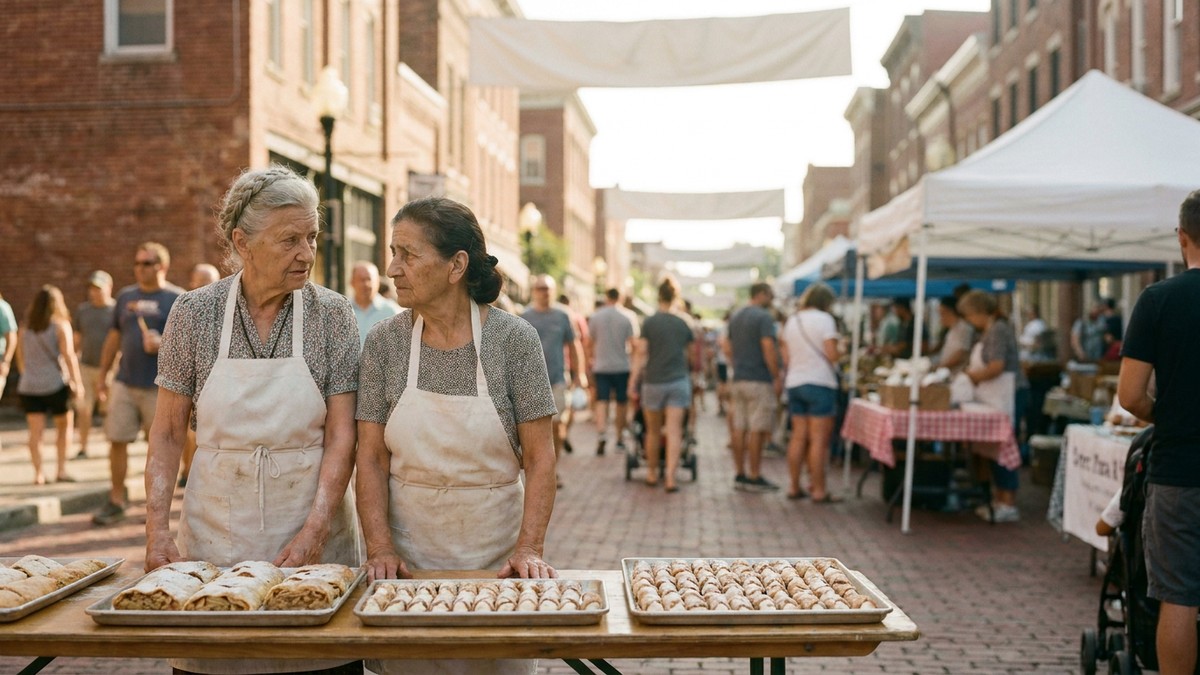
Greta Hoffmeier and Rosa Castellano had not bought so much as a cup of sugar from each other since 1986.
They'd stood thirty feet apart, across the brick pavement of Vine Street in the Over-the-Rhine neighborhood of Cincinnati, for forty-one years. Greta's bakery was on the east side of the street, in a narrow red brick building from 1880 with HOFFMEIER'S GERMAN BAKERY painted in gold on the window. Rosa's was on the west side, in a narrow yellow brick building from 1885, with CASTELLANO'S ITALIAN PASTRY painted in red and green.
Every morning, at exactly five-thirty, both women turned on their lights at the same moment and looked across the street at each other through the glass.
Neither one of them ever waved.
Greta was eighty. She'd been born in a farmhouse outside Stuttgart, come to Cincinnati at twelve with her parents in 1959, and married Klaus Hoffmeier, the baker's son, in 1966. The bakery had been in his family since 1952.
Klaus had died in 2017. Greta still baked six days a week, with her gray braid pinned up and her sleeves rolled to the elbow. Apple strudel.
Black Forest cake. Pretzels. Bienenstich, the bee-sting cake with honey and almonds on top.
Rosa was seventy-eight. She'd been born in Calabria, come to Cincinnati at twenty in 1968, and worked in an Italian bakery on the west side for eighteen years. In 1986, she'd scraped together every dollar she had and opened her own shop on Vine Street, right across from the Hoffmeiers'.
Her husband, Vito, had died in 2020. Rosa still made cannoli by hand, and sfogliatelle, and pizzelle, and a ricotta cheesecake that people drove in from Kentucky to buy.
They had very different ideas about almost everything.
The feud started in October of 1986, eight months after Rosa opened.
The Cincinnati Enquirer had run a little story in the food section about the bakeries of Over-the-Rhine. It called Rosa's cannoli the best thing on Vine Street.
The next morning, a new sign appeared in the Hoffmeiers' window. Hand-painted, by Klaus, in big gold letters.
BEST ON VINE STREET SINCE 1952.
The morning after that, a new sign appeared in Rosa's window. Hand-painted, by Vito, in big red letters.
BEST ON VINE STREET SINCE YESTERDAY.
And that was that. For forty-one years.
They competed over everything. Over who opened first. Over whose window display was better at Christmas.
Over customers, who learned very quickly that if you bought a strudel at Hoffmeier's, you did not carry it across the street in a Hoffmeier's box. When Greta started selling coffee in 1994, Rosa started selling espresso in 1995. When Rosa put out a bench, Greta put out two.
The neighborhood thought it was the funniest thing in Cincinnati. It had been going on so long that the tour guides on the Over-the-Rhine walking tours pointed it out.
Greta and Rosa didn't think it was funny at all.
Every September, the neighborhood held the Vine Street Harvest Fest. Three blocks closed to traffic. Bands.
Beer gardens. Food booths up and down the brick street, and fifty thousand people in two days.
For both bakeries, it was the biggest weekend of the year. For Rosa, it paid the property taxes.
Eight days before the festival, at two in the morning, the exhaust fan over Rosa Castellano's big oven caught fire.
Greta heard the sirens from her apartment over the bakery. She went to her window in her nightgown and watched the fire trucks fill Vine Street with red light, and the firefighters run their hoses in through Rosa's front door, and smoke roll out of the second floor.
Rosa was standing in the middle of the street, in a pink bathrobe, with a fire department blanket around her shoulders. She'd been asleep upstairs.
A neighbor had pounded on her door. She stood there on the bricks with her arms wrapped around herself and watched the smoke pour out of her shop.
She looked very small. Greta had never once thought of Rosa Castellano as small.
Greta stood at her window for a long time. Then she let the curtain fall and went back to bed. She didn't sleep.
The fire hadn't spread past the kitchen. The firefighters had seen to that. But the kitchen was gone.
The big deck oven was ruined. The mixer was ruined. The walls were black with soot and the floor was an inch deep in water.
The health inspector came on Monday and put a notice on the door. No food preparation until repairs were complete and inspected. The insurance adjuster said four to six weeks.
The Harvest Fest was in eight days.
Rosa's windows went dark. Somebody taped cardboard over the broken glass in the kitchen door.
Greta turned on her lights at five-thirty every morning that week and looked across the street at the dark yellow building. It was strange. In forty-one years, she'd never once looked across Vine Street and not seen Rosa looking back.
She told herself it was none of her business.
She told herself that on Monday, and Tuesday, and Wednesday.
On Thursday morning, four days before the festival, someone knocked on the back door of Hoffmeier's German Bakery at four a.m.
Greta was already up, in her apron, with the first batch of pretzel dough rising. She wiped her hands and went to the back door and opened it.
It wasn't Rosa.
It was a woman of about fifty, with dark eyes and dark hair streaked with gray, and her mother's stubborn chin. Greta knew her. Lucia Castellano.
She'd grown up across the street. She used to wave at Greta through the window when she was six, until her father told her to stop.
She was holding a big cardboard box full of mixing bowls, and she looked exhausted.
"Mrs. Hoffmeier," she said. "I'm sorry to bother you so early."
Greta didn't say anything. She waited.
Lucia took a breath.
"My mother needs ovens," she said. "For the festival. If she doesn't sell at the Harvest Fest, she can't pay the taxes on the building this year. And she might have to sell." Her voice shook. "She's been sitting at my kitchen table every night this week, crying. She's called every bakery in Cincinnati. There's nothing." She looked straight at Greta. "My mother's too proud to ask you. She'd rather lose the shop. So I'm asking."