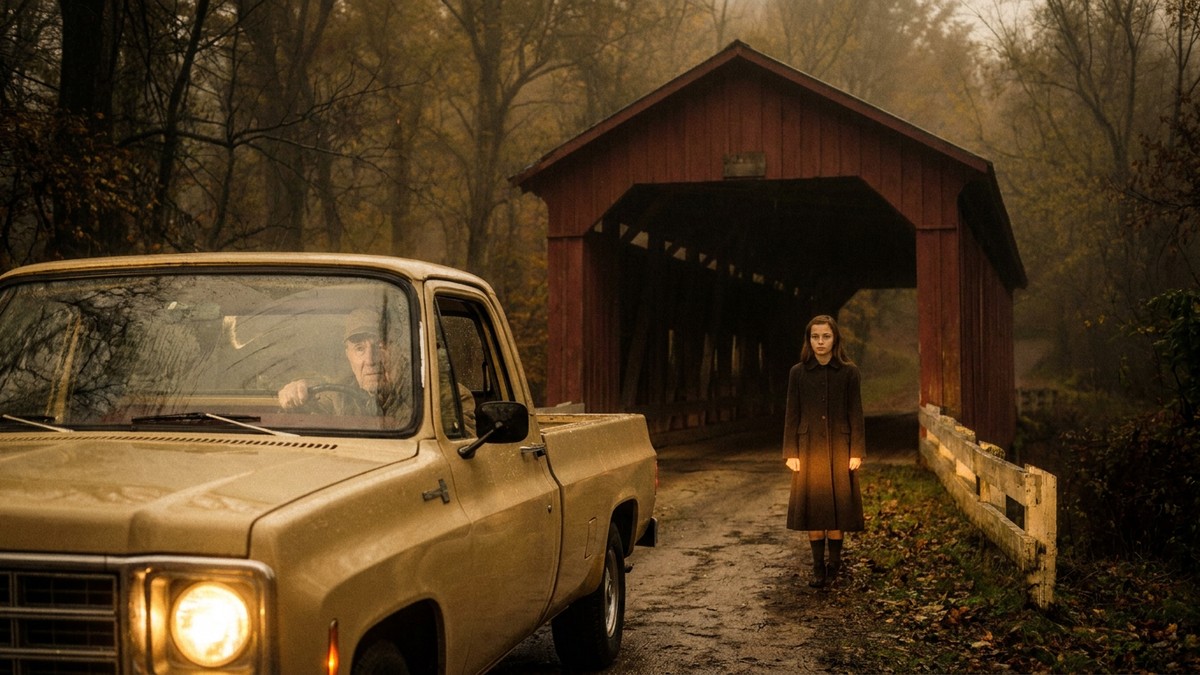
The girl on the covered bridge was standing in the rain without an umbrella, and Lyman Burkhart stopped because his mother had raised him right.
It was a little after ten on a Saturday night in October, the last weekend of the Covered Bridge Festival. He was driving home from the fish fry at the Bridgeton fire station, where he'd fried catfish for six hours and come out smelling like it. The rain had started at dark and settled in.
His wipers were going. The two-lane road through the Sugar Creek bottoms was black and empty.
He came around the bend above the creek, and his headlights swung across the open red mouth of the Weaver's Ford Bridge, and there she was.
She was standing just inside the entrance, out of the worst of the rain but soaked anyway. A girl of nine or ten, thin, in a long wool coat that came down past her knees and a pair of white socks. Her hair was dark and wet and hung down past her shoulders.
Lyman stopped the truck in the road with the engine running. He leaned over and rolled down the passenger window.
"Honey," he called. "You all right? Where's your folks?"
She looked at him for a moment. Then she walked out of the bridge and came to the window. Up close, her face was pale and serious, with a smattering of freckles.
"I'm going home," she said. "It's not far."
"Well, it's too far to walk in this. Hop in, and I'll run you there."
She opened the door and climbed up onto the bench seat and pulled it shut. She sat with her hands folded in her lap and her wet coat dripping on the floor mat. She smelled like rain and creek water.
Lyman pulled through the bridge. The tires rumbled on the old planks, the sound he'd been hearing his whole life.
He was eighty-two. He'd worked for the Parke County highway department for forty-one years, most of them on the bridge crew, and he knew every one of the thirty-one covered bridges in the county the way a man knows the rooms of his own house. He'd replaced floor planks on the Weaver's Ford Bridge four times.
He'd painted it red twice. He'd pulled two cars out of Sugar Creek below it, and once, in 1974, a teenage boy, alive.
He'd been born a mile from the bridge in 1945, in a farmhouse on Ford Road that wasn't there anymore. He'd lived in Parke County every day since, except for two years in the Army.
He'd never once liked driving across that bridge in the rain.
"Where's home, honey?" he asked.
"Ford Road," the girl said. "The white house by the sycamore."
Lyman glanced over at her. There wasn't a white house on Ford Road.
There hadn't been since the county bought out the bottomland after a flood in the fifties. The only thing on Ford Road now was soybeans and a sycamore, a big one, the one that had stood in his mother's front yard.
"You sure, honey?"
"I'm sure."
He decided she must be one of the festival families' kids, camping down at the river, mixed up in the dark. He'd drive her to the end of Ford Road and figure it out there. Maybe call the sheriff.
The wipers went back and forth. The girl sat looking straight ahead through the windshield.
"You're Lyman," she said.
His hands tightened on the wheel. Then he relaxed them. It was a small county.
He'd been on the bridge crew for forty years. Half of Parke County knew his name and his truck, and the other half had seen him at the fish fry.
"That's right," he said. "Who's your daddy?"
She didn't answer that. She just kept looking at the road.
"Do you still think about Rose Ellen?" she asked.
The truck drifted toward the shoulder. Lyman pulled it back.
Rose Ellen was his sister. She'd been nine years old in September of 1951, when Lyman was six. She'd had dark hair down past her shoulders, and freckles, and a blue satin ribbon she wore every Sunday, and she'd sung along with the radio in the kitchen while their mother cooked supper. That summer, the song on the radio had been "Because of You," and she'd sung it so many times their father had threatened to throw the radio in the creek.
On a Sunday afternoon in late September, after church, the two of them had gone down to look at the high water under the Weaver's Ford Bridge. They weren't supposed to. Sugar Creek was running brown and fast and loud after a week of rain.
Lyman had been throwing sticks into the current. His Sunday cap had blown off and gone into the shallows at the edge, caught on a snag, and he'd started to cry, because it was new.
Rose Ellen had climbed down the bank to get it for him.
He remembered the mud giving way. He remembered her hand coming up out of the brown water, and reaching for her, and catching the end of the blue ribbon in her hair, and feeling it slide out of his fingers like it was nothing at all.
They found her the next day, a mile downstream. They never found the ribbon.
He'd never said her name out loud since the funeral. Not to his mother, who never got over it, or to his father, who stopped going to church.
Not even to his wife, Bev, in fifty-four years of marriage. In the whole of his life, he'd told the story exactly once, to a chaplain in the Army in 1966, and then he'd never told it again.
He'd been six. He'd known for seventy-six years that he should have held on.
"How do you know about Rose Ellen?" he said. His voice came out rough.
The girl didn't answer. The rain drummed on the cab roof. They came to the corner of Ford Road, and Lyman slowed and stopped at the stop sign, and turned to look at her.
The passenger seat was empty.
The door was shut. The lock was down. The seat was soaked dark where she'd been sitting, and the floor mat was wet, and there was the smell of creek water in the cab.
And the radio, which he'd had turned off since he left the fish fry, was playing softly. A man's voice, warm and old-fashioned, under a swell of strings.
It was Tony Bennett. It was "Because of You."