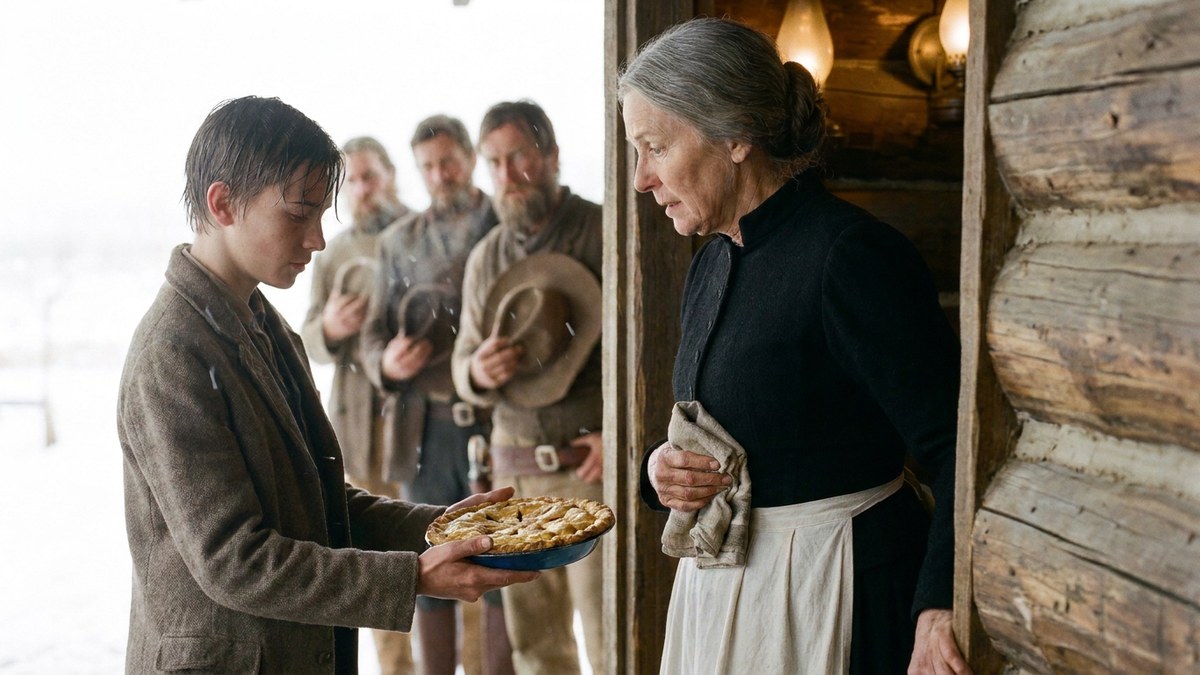
Ten men on Martha Ellery's porch went the color of chalk.
She knew the rider. It was Buck Harlan, foreman of the Bar Seven, the big outfit eight miles down the creek. He had a red face and a voice like a bull and a reputation for firing men on the spot.
Nobody on the porch said a word. Toby Rusk stood with the pie held out in front of him and did not move a muscle.
Martha stepped past them, down onto the top step, and looked at Buck Harlan across the snow.
"Mr. Harlan," she said. "Happy Thanksgiving."
He snatched his hat off. "Ma'am. Mrs. Ellery. I beg your pardon. I didn't see you there."
"You're just in time," Martha said. "We're about to sit down. Put your horse in the barn and come in."
"Ma'am, I came about a pie."
"I know you did," she said. "It's right here. You can have a piece of it."
Buck Harlan stood in the snow with his hat in his hands and his mouth open.
Then he looked past her at the window. He could see the long table through it, set with a white cloth and the good dishes, and twelve places now, and the sage hens browning on the platter by the stove.
He looked at it.
"My cook's name is Dutch," he said, more quietly. "He made four of them. He set them in the window to cool. I've got fourteen men and Dutch and me down at our place, and three of those pies left, and nobody's going to sit down at any table. We'll eat standing up out of the pot the way we always do."
"Then you'd better eat here," Martha said. "Ned, take Mr. Harlan's horse."
It was the quietest dinner Martha had ever served.
Eleven men sat at her table in a terrible silence, holding their forks the way they held a rope, watching her out of the corners of their eyes to see what she did next. When she picked up her napkin, eleven men picked up their napkins. When she put hers in her lap, eleven napkins went into eleven laps.
Lafe Turner knocked over a water glass and nearly died of it.
Martha let them stew for a minute. Then she looked down the table at Toby, at the far end, where she had put him on purpose.
"Toby," she said. "Will you say the grace?"
The boy went white. "I don't know one, ma'am."
"I'll give you one," Martha said. "Say it after me."
It was Henry's grace. His father's grace, from Vermont. She had not said it out loud since March.
She said the first line, and Toby said it after her, slow and careful, in his Texas voice.
She said the second. He said it.
On the third line, her voice went. It just went, in the middle of a word, and she sat there with her hands folded on the white cloth and could not get it back.
Nine cowboys and two foremen held absolutely still. Ned Purcell had warned her. They did not know what to do when a woman cried.
Toby Rusk did.
He said the rest of the grace by himself. He had only heard it once, two lines of it, but he finished it anyway, in his own words, with his head down and his ears red.
"And thank you for the birds," he said. "And for the lady. Amen."
"Amen," said ten men, all at once, very loud.
After that, it was a dinner.
They ate every scrap of six sage hens and a whole bin of potatoes. Buck Harlan told a story about a mule in Dodge City that made Lafe Turner laugh so hard he had to leave the table. Ned Purcell, who never talked, talked about Henry, and it was all right. Martha found it was all right.
Then she brought out the pies.
She cut the Bar Seven pie into twelve pieces, and set the first one in front of Buck Harlan. She cut her own pie, the vinegar pie, and set the first piece of that in front of Toby.
"Toby made the crust," she said.
Buck Harlan tasted the vinegar pie, and then he ate the whole piece, and then he looked at Toby.
"Son," he said. "If you ever want to cook for the Bar Seven, I'll pay you more than Dutch."
"No, sir," Toby said. "I'm staying here."
On Saturday, Toby rode eight miles down the creek with a pie on his saddle in a flour sack.
It was a vinegar pie in Martha's second-best tin, with a crust that did not tear. He handed it to Dutch at the Bar Seven cookhouse door, and he took back the blue tin plate, and he said he was sorry about the windowsill.
Dutch said it was the best vinegar pie he had eaten since Pennsylvania, and asked who had taught him the crust.
Martha Ellery kept that ranch nineteen more years.
Every Thanksgiving, the bunkhouse came up to the house at two o'clock, scrubbed and slicked and terrified, and every year the faces were a little different. Every year the Bar Seven sent somebody up the creek with a pie.
And every year, Toby Rusk made the crust. He said the grace, too, the whole of it. In time he knew it better than she did.
> What really happened: Most cowboys on the northern ranges in the 1880s were young men in their teens and twenties, a mixed crew of white, Black, Hispanic, American Indian and immigrant hands, and many had no family nearby. The cattle boom of the early 1880s filled Wyoming Territory with big outfits far from towns, supplied by wagon from the railroad at Cheyenne. Thanksgiving had been a national holiday since President Lincoln's proclamation of 1863, and on the frontier it was kept with whatever was on hand. Sources: National Park Service; The American Presidency Project.