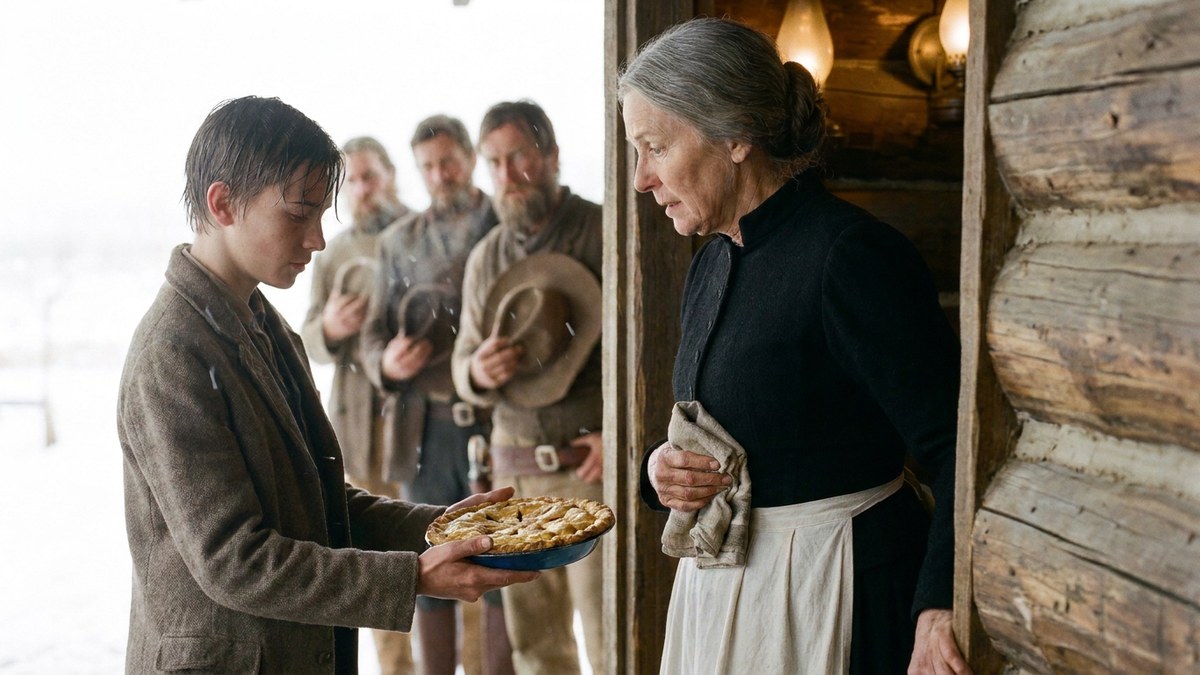
The youngest hand on the place asked Martha Ellery what people ate at Thanksgiving, and she understood that he had never once sat down to one.
It was November 1884, on the Ellery ranch in Wyoming Territory, forty miles from the nearest town. Toby Rusk was sixteen. He had come up the trail from Texas with a herd in the spring, and stayed on because he had nowhere else to go.
He was splitting kindling for her by the kitchen door when he asked it. He did not look up.
"Turkey, mostly," Martha said. "Or a goose. Potatoes. Pie."
"What kind of pie?"
"Whatever kind your mother made."
Toby split another stick.
"My mother died when I was four," he said. "On the Nueces. I don't remember any pie."
Martha was sixty-one. She had buried her husband in March, after his horse went down on him in a coulee in the spring snow, and she had not planned on Thanksgiving at all.
There did not seem to be much point. Henry had carved. Henry had said the grace, the same one every year, the one his father said in Vermont. Without Henry it would be one old woman at a long table, and she could not see the use of that.
She had told the foreman as much in October.
Now she stood in her kitchen door and looked at the back of Toby Rusk's neck, sunburned and thin, with the hair cut ragged where he did it himself with a knife.
"Toby," she said. "Tell the boys in the bunkhouse. Thanksgiving dinner is at this house. Thursday. Two o'clock."
He turned around with the hatchet in his hand.
"All of us?"
"All nine. And Ned."
Ned Purcell, the foreman, came up to the house that evening with his hat in his hands. He was fifty, with a gray mustache, and he had worked for Henry eleven years.
"Mrs. Ellery," he said. "I don't want to speak out of turn."
"You're going to anyway, Ned."
"Those boys have not sat at a lady's table in their lives. Half of them eat with their knives. Two of them can't read. Lafe Turner hasn't had a bath since the Fourth of July, and he's proud of it." He turned his hat around once. "And they're scared to death of you, ma'am."
"Why on earth?"
"Because you're a lady, and you're grieving, and they think if they do one wrong thing at your table, you'll cry. And they don't know what to do when a woman cries. None of them."
Martha thought about that.
"Then they had better not do anything wrong," she said. "Two o'clock, Ned."
The supply wagon from Cheyenne was due on Monday. It was supposed to bring flour and sugar and dried apples and a sack of cranberries, which Henry had always sent for special.
On Monday it snowed. On Tuesday it snowed harder. The wagon did not come.
Martha stood in her pantry on Tuesday night with a lamp and counted. One sack of flour, half gone. Lard. Salt pork. A bin of potatoes and a few onions. A crock of molasses. No sugar to speak of. No apples. No cranberries.
And no turkey. There had never been any turkey. There were no wild turkeys in that country, and the nearest tame one was in Cheyenne.
She had invited ten men to Thanksgiving dinner in two days, and she had nothing to give them but potatoes.
On Wednesday morning, Toby Rusk rode out before daylight with his rifle.
He came back at noon with six sage hens hanging from his saddle horn and frost in his eyebrows, and laid them on her kitchen table without a word.
"Toby," Martha said. "Where did you learn to shoot like that?"
"I didn't learn it," he said. "I just needed to eat."
She picked up one of the birds. It was heavy and fat from the late fall. Henry used to say a sage hen in November was as good a bird as God ever made, if you got the sage taste out of it.
"Go wash," she said. "Then come back. You're going to help me, and I'm going to show you how to make a pie crust with lard and a cold hand."
"I can't cook, ma'am."
"Nobody can, until somebody shows them."
They worked all afternoon.
She showed him how to cut the lard into the flour with two knives until it looked like coarse meal. She showed him how to sprinkle in the cold water from the well bucket a spoonful at a time, and to stop the moment it held, and not to handle it, because warm hands made a tough crust.
He was clumsy. His first crust tore in four places. His second held.
There was nothing to put in it. No apples. No sugar. Martha studied the molasses crock. Then she made a vinegar pie, the kind her own mother made in the bad years, with molasses and a little vinegar and eggs. It was not much to look at.
Toby looked at it with deep respect.
On Thursday at five minutes to two, there was a sound on the porch like a herd of cattle trying to be quiet.
Martha opened the door.
They stood there in a row in the snow: nine cowboys and the foreman. They had shaved. Their hair was slicked down with water and bear grease, and some of it had frozen. Every one of them had his hat in his hands. Lafe Turner had taken a bath. You could tell by how pink he was.
In the front of the row, Toby Rusk held out a pie.
It was a big, beautiful, golden dried-apple pie, in a blue tin plate, with a crimped edge and sugar on top. It smelled of cinnamon.
"We brought you this, ma'am," Toby said. "You're supposed to bring something."
Martha looked at the pie. She knew there was not a dried apple or a pinch of cinnamon on her ranch, or in the bunkhouse, or in forty miles of snow.
Then, out on the lane, she heard a horse coming hard.
A big man on a lathered bay pulled up at her gate, and stood in his stirrups, and roared across the yard at all ten of them.
"Which one of you thieving coyotes," he shouted, "took my cook's pie off the windowsill?"