Part 2
The half mile to the Holm place took them nearly an hour.
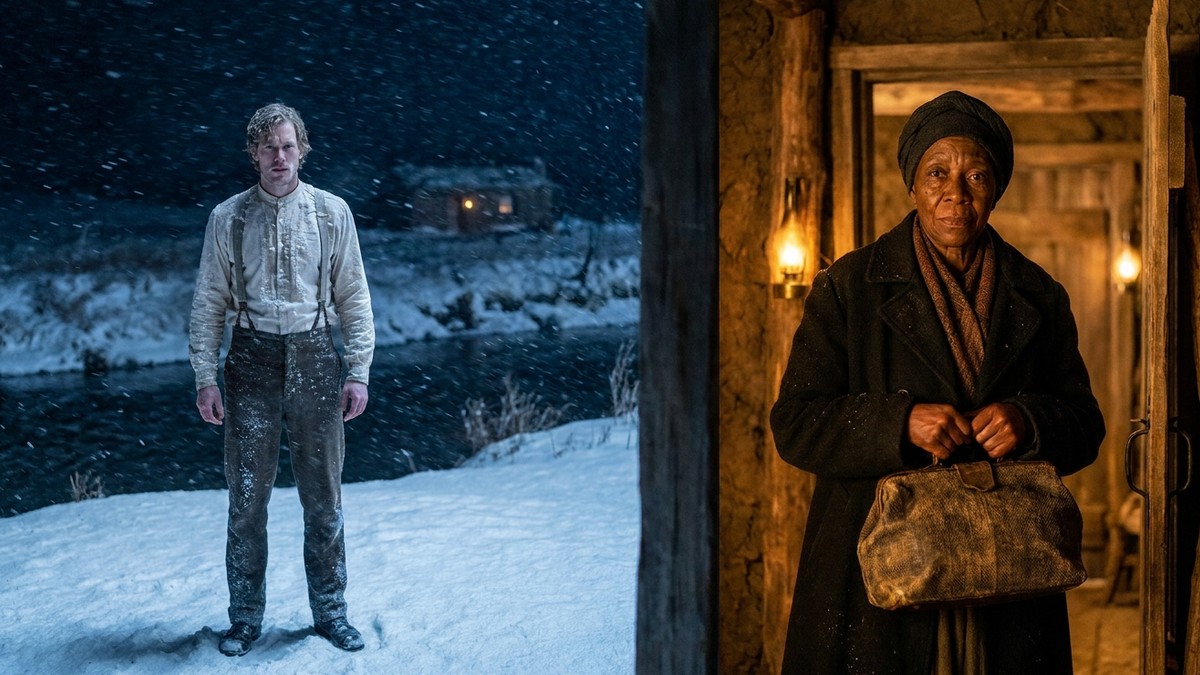
Isaac went first with the lantern, bent into the wind, and Minerva held on to the back of his coat, and Anders Holm went on her other side with his arm through hers, half carrying her over the drifts. The snow stung their faces like sand. They could not see the creek until they were in it, and the ice at the edge broke under them, and Minerva went in to her knees in the freezing water. Anders pulled her out. He did not let go of her arm again.
They saw the light of the sod house window at last, a small yellow square in the blowing white. And when Anders pushed open the door, Minerva heard what she had known she would hear. A young woman, crying out in a language she did not understand, in the one voice that is the same in every language there is.
Kerstin Holm lay on the bed in the corner of the one-room soddy, soaked with sweat, with her fair hair stuck to her face. The little boy was sitting up in the trundle bed, wide awake, terrified. The fire had burned low.
Minerva took off her wet coat. She went to the washbasin and washed her hands, slowly and thoroughly, with the yellow soap from her bag. Then she went to the bed and knelt beside it, and put her hand on Kerstin's forehead, and looked into her frightened face.
"Hush now, baby," she said. "Minerva's here."
Kerstin did not understand a word. But she stopped crying out. She stared up at the old Black woman kneeling beside her bed, and her hand came out and gripped Minerva's wrist, hard.
"Isaac," said Minerva, without turning around. "Build up that fire. Then water. All they've got, on to boil. Then you take that little boy up on your knee and you keep him there." She looked at Anders, standing in the doorway with the snow melting off him. "And you," she said, and pointed at the bed, and at a chair beside it, and at Kerstin's other hand. "Sit. Hold her. Right there."
He understood that. He sat.
She knew within ten minutes what was wrong. The baby had turned the wrong way, crosswise, with its shoulder down instead of its head. The young mother had been in labor since noon, Anders made her understand, holding up his fingers. Twelve hours.
Minerva had seen it before. Many times. Seven times in her life she had turned a baby like that, with her two hands, from the outside, between the pains, slow and patient and careful, the way the old midwife in Warren County had taught her when she was twenty. Six of the seven had lived.
She did not have any words to tell Kerstin what she was going to do. So she took the young woman's face in both her hands, and looked into her eyes, and nodded, slowly. Then she put her own hand on Kerstin's belly, very gently, and showed her, with her hand, the turn she meant to make. Around. Like the hand of a clock.
Kerstin looked at her for a moment. Then she nodded back.
It took Minerva most of an hour. Between every pain she worked, pressing, coaxing, her old hands spread wide, her knees aching on the dirt floor. When a pain came, she stopped, and held Kerstin's hand, and breathed with her, slow and deep, in and out, and Kerstin breathed with her. They counted together, Minerva on her fingers, Kerstin under her breath in Swedish. Ett, två, tre. One, two, three. By the end of the hour, Minerva knew how to count to ten in Swedish.
And then, at last, she felt the baby turn. Slowly, all the way round, and settle, head down, where it should be.
Minerva sat back on her heels and wiped her face.
"There, now," she said. "There, now. Now we can get to work."
The baby was born at a quarter to five in the morning, with the storm still howling outside. A girl. Small, red, furious, and perfect, with a fuzz of white-fair hair. She let out a yell that shook the soddy.
Minerva wrapped her in a warm flannel from the stove and laid her on her mother's breast. Kerstin wept and laughed and said something over and over in Swedish.
Anders Holm put his face down on the bed beside his wife and his daughter, and his big shoulders shook.
The storm blew itself out by noon. Minerva stayed two days, until she was sure Kerstin was out of danger. Isaac went home and came back with Dilsey, who brought a kettle of beans and cornbread and stayed to do the Holms' washing. Neither family could talk to the other. It turned out that they did not need to.
On the second evening, Anders came and sat down across the table from Minerva, by the stove, and put his hands flat on the table. He had a little English, it turned out, more than she had thought, when he had to use it. He used all of it.
"In Sweden," he said slowly, "and in Illinois, people tell us. Colored people. Not good. Stay away." He looked at his hands. "Last summer, on road. I step off. For you. I think, I don't know her, better stay away." He looked up, and his face was red. "I am ashamed."
Minerva studied him.
"I've been stepped off of my whole life, Mr. Holm," she said. "You're the first man ever told me he was sorry for it."
In April, when the ground thawed, Anders Holm drove his team and his breaking plow across the creek to the Tolbert claim, without being asked, and broke twenty acres of sod for Isaac in five days, and would not take a cent.
They named the baby Minna. For Minerva.
And for the rest of her life, whenever Minerva Tolbert walked down the creek road and met Anders Holm coming the other way, he did not step off into the grass. He stopped in the middle of the road, and took off his hat.
"Tack, Mrs. Tolbert," said Anders.
And Minerva, who had learned that word the night Minna was born, from hearing Kerstin say it a hundred times, said it right back to him.
"Tack, Mr. Holm."