Part 1
Elias Penney had kept one secret from his wife for fifty years, and the golden wedding meant his time was up.
It was April 1893, in the Willamette Valley of Oregon, on a farm of six hundred acres outside the little town of Forest Grove, with orchards and wheat fields and a big white house with a porch that ran around three sides. Elias was seventy-two. His wife, Sabra, was sixty-eight. They had eleven children, nine of them living, and thirty-four grandchildren, and four great-grandchildren, and they had been married since the twentieth of May, 1843.
Two days after the wedding, they had left Elm Grove, Missouri, with the first great wagon train to Oregon.
"Grandpa," said their granddaughter Lucinda, at Sunday dinner, with all the family around the long table. She was twenty-two and engaged herself, and she had organized everything. "We're going to have the golden wedding on the twentieth of May. At the church. Reverend Atwell says you can say your vows again, the same as you did in 1843. And then a dinner here, for everyone. The whole valley's coming."
Sabra laughed. She was a small, round, bright-eyed woman with snow-white hair and a laugh that had not changed in fifty years.
"Say our vows again? At our age? Elias, can you remember them?"
"Every word," said Elias.
"And Grandma," said Lucinda, "you'll need to wear your ring. For the ceremony. Where is it? I've never once seen you wear a ring."
The table went quiet for just a moment.
"I never had one, dear," said Sabra comfortably. "We were married in a hurry, in a tent, in the rain, with the wagons all ready to go. Your grandfather had a ring. His mother's. He'd brought it all the way from Tennessee. But he promised to give it to me in Oregon, when we had a proper house. And it was lost on the trail, on the Snake River. Wasn't it, Elias?"
"Yes," said Elias Penney. "On the Snake."
He looked down at his plate.
It was not lost on the Snake.
That was the secret.
He remembered it all, as clear as yesterday. The fall of 1843, on the Snake River plain, in what is now Idaho. Brown, burnt, endless sagebrush country, dust and heat by day and cold at night. The train had been on the road five months. The food was nearly gone. The oxen were dying. And Sabra, who was eighteen years old and four months with child, had taken a fever.
It was a bad fever. For a week she could not keep anything down. She grew thinner and thinner in the jolting wagon, until her wrists were like a child's, and Elias was afraid to look at her in the morning. There was no flour left in their wagon. No flour in anybody's wagon that anyone would sell. The other families were rationing their own to the spoonful.
At Fort Boise, the little Hudson's Bay Company trading post on the Snake, there was flour. The Company man in charge would sell it. But not for paper money. Not for promises. Only for coin, or furs, or something of value.
Elias had no coin. He had no furs.
He had his mother's ring. A plain, heavy gold band, which she had worn for forty years, and pressed into his hand on the day he left Tennessee, and said, Give it to the girl you marry, and tell her it was mine.
He had traded it at Fort Boise for a fifty-pound sack of flour.
He had never told Sabra.
When she got well, and asked him for the ring, he could not bear to tell her what he had done with his mother's gift, her wedding ring, her promise. So he had told her it was lost. That it had fallen out of his pocket while he was hauling the wagons across the Snake River at the Three Island Crossing, and gone to the bottom, and was gone.
She had cried. Then she had wiped her eyes and said it didn't matter. That she had him, and the baby coming, and Oregon ahead, and that was all the gold she needed.
That baby was their son John, who was forty-nine now, with grandchildren of his own, and sat at the end of the table at every Sunday dinner, and had no idea that his life had been bought with his grandmother's wedding ring.
Elias had meant to tell her a hundred times. In 1844, when they built the first cabin. In 1850, when they built the frame house. In 1870, when they built this one. Every year, on the twentieth of May. And every year, he had not.
And now, a month from now, he was going to stand up in front of the Reverend and the whole Willamette Valley and say his vows again, to a woman he had lied to for fifty years.
That night, he could not sleep.
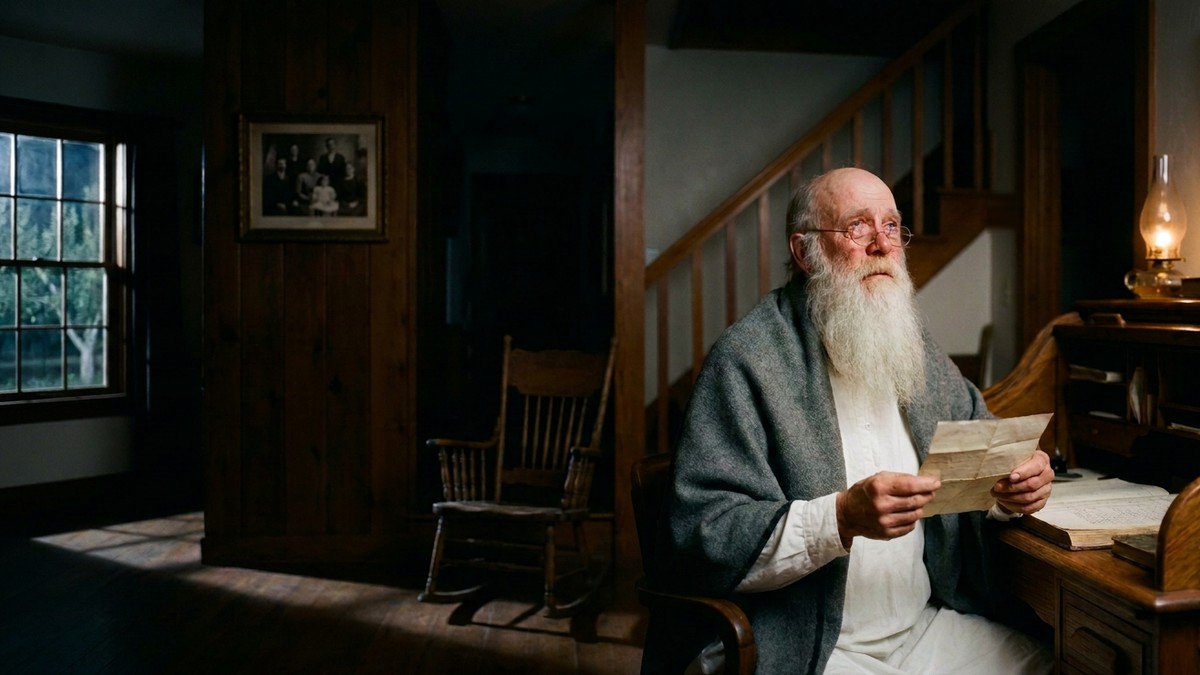
He got up, very quietly, so as not to wake Sabra, and went downstairs in his nightshirt, and lit a lamp in the front room, and sat at the old rolltop desk where he kept the farm accounts.
From the back of the bottom drawer, from under fifty years of ledgers, he took out a letter.
It had come in February, in a long envelope with a Canadian stamp, from the office of the Hudson's Bay Company in Victoria, British Columbia. It was the answer to a letter he had written the summer before, after forty-nine years, with a shaking hand.
He unfolded it and read it again, for the twentieth time, in the lamplight.
Then he folded it back up, and sat with it in his hands, and looked up at the ceiling, toward the room where his wife was asleep.