Part 1
Minerva Tolbert had delivered two hundred and eleven babies, and not one of them to a family that could not understand a word she said.
It was March 1880, in Graham County, Kansas, on the high, bare, windy plains along the South Fork of the Solomon River, a few miles from the Black town of Nicodemus. Minerva was sixty-four. She had been born enslaved in Mississippi, in 1816, on a cotton place in Warren County, and had been a midwife since she was twenty, first to the people in the quarters and then, after freedom, to anyone in the county who would send for her.
In the spring of 1879, she had come to Kansas with her son Isaac, his wife Dilsey, and their four children. They were Exodusters. They had come up the Mississippi on a crowded steamboat, with thousands of others, fleeing the violence and the debts and the broken promises of the South after Reconstruction ended. They had landed at Wyandotte with nothing but their bundles and their faith, and come west to Graham County, where there was free land, and a Black town, and a chance.
Isaac had filed on a quarter section on the creek. They lived in a dugout in the creek bank, with a sod front and a stovepipe through the roof, and they had broken twenty acres the first summer.
Across the creek, a half mile east, lived the Holms.
They had come that same spring, from Sweden by way of Illinois. Anders Holm and his young wife Kerstin, and a little boy of three. They had built a sod house on the rise across the creek and broken their own twenty acres. Anders was perhaps thirty, tall and fair and silent. Kerstin was smaller, with a round, cheerful face and a white kerchief, and she sang while she hung out the washing, in a language Minerva had never heard before.
Neither of them spoke more than a few words of English. Minerva spoke no Swedish at all.
All that first year, the two families lived within sight of each other's smoke and hardly spoke. When they met on the creek road, Kerstin smiled shyly and nodded. Anders touched his hat and looked away. The first time Minerva had passed him on the road, the summer before, he had stepped down off the track into the grass, all the way, and waited for her to go by, and she had not known whether it was manners or something else.
She had seen a good deal of something else in her sixty-four years. She did not ask.
By the winter, Kerstin Holm was expecting.
Minerva could see it from across the creek, in how the young woman moved, slow and careful, with one hand at the small of her back. She counted. The baby would come in March. And the nearest doctor was at Hill City, a long day's ride away, if the roads were open, which in March they often were not.
She said as much to Dilsey one evening.
"They'll have somebody," said Dilsey. "Some Swede woman. They always do."
"There's no Swede woman for twenty miles," said Minerva. "I asked at the store."
Dilsey looked at her mother-in-law.
"Mama, they don't want us," she said gently. "You saw him step off the road. You go knocking on that door and he'll run you off. And then what?"
Minerva did not answer that. But she put her midwife's bag, the old carpetbag with her scissors and thread and clean rags and her bottle of camphor, by the dugout door. And she kept it there.
On the night of the eleventh of March, the wind came up out of the north with snow in it.
It was a hard, mean late-winter storm, the sort the plains could throw at you after a week of thaw. The temperature dropped, and the wind howled down the creek, and the snow came sideways. Minerva lay awake in the dugout listening to it.
At a little after midnight, someone pounded on the door.
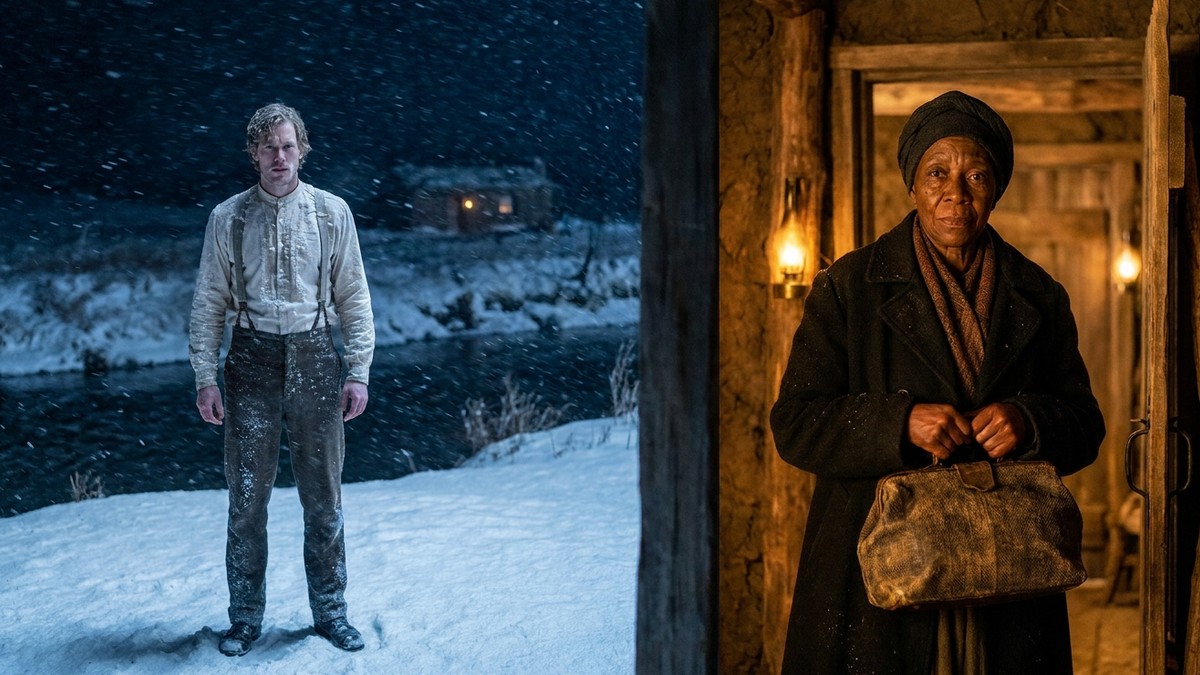
Isaac got up with a lamp. He opened the door, and the wind blew the snow in across the floor, and there on the step stood Anders Holm.
He had no coat on, only his shirt, and he was white with snow from his hair to his boots. He had run the half mile through the storm. He stood in the doorway of the dugout, gasping, staring at them, and his face was the face of a man who was terrified.
"Please," he said. It was one of the few English words he had. He looked past Isaac, searching the dark dugout, until his eyes found Minerva, sitting up on her pallet by the stove.
"Please," he said again, to her. And then something in Swedish, fast, broken. And then he put his hands out in front of his own belly, in a great curve, and made a sound in his throat that was half a word and half a sob.
Minerva Tolbert was already on her feet.
She was sixty-four, and her knees were bad, and it was a half mile through the snow in the dark. She took her shawl from the peg, and her heavy coat over it, and Isaac's old hat. And she picked up the carpetbag from beside the door, where it had been waiting all winter.
"Isaac," she said. "Light the lantern. You're coming with me."