Part 2
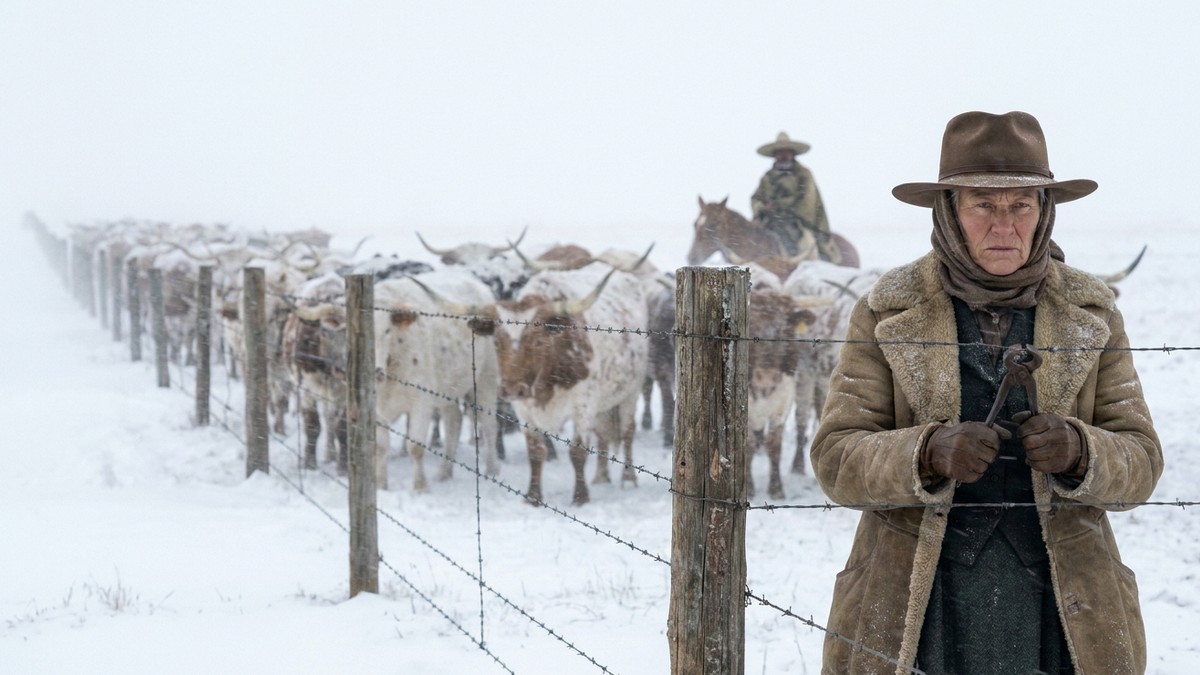
The wire parted with a twang that Cora felt in her teeth.
She cut the second strand, and the third, and the fourth, and moved to the next post, and cut all four again. Her fingers went numb inside her gloves. The snow blew into her eyes. The cattle pressed up against the wire beside her, so close she could feel the heat of their breath, and bawled.
At the fourth post she pulled the loose wire back, coil by coil, out of the way, and dragged it into the snow, so the cattle would not tangle in it.
There was a gap in her fence now. Forty yards wide.
At first the cattle stood where they were, heads down, tails to the wind, as if they could not believe it.
Then one old brindle cow at the front took a step. And another. And she walked through the gap and on south into the white, with the wind at her back. And the one behind her followed. And the one behind that.
"Mira," said Tomás softly. "Look. They know."
They did not stop at one gap.
All that night and all the next day, in the howling storm, Cora Bledsoe and Tomás Garza rode the three miles of her south line and cut it to pieces. Every quarter mile they stopped, and she got down and cut forty yards of wire, and Tomás rode into the packed cattle, swinging his rope and whistling the high, sharp vaquero whistle she had heard him use on the trail in '79, and turned the leaders toward the gap, and pushed them through.
Once the leaders went, the rest followed. Thousands of them. A slow brown river of cattle flowing south through the cut fence into the storm, toward the Canadian River and the deep sheltered breaks thirty miles away.
At the end of the second day, Cora could no longer close her hands. Tomás cut the last gap for her, and lifted her onto her horse, and led her home through the snow.
She sat by the stove all that night with her hands in a pan of cold water, while the feeling came back into them, which hurt worse than anything she could remember. Tomás made coffee and did not say anything.
Outside, the wind kept screaming for three more days.
When the blizzard broke, on the fifth of January, the plains were white and silent under a hard blue sky.
Cora rode out with Tomás along her south line. The fence was down in a dozen places, the way she had left it. The snow was trampled flat and brown where the cattle had passed. There were dead cattle here and there, the old and the weak, but not many.
Then they rode east, along the Glenisla's drift fence, where she had not cut anything.
They rode a mile. Then two. Then they stopped, and turned their horses, and rode back home, and neither of them said a word all the way.
Mr. Robert Ainslie came to Blue Creek on the twentieth of March, in a buggy, with a lawyer from Tascosa beside him and a sheaf of papers in his lap.
He did not take off his bowler hat.
"Mrs. Bledsoe," he said, "you destroyed three miles of fence that the Glenisla Company relied on for the protection of its range. You let thousands of drift cattle onto our winter grass. The company intends to sue you for the full damages."
"I expect it does," said Cora. "Before you do, Mr. Ainslie, Tomás would like to show you something. It's a day's ride. I'll pack a lunch."
They rode south together the next morning, the four of them, Cora, Tomás, Ainslie, and the lawyer, across the Glenisla's own range, to the rim of the Canadian River breaks.
At the rim, Tomás reined in.
Below them, the canyons ran down to the river, deep and red and sheltered, with cedar on the slopes and green grass already coming in the bottoms. And in them, everywhere, scattered along the creeks and the draws as far as they could see, there were cattle. Thin, rough-coated, ribs showing. But alive. Thousands of them, grazing in the spring sun.
"These are the cattle that went through Señora Bledsoe's gaps," said Tomás. "They kept walking. They found the breaks. And they lived."
Ainslie took a small brass telescope out of his coat and looked down into the canyon.
Cora watched him. She knew what he was seeing. She had ridden down there herself the week before with Tomás and counted. The brands of every outfit from Kansas to the Strip. And among them, hundreds and hundreds, more than any other, a G with a bar under it.
The Glenisla's own brand. From its northern herd, on its leased grass up in the Strip, that had drifted down ahead of the storm with all the rest. And had come to the Glenisla's own drift fence, and had gone along it, the way drifting cattle did, until they found the gaps in hers.
Ainslie lowered the telescope.
"How many of ours," he said, "along the drift fence? Where it wasn't cut?"
"Tomás and I rode it in January," said Cora. "We stopped at two miles. We couldn't go on."
The young Scot sat his horse on the rim of the breaks, looking down at his living cattle.
Then he turned to the lawyer from Tascosa and held out his hand for the papers.
He tore them in half. Then in half again. And he let the pieces go, one by one, into the wind over the Canadian River breaks.
The Glenisla's drift fence came down that fall. All thirty-five miles of it. Mr. Ainslie oversaw it himself.
In October a wagon came to Blue Creek from Tascosa, loaded with new barbed wire and cedar posts, enough for three miles of fence, with a note in a neat, correct hand.
With the compliments of the Glenisla Company. Gates, this time, Mrs. Bledsoe. Every quarter mile. R. A.