Part 1
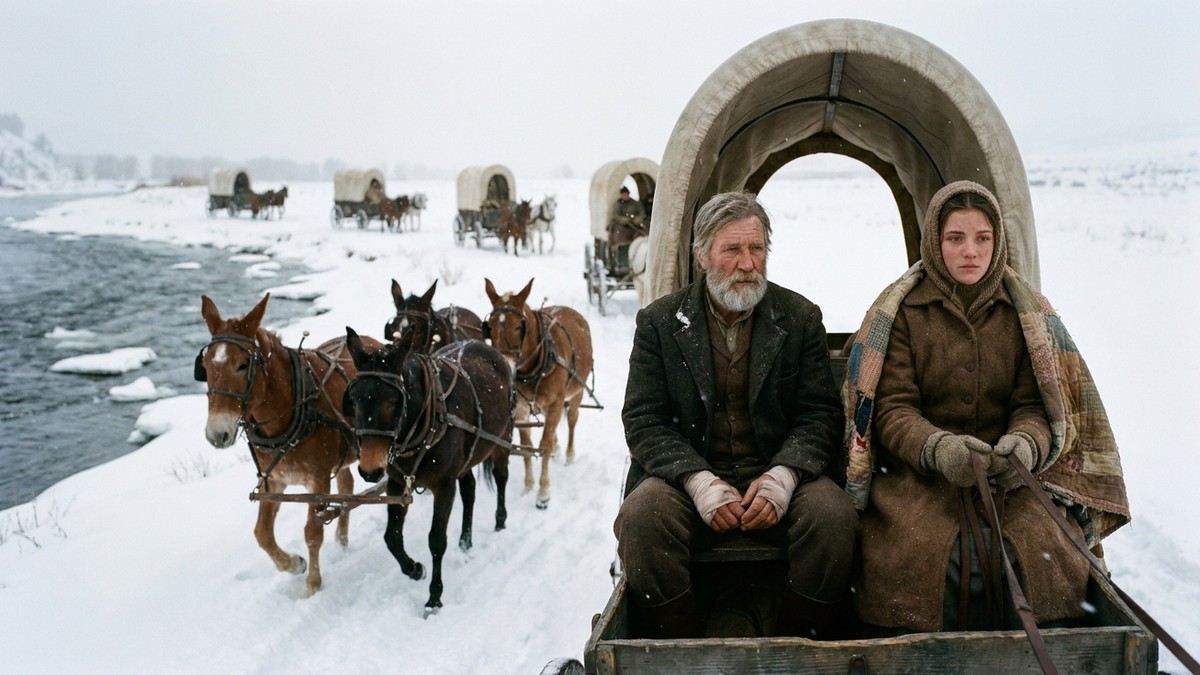
At the Green River, with snow to the axles, the men in Abby Rand's rescue party voted to turn their wagons around and go home.
It was the eighth of November, 1856, in the high, frozen country of what would one day be Wyoming. Somewhere out ahead of them, three hundred miles east of Salt Lake City, two companies of emigrants pulling handcarts had been caught on the trail by early snow. A thousand people, more or less. English and Welsh and Scottish converts, mostly, who had crossed an ocean and half a continent on foot, pushing and pulling their belongings in little wooden carts, to reach the valley before winter.
Winter had reached them first.
Abby was seventeen. She was not supposed to be there.
Her father, Jonah Rand, was a teamster, fifty-two, with a voice like a gravel road and hands like shovels. When the call had gone out from the pulpit in Salt Lake in October for men and teams and wagons to go east with flour, he had gone with the first wave, and come back, and loaded up again. And this time, because his hands had been frostbitten on the first trip and he could not grip the lines for long, Abby had come along to drive.
Her mother had cried. Abby had gone anyway. She could drive four mules as well as any boy in the ward, and everybody knew it.
There were five wagons in their little party. Four hundred pounds of flour in each. Blankets. Quilts. Onions. And five men, and Abby.
At the Green River, the men stopped.
They built a fire on the bank. The river was black and choked with ice. The wind came down off the snowfields like knives. And for most of an evening, while Abby sat in the wagon with the quilts around her and listened, the men argued.
"We've had no word in eleven days," said Brother Elam Pike. He was the captain of their party, a big, careful, decent man, with a gray beard frozen into a single lump. "Not a rider. Not a message. The first rescuers found the Willie company three weeks ago. The others may have found the Martin company too. Or the Martin company has gone into winter quarters at Fort Laramie. Or..." He stopped. "Or they're past helping. Any way it falls, five wagons on this side of South Pass won't change it."
"And if they're out there?" said Abby's father. "Waiting?"
Elam Pike looked into the fire.
"Jonah," he said, "I have a wife and five children in the valley. So do most of us here. If our teams die out on the Sweetwater, there'll be no plowing in the spring, and our own will go hungry. I'm not a coward. But I can count. We go back to Fort Bridger and wait for word."
The other men nodded, one after another.
Abby's father did not nod. He sat with his ruined hands spread to the fire and said nothing at all.
They turned the wagons in the morning.
Four of them. The fifth wagon, Jonah Rand's, stood on the riverbank with its mules hitched and its nose still pointing east.
Elam Pike walked back to it through the snow.
"Jonah," he said gently. "Come on. You can't drive alone. Not with those hands."
"I know it," said her father.
Abby climbed down from the wagon seat. She walked around to the front, to the lead mules, Bess and Shadrach, and checked their harness, the way her father had taught her, buckle by buckle. Her hands were shaking. She did not let them show.
Then she climbed back up onto the seat, and took the lines in her mittened hands, and gathered them up.
"He's not alone, Brother Pike," she said.
The men stared at her. Her father turned around on the seat.
"Abby," he said. "No."
"You said it yourself, Pa. If they're out there. Waiting." Her voice cracked and she let it. "Somebody has to go and see."
They crossed the Green on the ice, at a ford the men had tested with poles, the mules sliding and snorting, the wagon groaning under its flour.
Then they went east. Alone. One wagon, four mules, a man who could not hold the lines, and a girl of seventeen.
The snow got deeper. Past the Big Sandy, it was over the wheel hubs. At night it was so cold that the flour froze in the sacks and the mules' breath froze in white beards on their muzzles, and Abby and her father slept under the wagon in every quilt they had, back to back, and did not sleep.
They went up over South Pass in a ground blizzard, with the wind blowing the snow along the ground so thick she could not see Bess's ears. She walked at the leaders' heads half the day, leading them, because she could not see the trail from the seat.
On the far side, they came down to the Sweetwater.
And there, on the fourteenth of November, in the gray late afternoon, under a cutbank in a little side draw off the river, Abby saw a thin line of smoke.
Somebody was alive out here.
She stopped the mules and stood up on the wagon seat in the wind, staring at it. And then, under the smoke, against the white snow, she saw the dark shape of a single overturned handcart.