Part 2
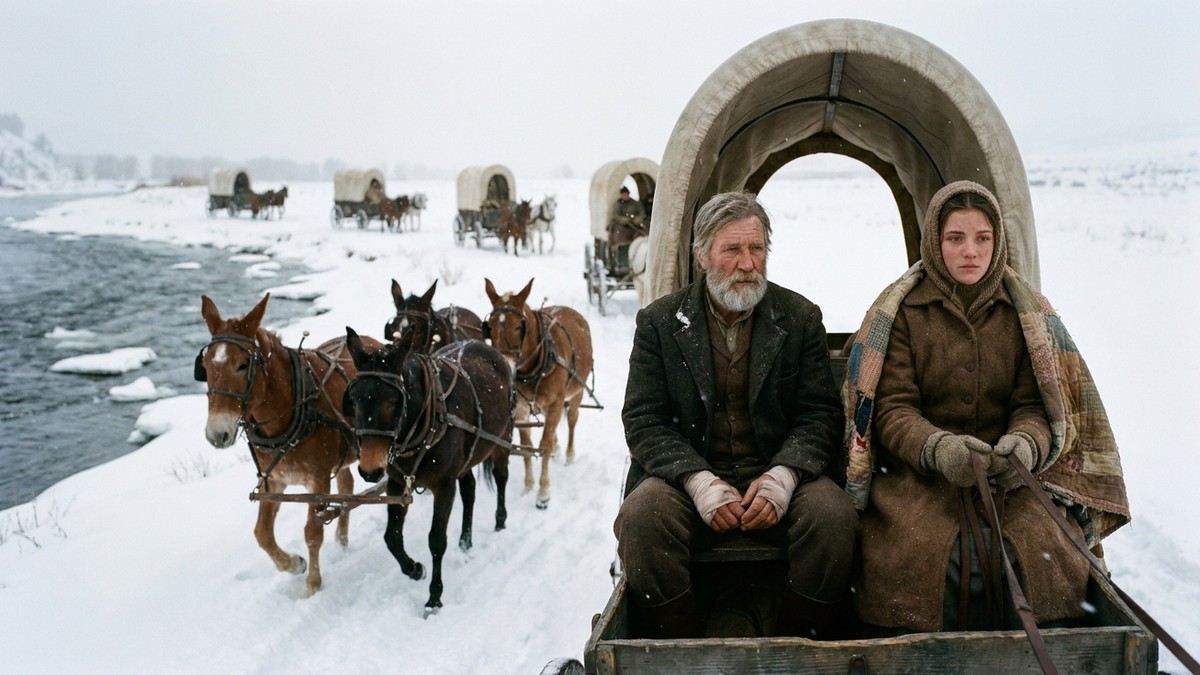
Abby was off the wagon seat before the mules had stopped.
She floundered through the snow to her knees, then her waist, down into the little draw, toward the smoke. Behind her she heard her father shouting her name. She did not stop.
Under the cutbank, out of the wind, someone had turned a handcart on its side to make a wall. Over it was stretched a patched gray quilt, pegged to the frozen ground with sticks. In front of it, a tiny fire of sagebrush smoldered in a ring of stones.
And under the quilt, in a heap of shawls and blankets, there were people.
A face looked up at her out of the heap. A woman's face, thin and gray and very old, with a black knitted cap pulled down over her ears, and blue eyes that looked straight at Abby without the least surprise.
"Well," said the woman, in a soft English voice. "I did tell them you'd come."
Her name was Ann Whitlock. She was fifty-eight, a widow, from a village in Bedfordshire. She had been a laundress in England. She had crossed the ocean on the ship Horizon with the Martin company, and pulled a handcart a thousand miles from Iowa City.
Under the quilt with her were four children. None of them were hers.
Two little girls, twins, six years old, Lucy and Mary Hollins. A boy of nine, Robert Shaw, with frostbitten fingers wrapped in rags. And a baby girl of two, Ellen, asleep against Ann Whitlock's chest inside her shawl.
Their parents had not come through the snows on the Sweetwater. Ann said it quietly, with her hand on the baby's head, so the older children would not have to hear it said again.
"When the company went on to the cove," she said, "these four couldn't walk, and I couldn't carry them, and I couldn't leave them. So we stopped. The others said a wagon would come back for us." She looked at Abby. "That was nine days ago."
"Nine days," whispered Abby. "How?"
Ann Whitlock pointed at the handcart.
It had been a box on two wheels. Now there was almost no box left. Only the wheels, the axle, the handle, and a few boards.
"A board a day," said Ann. "I burned the sides first, and then the bottom. Two ounces of flour a day for each of us, and none for me after the fourth day, and the children in the middle of the heap, turn and turn about, so no one was on the outside all night." She smiled, a very little. "And we sang. Every hymn I know, twice over. When the hymns ran out I taught them nursery rhymes. Mary can say all of 'The House That Jack Built' now. Can't you, Mary?"
The twin nodded solemnly.
"I had two boards left," said Ann Whitlock. "I thought perhaps tomorrow."
Abby's father came down into the draw then, stumbling, and saw them, and went down on his knees in the snow.
They worked fast.
Abby built up the fire with sagebrush and the last of the handcart boards, and her father held the children against him inside his buffalo coat, one at a time, with his useless hands. Abby boiled flour and water into a thin gruel, the way her mother made it for sick babies, and fed it to them by spoonfuls. Not too much. Not too fast. Ann Whitlock told her exactly how much, and she listened.
When the children were in the wagon, under every quilt from the flour sacks, Ann Whitlock caught Abby's sleeve.
"There are two more families," she said. "In the next draw east. The Pughs and the Lewises. Welsh. I walked over to them every morning with a coal from the fire, until three days ago, when my feet wouldn't go." She held on to Abby's sleeve. "You must go and look. Before dark."
Abby went.
She found them in the next draw, as Ann had said. Seven people under two carts. Weak, frozen, starving. Alive.
They started west the next morning with a wagon full of people and the mules straining.
On the fourth day, west of South Pass, near the Big Sandy, they saw wagons coming toward them through the snow from the west.
Four wagons. Elam Pike was driving the first.
He pulled up beside Jonah Rand's wagon and stared at it. At Abby on the seat with the lines in her hands. At the faces under the quilts behind her. At Ann Whitlock, with the baby in her shawl.
"We met riders at Bridger," he said hoarsely. "Brother Brigham sent them. Said any party that turned back was to turn right around and go on until the last company was found." He looked at the children. "We were coming."
"I know it," said Abby's father.
Elam Pike climbed down from his wagon. He walked around to the back of the Rand wagon and held out his arms.
"Give me some of them," he said. "You're overloaded. Your mules won't make it to Bridger."
They split the people among the five wagons. Elam Pike took the four children. He drove all the way to Salt Lake with Robert Shaw on the seat beside him, wrapped in his own coat, teaching the boy to hold the lines.
They came down Emigration Canyon into the valley on the last day of November, in a gray snowfall, with the lights of Salt Lake City coming on below them one by one.
Abby drove the lead wagon. Her father sat beside her. In the back, under the quilts, Ann Whitlock was singing, very softly, in her thin English voice, to the baby asleep in her shawl.
Come, come, ye Saints, no toil nor labor fear.
Abby knew the words. Everyone in the valley knew them. She sang the last line with her, under her breath, as the wagon rolled down out of the snow.
All is well. All is well.