Part 1
For eleven years, Phoebe Lane had kept a rowboat in her yard on Fourth Street, and for eleven years Sacramento had laughed at it.
It was January 1862, in Sacramento, California, the new state capital, a city of wooden houses and brick stores built flat on the low ground where the American River ran into the Sacramento. It had been raining since the ninth of December. Not ordinary rain. A gray, steady, endless downpour, day after day, week after week, until the rivers ran brown and high against the levees and the whole valley was soaked like a sponge.
Phoebe was fifty-seven. A widow, a free Black woman from Ohio who had come west in 1850 with her husband, Isaiah, and had taken in washing ever since. She had a narrow two-story frame house on Fourth Street, three washtubs, two copper boilers, a mangle, and a list of customers that ran from the Orleans Hotel to the governor's own housekeeper.
And she had the boat.
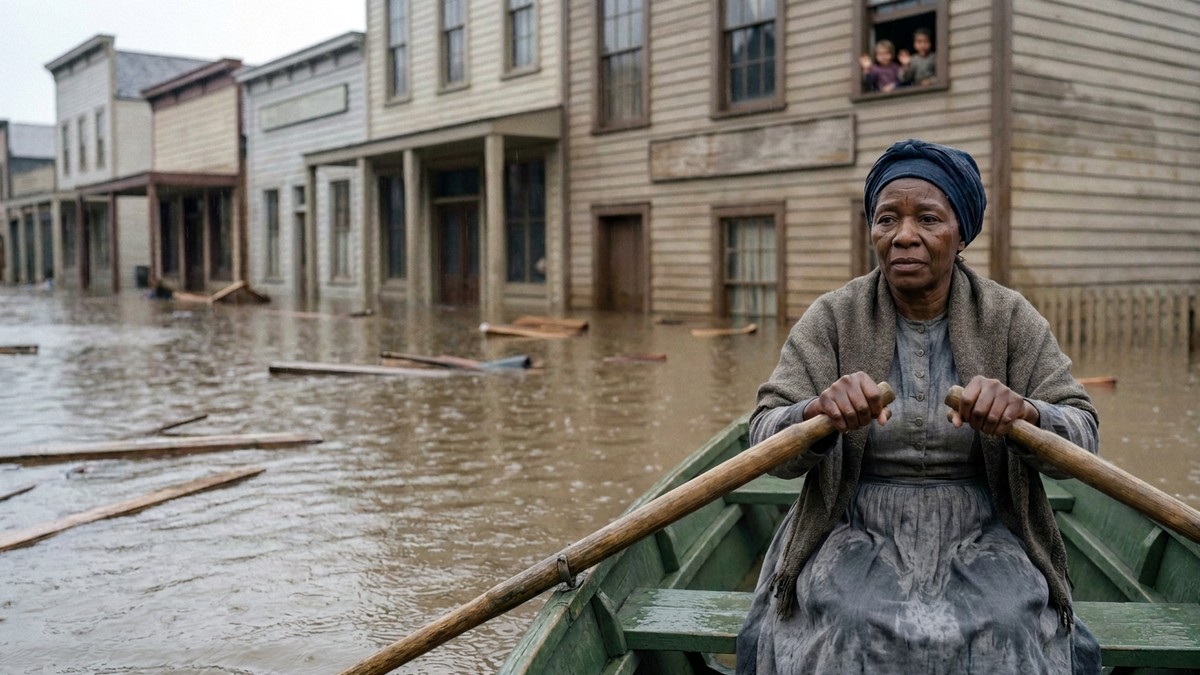
It sat in the side yard on two sawhorses, upside down, with a canvas over it. A heavy, flat-bottomed skiff, fourteen feet long, painted green, with two pairs of oars lashed underneath. Isaiah had built it with his own hands in the spring of 1851.
He had been a boatman on the Ohio River as a young man, and he had seen the flood of 1850 come through Sacramento the first winter they were there. He had stood on the roof of a store on J Street with Phoebe beside him, holding her hand, watching the water rise, and he had said, "Never again, Phoebe. Never again without a boat."
The water came back in 1853. Isaiah rowed out in the green skiff and brought in four families.
Isaiah had been dead since '58. Phoebe kept the boat. She tarred the seams every fall. She oiled the oarlocks. She turned it over every spring to let it air.
"Mrs. Lane's ark," the neighbors called it. "Waiting for the forty days." Children knocked on the bottom of it on their way past, and called out, "Is Noah home?"
Phoebe let them laugh. She had heard worse things called after her in her life than Noah.
In November, before the rains, she had gone to the bank.
It was the Sacramento Savings and Exchange, a brick building on Front Street with iron shutters and a marble floor. She had put on her good black silk and her best bonnet and carried her account book in her reticule, and asked to see Mr. Everett Hale.
Mr. Hale was the cashier. A thin, neat, gray man of sixty, with spectacles on a gold chain. He listened politely while she explained. The lot next to her house was for sale. Four hundred dollars. She wanted to build a proper wash house there, with a brick floor and a boiler room, and hire two girls. She had two hundred dollars saved, in this very bank. She needed to borrow the rest. She would pay it back in two years. Her customers would vouch for her.
Mr. Hale turned the pages of her account book one by one. Then he closed it and gave it back.
"Mrs. Lane," he said, "I'm afraid the bank cannot make the loan."
"May I ask why, sir?"
He took off his spectacles and polished them.
"This bank lends against property and against security, Mrs. Lane," he said. "A laundry is not security. It is soap and water and a woman's two hands, and hands can sicken. If I lent on every honest widow's two hands in this city, the directors would have my position by spring." He put his spectacles back on. "And there are some of the directors who would object to the loan for other reasons, which I will not repeat. I'm sorry. That is the truth."
Phoebe stood up. She thanked him for his time. She walked out across the marble floor with her back very straight.
At least he had told her the truth. She would give him that.
On the ninth of January, 1862, the levee broke.
It went in the night, east of town, on the American River side. Phoebe woke at three in the morning to a sound like wind, and a different smell in the air, cold and muddy, and when she went to the window with a candle, Fourth Street was a river.
The water came up the steps. It came in under the door. By dawn it was in the ground floor of every house on the street, brown and cold, full of sticks and barrels and dead chickens, and still rising. People were shouting from upstairs windows. A cow went by, swimming. A whole wooden sidewalk floated past, turning slowly.
Phoebe stood on her stairs in her nightgown and looked down into her own front room, where the water was up to the seats of the chairs.
Then she went out the upstairs back window, onto the shed roof, in the rain, and looked down into the side yard.
The green skiff was floating. It had lifted right off its sawhorses, still upside down, and was bumping gently against the fence, tied by the long line Isaiah had always kept on it, just for this.
Phoebe Lane hitched up her nightgown, and tied her shawl around her waist, and climbed down off the shed roof into the cold brown water to turn it over.