Part 2
It took her a quarter of an hour to turn the boat over.
The water was to her chest, and so cold it took her breath, and the skiff was heavy and slick with rain. She got her shoulder under the gunwale and heaved, and slipped, and went under, and came up spitting mud, and heaved again. On the fourth try it rolled over with a great slap and sat right side up on the water, rocking, with the oars still lashed under the seats where Isaiah had always kept them.
Phoebe dragged herself over the side and lay in the bottom of it, gasping, in her soaked nightgown.
Then she sat up, and untied the oars, and fitted them in the oarlocks.
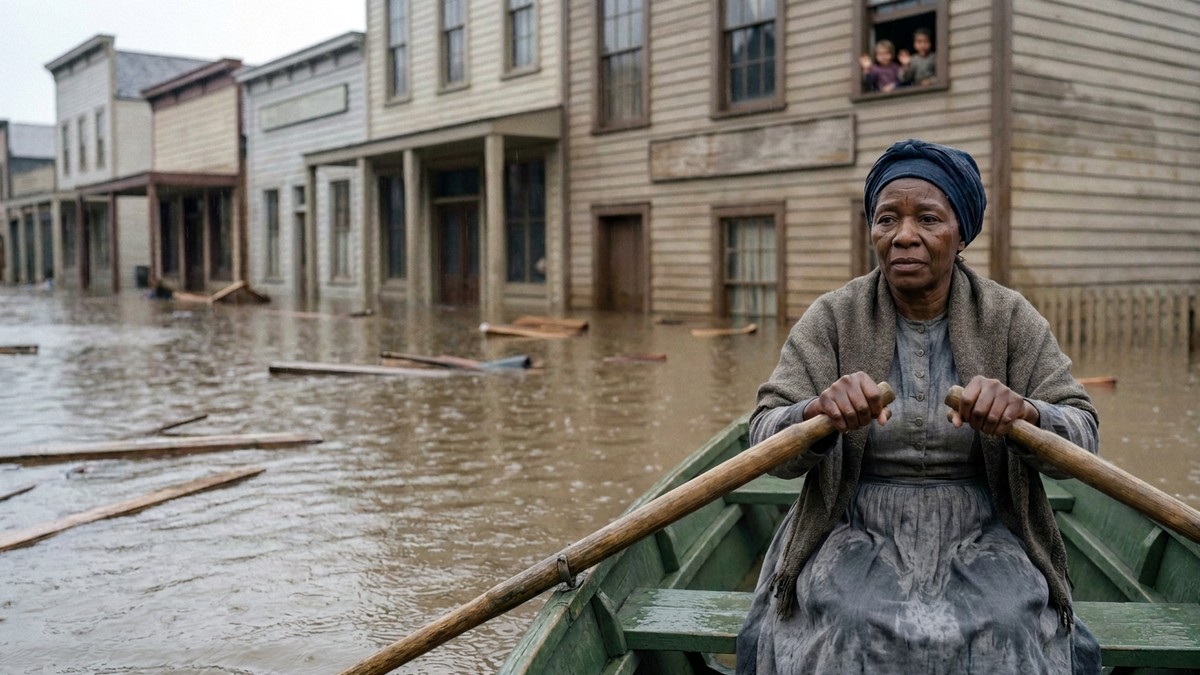
From the upstairs window across the street, the Murphy children were watching her with their mouths open. The same children who had knocked on the bottom of her boat all summer and asked if Noah was home.
"Well," Phoebe called to them across the water. "Noah's home. Get your mama and get your shoes."
She rowed for six days.
The water kept rising. By the second day it was over the windowsills of the ground floors. By the third it was lapping at the second stories all down Fourth Street, and Fifth, and Sixth, and the whole low part of the city was a brown lake with roofs and chimneys sticking out of it. Houses that had been knocked off their foundations floated slowly down the streets with lamps still burning in their upper windows.
Phoebe rowed from one to the next.
She took people off porches, out of windows, off roofs. Mothers with babies. Old men. A family of nine Germans, two trips. A blind piano tuner and his piano stool, which he would not leave. She rowed them to the brick church on Seventh Street, where the second floor stayed dry and the ladies had set up kettles and blankets, and then she rowed back for more.
On the second morning she passed a fine new boat with a crowd of gentlemen in tall hats in it, being rowed toward the Capitol. Somebody said it was the new governor going to be sworn in. Phoebe did not stop to look. She had a woman with twins in the bow.
At night she slept on her own upstairs floor in wet blankets, three hours at a time. Then she got up in the dark and went out again, because people were still calling from the roofs.
She kept count on a piece of string. A knot for every soul. By the sixth day it had forty-one knots.
On the morning of the sixth day, rowing back through the cold drizzle along what had been H Street, near the slough, she heard someone calling from a rooftop. A thin, hoarse voice. A man's.
She turned the skiff and pulled toward it.
It was a fine two-story house with a widow's walk on the roof, half sunk in the brown water. On the ridgepole, wrapped in a soaked wool blanket, without his hat, without his spectacles, sat Mr. Everett Hale of the Sacramento Savings and Exchange.
He had been there two days, he told her later. His housekeeper had gone to her sister's before the levee broke. He had stayed to guard the silver. When the water came into the second floor he had climbed out the dormer onto the roof with a blanket and a loaf of bread, and the bread had run out yesterday.
He knew her at once. She saw it in his face.
Phoebe brought the skiff alongside the roof, and shipped her oars, and held up her hand to him.
"Come on down, Mr. Hale," she said. "Mind the gutter. It's loose."
He came down. Clumsily, shaking, half falling into the bottom of the boat. She caught him by the arm and steadied him on the seat and wrapped Isaiah's old oilskin coat around his shoulders. Then she took up the oars and turned for the church on Seventh Street.
She did not say anything else.
They had gone three blocks before he spoke.
"Mrs. Lane," he said. His teeth were chattering. "You know who I am."
"I do, Mr. Hale."
"You came to my bank in November. And I refused you."
"You did."
He sat huddled in the oilskin, watching her row. The steady pull and lift of the oars. The water running off the blades.
"You haven't said one word about it," he said.
"You were sitting on a roof, Mr. Hale," said Phoebe Lane. "It didn't seem the time."
The water went down slowly, through January and February. Sacramento came out of it gray with mud to the second floors, and stinking, and broke. The legislature went to San Francisco for the rest of the session. Half the city shoveled mud for a month.
In March, when the streets were dry enough to walk on, a clerk from the Sacramento Savings and Exchange came to Phoebe's door on Fourth Street with an envelope.
Inside was a loan agreement for two hundred dollars, at six percent, two years, against the lot next door. And under the bank's signature, in a thin, neat hand, there was a second signature, as personal guarantor.
Everett Hale.
There was a note folded in with it.
Mrs. Lane. I told you a laundry was only a woman's two hands. I was wrong about what two hands can do. The directors may say what they like. E. H.
She built the wash house that summer, with a brick floor and a boiler room, and hired two girls, and paid off the loan in nineteen months.
The green skiff she did not put back on its sawhorses. She hung it from the rafters of the new wash house, right side up, with the oars lashed underneath and the long line coiled in the bow, where everyone who came in could see it.
The Murphy children still called it Mrs. Lane's ark. But they did not knock on it anymore. They took their hats off when they passed.