Part 1
Every morning in the snow camp, Kathleen Mulry watched the Chinese cook boil water, and every morning the Irish crew laughed at him.
It was December 1866, high in the Sierra Nevada of California, near the summit where the Central Pacific Railroad was blasting its tunnels through solid granite. That winter would bring forty-four storms. The snow at the summit lay eighteen feet deep. The crews lived and worked in long tunnels dug under the snow, lit by lanterns, between the camps and the rock faces, and in the deep blue cold above them the drifts grew higher every week.
Kathleen was fifty-nine. She had come up the mountain in the spring with her husband, Michael, who was the cook for an Irish crew of forty men. In September, Michael's heart had stopped one evening while he was rolling out biscuits. They buried him at Cisco. The crew boss asked Kathleen to stay on and cook, at Michael's wages.
She had nowhere else to go. She stayed.
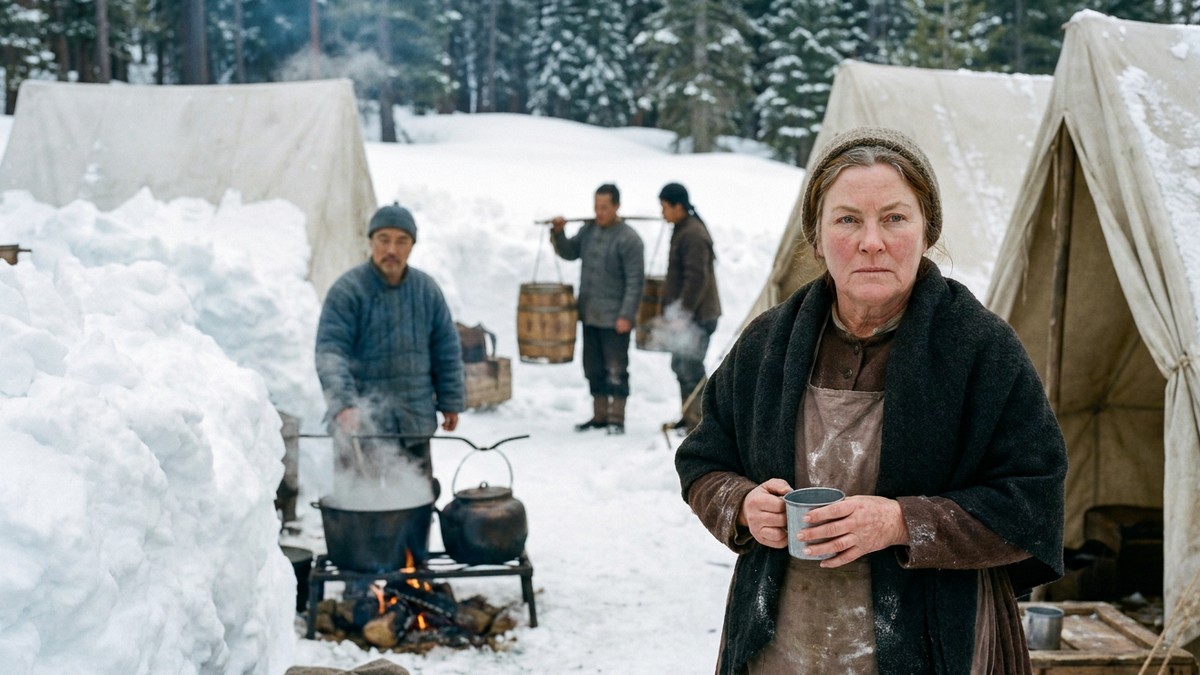
Her cook tent stood at the end of the Irish camp, where the snow tunnel opened into a long cave dug out of the drift. Twenty yards farther on, across a little open space where the snow had been trodden flat, was the Chinese camp.
There were several hundred Chinese workers on that stretch of the line. They did most of the heavy work in the tunnels, the drilling and the blasting and the hauling, and they kept to themselves, and ate their own food, which they bought from their own stores and cooked themselves.
Their cook was a man named Lim Sang.
He was about Kathleen's age, small and quick and very neat, with a long gray queue down his back and a padded blue jacket. Every morning before dawn, while she was still lighting her stove, she could see him across the trodden snow, filling great iron kettles from the barrels and setting them over his fire.
Boiling water. Every morning, every noon, every night. Kettle after kettle. He made it into tea and filled wooden barrels with it, and sent it out to the men in the tunnels on shoulder poles, two barrels at a time, and they drank nothing else all day.
The Irish crew drank from the creek.
"Look at him," said the foreman, Hiram Stokes, at breakfast, pointing with his fork. "Stewing leaves again. All day long. Like an old woman."
The men laughed. Stokes was a big, hard, red-bearded man from Boston, with a voice that could carry the length of a tunnel over the drills. He was not a cruel man, Kathleen thought. Only loud, and very sure.
"A man wants a drink of water," he said, "he goes to the creek. That snowmelt's the cleanest water God ever made. They're wasting wood and time and good water on stewed weeds."
Kathleen poured his coffee and said nothing.
But she watched.
She watched Lim Sang's kettles, and she watched the creek. The creek ran down past both camps from the snowfields above, through a little gully just below the latrine trenches of the Irish camp. In the summer, Michael had said it was fine. In the winter, with forty men living packed in the snow tunnels and the trenches frozen solid, she was less sure.
She noticed one other thing too. She noticed which men came to her tent with bellies cramping, and which men did not. Since November, eight of her forty had been down sick with the flux at one time or another. She had not heard of a single man in Lim Sang's camp who had.
One morning in mid-December she walked across the trodden snow to the Chinese cook fire.
Lim Sang looked up from his kettles. The men around his fire went quiet. Irish women did not come to the Chinese camp.
Kathleen held out a tin cup.
"Would you spare me a cup of your tea, Mr. Lim?" she said. "I'd like to taste it."
He studied her face. Then he took the cup, and filled it from the nearest kettle, and handed it back.
It was green and hot and a little bitter. Not unpleasant.
"Why do you boil it?" she asked. "All of it. Every drop."
Lim Sang spoke English carefully, the English of a man who had worked in San Francisco for ten years.
"My grandfather was a doctor in Taishan," he said. "He said, never drink water that has not been boiled. Where many men live together, the water carries sickness. Boiled water does not." He nodded across at the Irish camp, at the gully. "Your men drink from below the trenches."
Kathleen looked down into her cup.
"Thank you, Mr. Lim," she said.
She went back across the snow and thought about it all that day.
She thought about asking Hiram Stokes for more wood. She thought about what he would say. She thought about forty men laughing at the Irish cook's widow stewing leaves like the Chinese, and she thought about her own pride, which was considerable, and she did not ask.
She told herself she would ask after Christmas.
On the twenty-eighth of December, a man named Pat Kinnane came off his shift with a fever and a terrible cramping in his belly, and went to his bunk in the snow tunnel, and did not get up.
By the second of January there were six of them. By the fifth, there were fourteen. Burning with fever, out of their heads, too weak to lift a cup. Camp fever, the men called it. Kathleen had seen it before, in the famine years in Mayo, in the fever sheds. She knew what it could do in a crowded place.
On the morning of the sixth of January, they carried Hiram Stokes into her cook tent on a plank, gray-faced and shaking, and laid him down by her stove.
"Water," he whispered. His lips were cracked. "For God's sake, Mrs. Mulry. A drink of water."
One of the men was already holding out a dipper, full to the brim, fresh from the creek.