Part 2
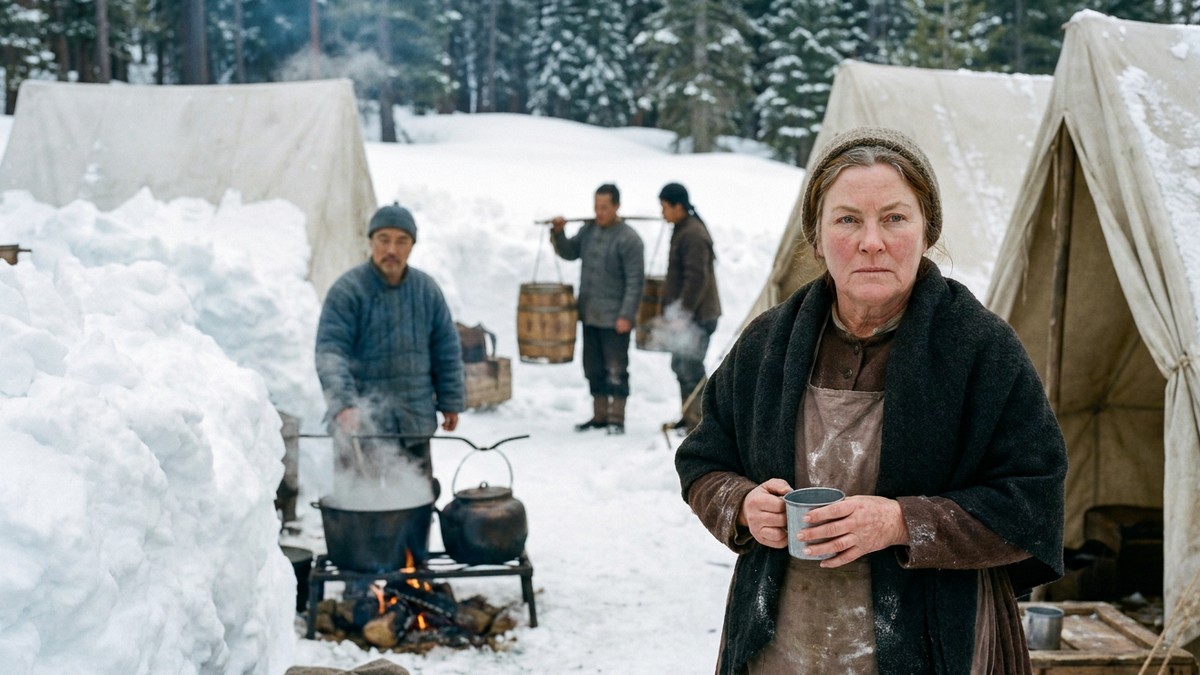
Kathleen Mulry knocked the dipper out of the man's hand.
It flew across the tent and splashed against the canvas wall. The man stared at her. So did everyone.
"Not from the creek," she said. "Not one more drop. Not for him, not for any of them."
"Mrs. Mulry, he's dying of thirst..."
"He'll not die of thirst. He'll drink what I give him." She was already pulling her biggest kettle onto the stove. "Get me snow. From above the camp, mind, from the top of the drift, not from the trench side. Fill every pot I've got. And somebody run for more wood."
"Run," said Kathleen Mulry, in the voice she had used on forty men for three months, and two of them ran.
She did not have enough kettles. She did not have enough fire. Fourteen sick men drank more water in a day than her one stove could boil, and the well men had to drink too.
So she walked across the trodden snow to the Chinese camp again.
Lim Sang was at his fire. He looked up and saw her face, and put down his ladle.
"The fever," he said.
"Fourteen," said Kathleen. "And the foreman this morning. I've been a proud, stupid woman, Mr. Lim. I watched you for a month and said nothing because I didn't want forty men laughing at me. Now I've fourteen men in their bunks." She swallowed. "I need kettles. And I need you to tell me everything your grandfather said."
Lim Sang looked at her for a moment. Then he turned and spoke quickly in Cantonese to the young man beside him, his helper, who nodded and ran.
He came back in ten minutes with two of his own big iron kettles on a shoulder pole, and a sack of tea, and a sack of rice.
For three weeks, the two of them fought the fever together.
Lim Sang showed her what his grandfather had taught. Boil every drop, a full boil, not just warm. Drink it as tea, or as rice water, the thin broth from boiling rice, which the sick could keep down when they could keep nothing else. Wash the cups in boiling water. Keep the sick men apart from the well. Burn the bedding. Dig the new latrine trenches far downhill, below where anyone drew water.
And the water for the Irish camp would come from the top of the drift, or from the spring above the Chinese camp, never from the gully again.
Kathleen did all of it. She boiled water day and night, on her stove and on Lim Sang's kettles over a second fire outside the tent. She sat by the bunks in the snow tunnels with a lantern and spooned rice water into men too weak to lift their heads. She sent the well men to haul snow and wood, and they went, because nobody laughed at boiled water anymore.
Lim Sang came every evening after his own men were fed. He did not say much. He looked at each sick man, and felt the heat of his forehead, and told Kathleen which ones were turning the corner and which ones she must watch through the night.
He was almost always right.
Hiram Stokes lay by her stove for eleven days.
He was out of his head for most of them. He talked about Boston. He talked about his mother. Once, deep in the night, he opened his eyes and saw Lim Sang bending over him with a cup of rice water, and tried to push it away, and Kathleen held his hand down and said, "Drink it, Hiram. He's keeping you alive." And Stokes looked at her, and at the small gray-haired man with the cup, and drank.
On the twelfth day his fever broke.
Of the fourteen men who took the camp fever that January, twelve walked out of the snow tunnels in the spring. Kathleen grieved for the two they buried at Cisco, beside her Michael. She knew she would grieve for them a long time. She knew why they had died, and that it might have been different if she had walked across the snow in November instead of December.
But twelve lived. And not one more man in the Irish camp took the fever that winter, after the first week of boiled water.
At the end of January, on a clear, bitter evening, Hiram Stokes was strong enough to stand.
He put on his coat. He asked Kathleen for a tin cup. And then, while forty Irishmen watched from the mouth of the snow tunnel in silence, the foreman walked across the trodden snow to the Chinese cook fire, slowly, leaning on a shovel for a cane.
Lim Sang looked up from his kettles.
Hiram Stokes held out the tin cup.
"Mr. Lim," he said, loud enough for the whole camp to hear, in the voice that could carry the length of a tunnel. "I called your tea stewed weeds. In front of my men. I was wrong, and I'm alive because of it, and so are eleven of my crew." He held the cup out steady. "I'd take it as a favor if you'd fill this."
Lim Sang took the cup. He filled it from the kettle. He handed it back.
Hiram Stokes drank it down, hot and green and bitter, standing in the snow in front of both camps. Then he took off his hat.
The next morning, there were four new iron kettles in the Irish cook tent, and a woodpile twice as high as before, which the foreman had ordered cut himself. And on the board by the door where the crew boss posted the day's orders, in Stokes's own big hand, there was a new line.
All water boiled. By order. Lim Sang's rule.