Part 1
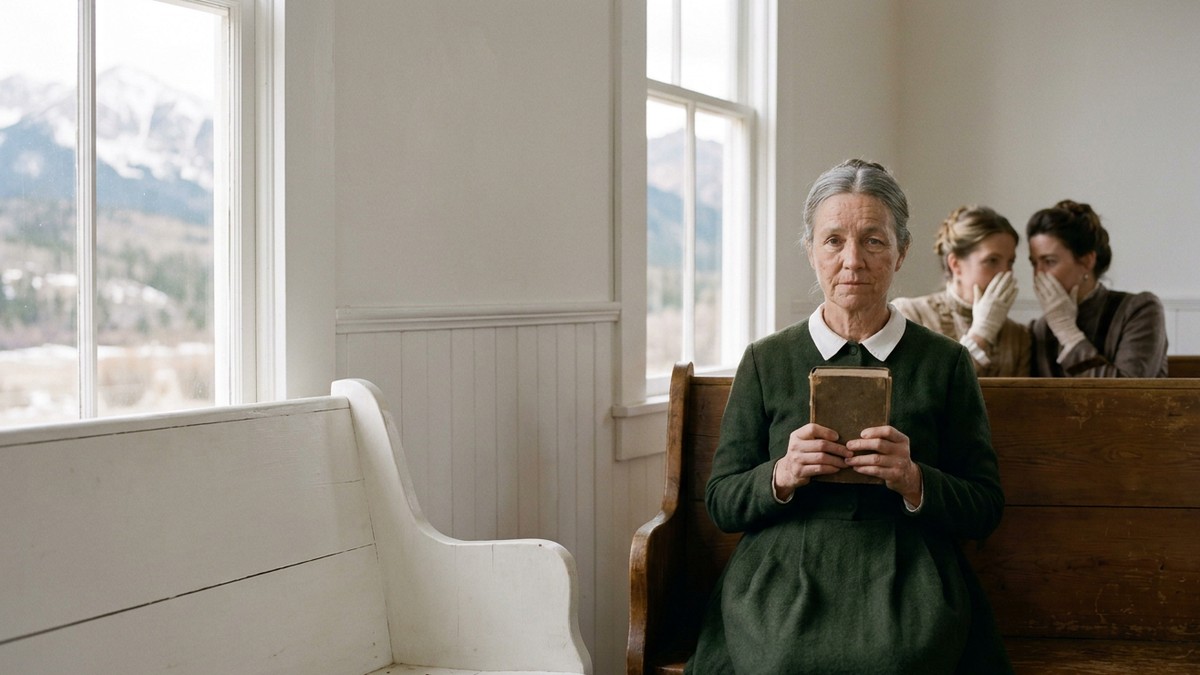
The church ladies of Silver Bell always left an empty space on the pew beside Thankful Gage, as if her face might rub off.
It was the spring of 1882, in Silver Bell, Colorado, a mining camp of two thousand people high in the San Juan Mountains, with a main street of false-fronted stores, a stamp mill, a schoolhouse, and one white frame church with a bell from St. Louis. Thankful was sixty-one. A widow. She kept a small house at the top of Ruby Street and took in sewing, and every Sunday she sat in the fourth pew on the left, alone.
Her face was the reason.
She had taken the smallpox at nineteen, in Vermont, in 1840. It had killed her mother and her two little sisters in the same week. Thankful had lived. But it had left her face pitted from brow to chin, deep pockmarks like a field after hail, and one eyelid that never quite opened all the way.
She had been looked at like that for forty-two years. She was used to it. Mostly.
The leader of the church ladies was Mrs. Adeline Starr.
Mrs. Starr was the wife of the mine superintendent, handsome and well dressed and certain of everything, with a voice that carried. She ran the Ladies' Aid. She ran the church suppers. She ran the Christmas program and the Fourth of July picnic, and she decided, without ever saying so, who sat where.
"I don't say she's not a good woman," Thankful heard her tell the minister's wife once, on the church steps, not quite quietly enough. "I'm sure she is. But the children are frightened of her face. My Lucy had nightmares after the picnic. A woman like that ought to have the decency to sit at the back."
Thankful had walked home that day without stopping. She did not move to the back. But she sat a little straighter in the fourth pew after that, and she did not go to the church suppers anymore.
There was one person in Silver Bell who did not mind her face.
That was old Dr. Ruggles, who had been a surgeon in the war and had seen every kind of face there was. He came to Thankful every month or so with his shirts to be mended, and stayed for coffee, and talked to her like a person.
"You know, Mrs. Gage," he said once, stirring his coffee, "you're the safest woman in this town."
"Safe from what, Doctor?"
"Smallpox," said Dr. Ruggles. "You've had it. You can't take it again. Not ever. Not if you nursed a hundred cases." He sipped his coffee. "I've been after this town to be vaccinated for two years. Half of them won't hear of it. They say it's poison, or it's against God, or it's for city folk. One of these days a man will walk in off the stage with a fever, and then they'll listen."
Thankful thought about that after he left. Safe. Nobody had ever called her face safe before.
The man walked in off the stage on the eighteenth of May.
He was a young teamster from Durango, flushed and aching, who took a bed at the Miner's Rest boardinghouse and asked for a doctor. By the time Dr. Ruggles saw him the next morning, the spots had begun.
Within a week there were five cases. Within two, there were nineteen.
Silver Bell went mad with fear.
The town council voted to open a pest house: an old log cabin a half mile up the gulch, above the town, where the sick could be kept apart. Dr. Ruggles begged them to send for vaccine from Denver, and this time, they did. But the vaccine would take ten days to come. And in the meantime, somebody had to nurse the sick in the pest house.
Nobody would.
The two women the council hired from the boardinghouse ran off the first night. A man who said he had had the smallpox as a boy lasted three days, and took a fever himself, and was carried down to the pest house as a patient. The minister prayed for volunteers from the pulpit. Not one hand went up.
People stopped going to church. They stopped going to the stores. They tied cloths over their mouths and crossed the street when anyone coughed.
On the first of June, Dr. Ruggles came to Thankful's door on Ruby Street.
He looked ten years older. He had not slept, he said, in four nights. He was the only one going up to the pest house, and there were twenty-three people in it now, and he could not doctor them and nurse them and cook for them and wash for them all at once.
"Two of them are children," he said. "One of them is Lucy Starr. Adeline Starr's girl. She went in yesterday." He took off his hat and turned it in his hands. "Mrs. Gage, I hate to ask it. But you're the only person in this town who can walk into that cabin and walk out again."
Thankful Gage stood in her doorway.
She thought about the empty space on the pew. She thought about Mrs. Starr's voice on the church steps. The decency to sit at the back. She thought about her mother and her sisters, in Vermont, in 1840, and the neighbors who would not come to the door.
Then she took off her sewing apron, and folded it, and laid it over the back of a chair.