Nora Sorensen signed the preliminary listing sheet on the broker's silver SUV before she even unlocked her father's front door.
"One million, one hundred and eighty thousand in wired funds, Nora," Brad Vance said, clicking his gold pen shut as October wind bent the grass along Road 34. "Prairie Horizon Ag Holdings wants all two hundred and forty acres. Once title clears this afternoon, our crew brings bulldozers November first to clear the house, barn, and cedar windbreak."
Nora pulled her camel wool coat tighter and glanced at her black leather ankle boots, dusted with gray limestone from the lane.
"Friday at four o'clock is my flight back to Denver," she said. "My condo mortgage payoff is due next week, and I don't want a second trip."
"Sign the site-entry guarantee here so our surveyor can stake the pivot line tomorrow," Brad said, tapping the clipboard. "Notice the five-thousand-dollar penalty if the seller cancels without a recorded title bar."
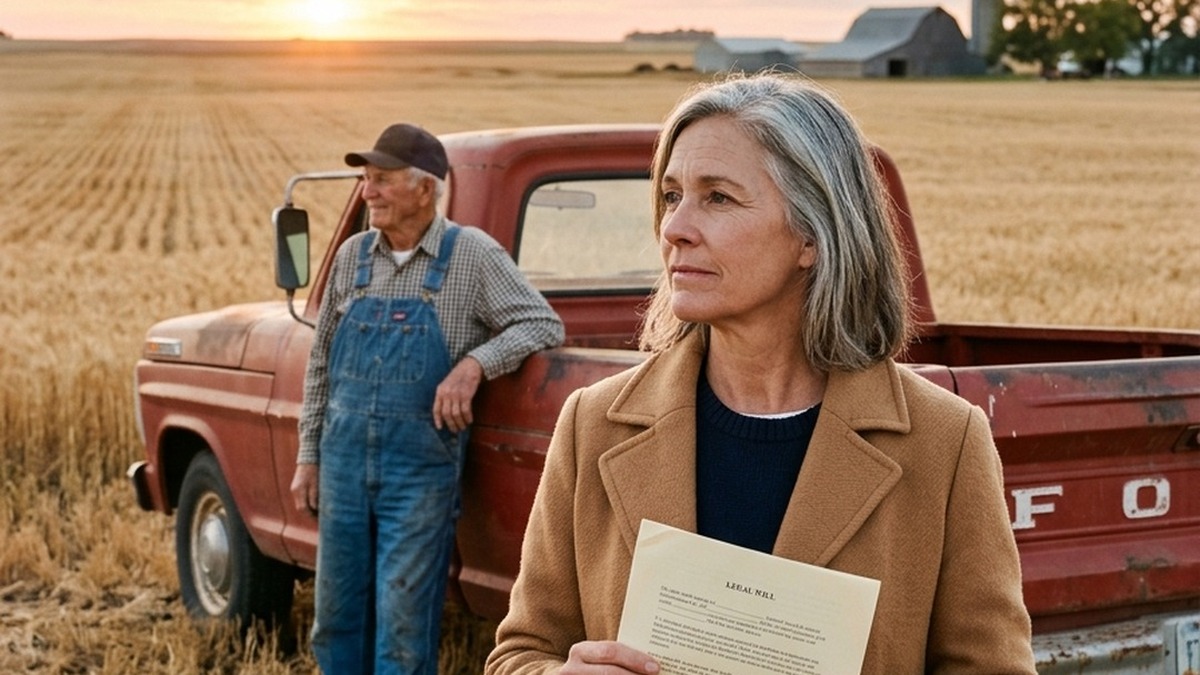
An old red 1996 Ford F-250 stopped by the mailbox. Otis Finch, seventy-four years old in faded denim overalls and a flannel shirt, stepped out with a brass key ring in his scarred hand.
Otis had farmed the neighboring quarter section for fifty years. He leaned on the truck door, his gray eyes taking in the realtor's sign post.
"Arthur Lindquist is reading Einar's will at two o'clock in Minden, Nora," Otis said calmly. "Let the ink dry on the probate copy before you invite a bulldozer into the yard."
"There's no mystery about what my father owned, Otis," Nora said, tapping her phone screen. "Two hundred and forty acres of dryland wheat and an eighty-year-old farmhouse. Prairie Horizon is paying cash, and I have a four o'clock flight to Denver on Friday."
Otis placed the brass farmhouse key ring into her palm.
"The ground freezes hard Thursday night," Otis said quietly. "Your dad had the grain drill greased in the shed. Don't sign anything else until two o'clock."
After both trucks left, Nora climbed the back steps into the mudroom.
The house smelled of cedar shavings and well water. On the mudroom shelf sat her father's brass soil thermometer and his black ledger, its cloth spine worn gray. She flipped to the last page.
*Oct 14, 2024: North ridge 44 degrees, dry at 2 inches. South forty subirrigated silt loam 52 degrees, four inches dark moisture above the Platte gravel shelf. Holds warmth twelve days past first frost.*
Setting the ledger down, she walked into the kitchen. A 2019 Minden Co-op calendar still hung on a nail beside the pantry door, five years out of date.
When she lifted it down, a cramped pencil note in the margin beside October 18 caught her eye: *Red truck bearings packed, 480 mi round trip, parked on 17th St at 5:10.*
Inside the cupboard door where the granary keys hung on brass hooks, her father had written in white chalk: *Bin 3: 30 sacks cleaned Turkey Red, 61 lb test weight, saved for Nora.*
She locked the back door and drove six miles into Minden.
At two o'clock, county attorney Arthur Lindquist sat behind his oak desk across from Nora, Otis Finch, and Brad Vance.
Arthur adjusted his wire-rimmed glasses and unfolded a four-page document inside a blue backing.
"Einar Sorensen executed this Last Will and First Codicil on November twelfth, 2021," Arthur said. "He named Otis Finch independent executor with quarterly verification authority."
Brad leaned forward. "We have a cash wire ready for Friday morning, Mr. Lindquist. If Nora signs the estate deed today, we can close in seventy-two hours."
"Nobody is closing on Friday, Mr. Vance," Arthur said evenly, turning to page two.
"Under Article Four of the Codicil, I devise my two hundred and forty acres in Kearney County, together with the residence, barns, windbreaks, and equipment, to my daughter, Nora Ellen Sorensen, subject to one condition precedent."
Nora's fingers tightened on her handbag strap.
"To take title," Arthur read, "my daughter must occupy the farmhouse for three hundred and sixty-five consecutive days, absenting herself no more than seven nights. No building may be razed, and she must personally plant one fall crop of winter wheat before the freeze and see it to harvest."
The corner radiator ticked once in the silence.
"And if I don't?" Nora asked, her voice tight. "I was laid off in Denver last month, Mr. Lindquist. What happens if I sell it now?"
"If you decline occupancy or fail to drill a fall crop before the freeze," Arthur said, "your interest forfeits, and the land transfers to the Nebraska Agricultural College Foundation as a research farm."
Brad stared at the blue backing. "She can't convey title for a year? And she has to plant fall wheat herself?"
"That is Nebraska law for a valid conditional devise," Arthur said, handing a cream-colored copy to Nora. "If fall wheat isn't in the dirt before the freeze, the foundation takes the deed."
Brad stood up, tapping the guarantee Nora had signed that morning.
"Then you either forfeit a million-dollar farm by Monday, Nora, or you owe my office five thousand dollars by Friday for signing that guarantee," Brad said, and walked out.
At sunset, Nora stood in her wool coat at the edge of the golden wheat stubble, the prairie wind whipping her silver-streaked hair across her collar. In her hands she held the cream-colored will and her father's brass key ring.
"Why would he trap me here for a year, Otis?" she asked as the sun dropped behind the cedars. "To punish me for staying in Denver?"
"Your dad didn't know how to punish a stray dog, Nora," Otis said softly. "You have forty-eight hours before Thursday night's twenty-degree front turns the topsoil to concrete. Sleep in the house tonight and decide in the morning."
The yard light hummed on as Otis's taillights faded down the lane.
By nine o'clock, the northwest wind rose to thirty miles an hour. The farmhouse furnace rattled twice, clicked, and went silent. The red failure light blinked on the hallway thermostat.
Within an hour the kitchen thermometer dropped to forty-eight degrees. Outside, freezing sleet tapped against the north glass.
Grabbing the chrome flashlight from the mudroom, Nora pulled on her coat and boots, fought the wind to the machinery barn, and slid the door open. Her beam swept across the red tractor and grain drill. There, on a wooden pallet beneath the loft ladder, sat thirty heavy burlap sacks tied with twine, a white tag wired to the center bag in her father's handwriting.