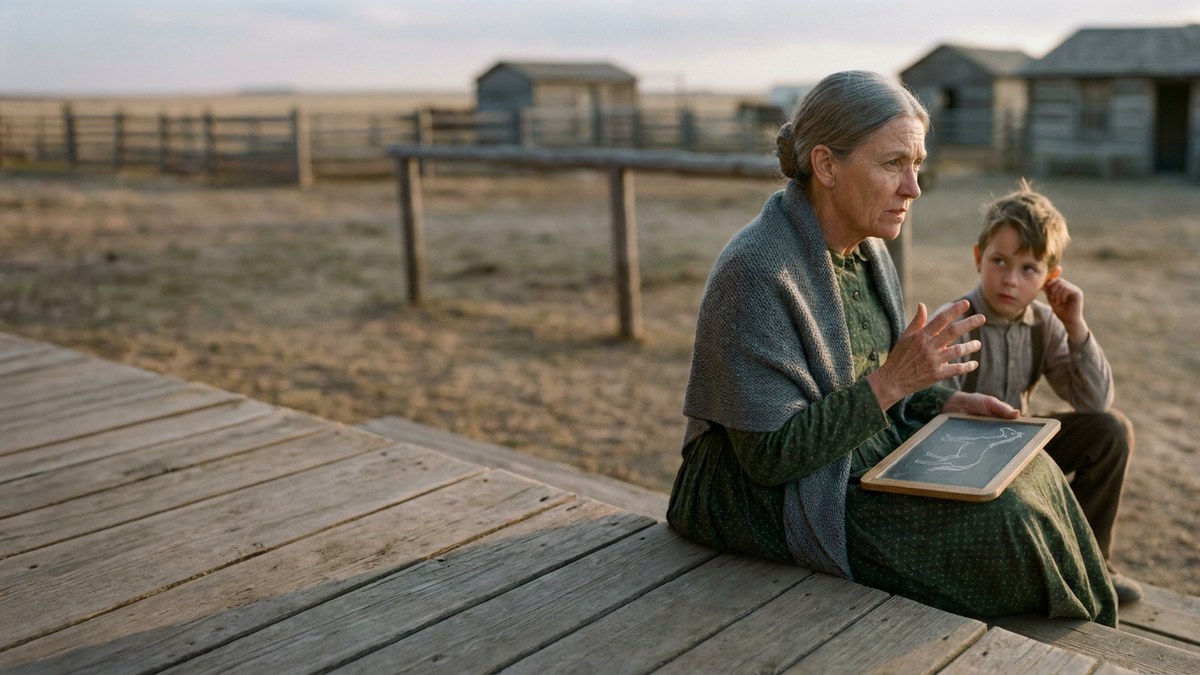
Lavinia blew out her lamp.
She did not run. Running would make a noise even Eli could feel through the boardwalk. She put one hand on the boy's shoulder and pressed down gently, and they crouched together below the window in the dark.
Inside, the chair scraped. Footsteps crossed the shop.
The shutter rattled once, as if a hand had tried the latch. Then the footsteps went back.
She counted to two hundred under her breath before she stood.
Sheriff Ashby came to the door of his house in his long underwear and a temper.
"Mrs. Hart. It's half past two."
"I know who robbed your bank," Lavinia said. "He's sewing the money into a saddle right now, and if you're quick, he'll still be sewing."
"Whose shop?"
She looked down at Eli. He looked up at her face.
She said the name she had worked out on the walk over. She had seen the man that very afternoon, at the jail door in his leather apron, talking to the sheriff about the robbery, and as he talked, he had reached up with his left hand and tugged his ear. Twice. The way a man does without knowing it, ten times a day, for twenty years.
She had not thought anything of it then.
"Wade Ottley," she said. "The harness maker."
Ashby stared at her.
"Wade Ottley is a deacon in my church."
"Then go and ask him why he's up so late," Lavinia said.
Ashby went. He took his deputy, and he made Lavinia and Eli wait at the corner.
The lamplight was still under the door of the harness shop when they knocked.
Lavinia did not see what happened inside. She saw the deputy come out ten minutes later carrying a saddle under one arm, with the seat leather hanging open. She saw Ashby come out behind him with a slicker over his shoulder, yellow and long, and a flour sack folded small in his fist.
Then she saw Wade Ottley come out between them, without his hat. He did not struggle. He walked down the steps like a man going to a funeral.
As he passed under the street lamp, he stopped and looked at Eli.
His hand came up to his ear. He caught himself, and slowly put it down.
The bank notes were all there. Eleven hundred dollars. The cashier had written down the serial numbers when the new notes came in from Topeka, as he always did, and every number matched.
In the morning, at the jail, Ottley talked.
He was fifty, with a wife and three children and a shop that had been going under since the dry year. He owed money to men in Wichita who did not wait. He had talked in a Texas drawl because he had driven cattle up from Texas when he was young, and he could still do the voice.
"I knew every man in this town would hear a Texan," he said. "Nobody listens to anything else."
"Eli wasn't listening," said the sheriff.
"No," said Ottley. He looked at the floor. "I suppose he wasn't."
Tomás Reyes walked out of the jail at nine o'clock that morning with his saddle and his yellow slicker and an apology from the sheriff, which Ashby made standing up, with his hat in his hand.
Reyes listened to it without a word. Then he walked across the street to the livery, where Eli was sitting on the top rail.
He stood below the boy where Eli could see his whole face. He touched his own chest. Then he did something Lavinia did not expect.
He made a sign, slow and careful. Thank you.
Lavinia came over. "Where did you learn that?"
"My little sister," Reyes said. "She was born deaf. There's a school for her in Austin. She taught me some in the summers. Not much."
"It's enough," said Lavinia.
Reyes stayed in Prairie Hill a week before the trail outfit took him on. He spent most evenings at the livery corral, trading signs with Eli. By the end of the week they were laughing at things nobody else could hear.
The town took up a collection for the boy who had seen the robber's face. Mrs. Bauer started it. She put in five dollars and a spool of thread.
It came to forty-one dollars.
Rob Dunbar came to Lavinia's kitchen door the evening it was counted. He stood on the step with his hat in his hands, the way he had stood at the jail.
"I took the slate away from him," he said. "I was afraid for us. I was wrong to be."
"You were afraid for him," Lavinia said. "That isn't the same thing."
He asked her then, in a low voice, if she would teach him the sign for son.
She showed him. He practiced it all the way home.
On a hot morning at the end of August, Lavinia Hart and Rob Dunbar put Eli on the eastbound train with a carpetbag and the forty-one dollars and a letter in Lavinia's best hand, addressed to the superintendent of the state school at Olathe.
Through the window of the coach, Eli made his signs for each of them. His father, a hand pulling a rope. Mrs. Bauer, a pinch of thread, which made his father laugh for the first time in a year.
Then he looked at Lavinia and stopped.
He had never made a sign for her.
He thought for a moment. Then he lifted both hands, and moved them in the air in front of him, quick and graceful, the way her hands moved when she talked to him.
The train pulled out. He kept making it until the coach was gone.
> What really happened: The Kansas School for the Deaf, the oldest state school in Kansas, was founded in 1861 at Baldwin City by Philip A. Emery, a deaf teacher. It moved to Olathe in November 1866 with 18 students, and by 1893 it had more than 200. Many deaf children who arrived at schools like it had already invented their own "home signs" with their families before learning sign language. Sources: Kansas School for the Deaf; Kansas and Kansans (1919).