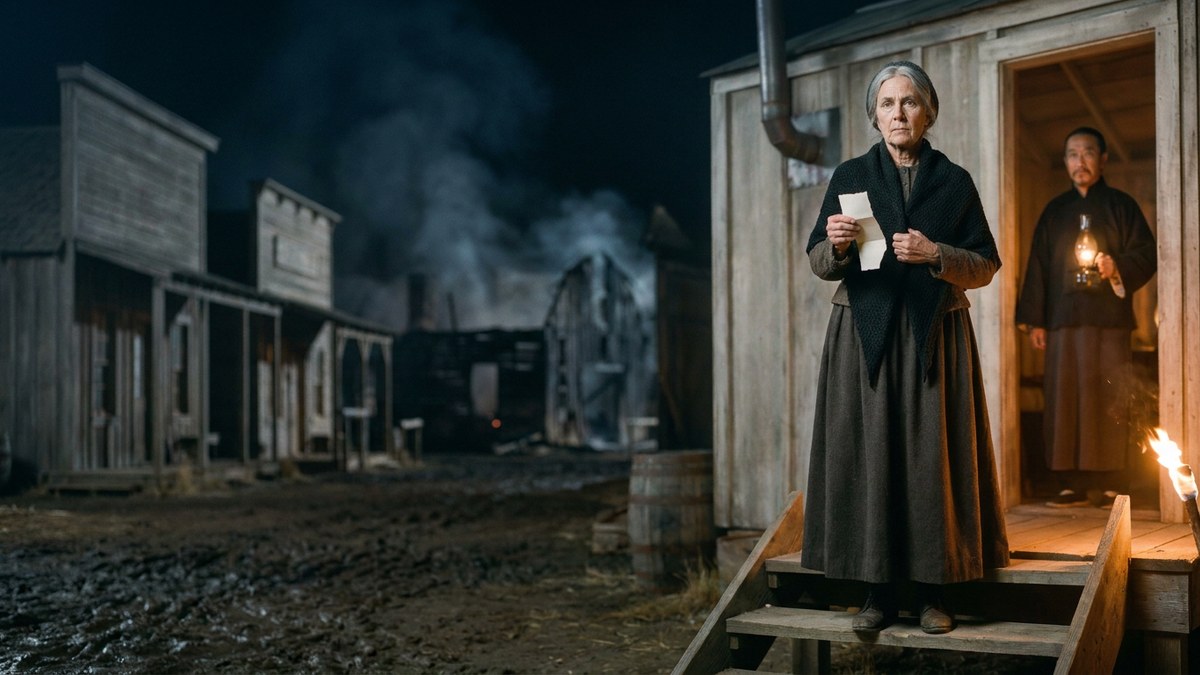
The livery barn in Cache Gulch caught fire at twenty minutes past midnight.
By one o'clock, the crowd in the street had decided who set it.
Cora Bellamy was awake before the fire bell rang. She was sixty-three, and her right hand ached at night from forty years of wringing boarders' sheets, so most nights that October of 1886 she sat up in her kitchen in the Idaho Territory with a cup of hot water and the lamp turned low.
At twenty minutes to twelve, she heard the third stair squeal.
It was the only stair in Bellamy House that talked. Her husband had meant to fix it the winter he died. She had never let anyone else touch it, because she liked knowing when a boarder went out. She heard the squeal, and then the back door latch, and then nothing.
One of the miners going out to the privy, she thought.
At twenty past twelve, the window over her sink turned orange.
The men got the horses out first, and they did it well. Emmett Ammon, who owned the livery, ran in twice with a wet sack over his head and came out leading a team each time. The miners from the Blue Jay boardinghouse made a bucket line from the creek.
The barn could not be saved. It was dry pine with a loft full of hay.
Cora stood on her own porch across the street with her shawl around her and her bad hand tucked under her arm. The heat reached all the way across and pressed on her face like an open oven door. Ash came down in her hair.
When the roof went in, Ammon walked over to her porch. His beard was singed on one side. He was a big, loud man who had never once said good morning to her in eleven years.
"Six years of work," he said, to nobody. "Six years."
Marshal Ned Corliss came up behind him with a lantern. He was young for a marshal, and he looked like he wished he were anywhere else.
"Mrs. Bellamy. You sit up nights. Did you see anything?"
Cora thought carefully, because she knew he would remember what she said.
"A little before the fire, a man went along the back of the corral," she said. "Tall. In a long coat. I didn't see his face."
"A long coat," said a voice from the street.
It was Pete Varner, a tall young man with a red wool scarf, who had boarded at Bellamy House since spring. He had been Ammon's hostler until four o'clock that afternoon, when Ammon put him out for coming to work late three days running. His hands were black from the bucket line.
"A long coat," Pete said again, louder, so the men could hear. "Like the one the Chinese laundryman wears."
Cora had picked up her sheets from Mr. Yee's that same afternoon.
The laundry stood right next door to Bellamy House, a narrow frame building with a steam pipe through the roof and a counter worn pale in the middle. Mr. Yee had come to the Idaho placers in 1869 and had washed the town's shirts since 1874. He was about fifty-five, small and very straight, and he wore a long dark coat with wide sleeves in every season.
"Two hundred six," he said, before she opened her purse.
She handed him her half of the ticket. It was a strip of pale paper with his brushstrokes on it, a number and a few characters, torn across the middle. He took the other half off the brass pin on her bundle and held the two together against the window.
The torn edges met like the two halves of a broken plate.
He crossed off two hundred six in a long paper book on the counter, where every bundle had its line.
"My half stays here," he said, as he had said every week for twelve years. "Your half walks around town."
"What did you write on mine?" she asked. She asked every few years. It amused him.
"Early," he said. "You always come early."
Now the marshal stood at the back corner of the burned barn with his lantern, and the crowd stood behind him. Cora had followed. She was not sure why. Her knees hurt on the rough ground.
The marshal picked up a coal oil can, bent by the heat. Then he picked up something smaller out of the mud by the water trough, where the bucket line had soaked everything.
It was a wet strip of paper, torn across the middle, with brushstrokes on it.
"Chinese writing," said Pete Varner. "There's your proof."
The crowd made a low sound that Cora had heard once before, years ago in another camp. She had never forgotten it.
"Ned," she said. "That's a laundry ticket. Half the town carries one."
"Go home, Mrs. Bellamy," said Ammon. "This is men's business."
Somebody lit a pitch torch from the embers. Then somebody else lit one.
At supper that night, Pete had pushed his beans around his plate and talked about leaving.
"Saturday stage at six," he had said. "I'm done with this town. I left my good shirts at Yee's at six o'clock so I'll have something clean for Boise. Ammon said if I set foot in his barn again, he'd break my arm."
"He didn't mean it," Cora had said.
"He meant it," Pete had said.
She had not thought about that supper again until now, walking back up the street behind the torches, with her shawl slipping and her hand throbbing.
Six o'clock, he had said. And the third stair at twenty minutes to twelve.
The crowd stopped in front of the laundry. The windows were dark. The steam pipe was cold.
There were perhaps forty men. Cora knew most of them by their sheets.
"Yee," Ammon shouted. "Come out."
Nothing.
Cora did not decide to do it. Her feet did. She went past the marshal and up the three wooden steps of the laundry, and she turned around at the top with her back to the door.
The torches lit the faces below her. Their heat was on her cheeks again, the same as the fire.
"Mrs. Bellamy," the marshal said. "Please."
"I'll stand where I like on my neighbor's steps, Ned."
Pete Varner was at the front with a torch. His red scarf was black with soot at the ends.
He would not look at her.
Ammon put his boot on the bottom step.
Behind Cora, very quietly, the bolt slid back.