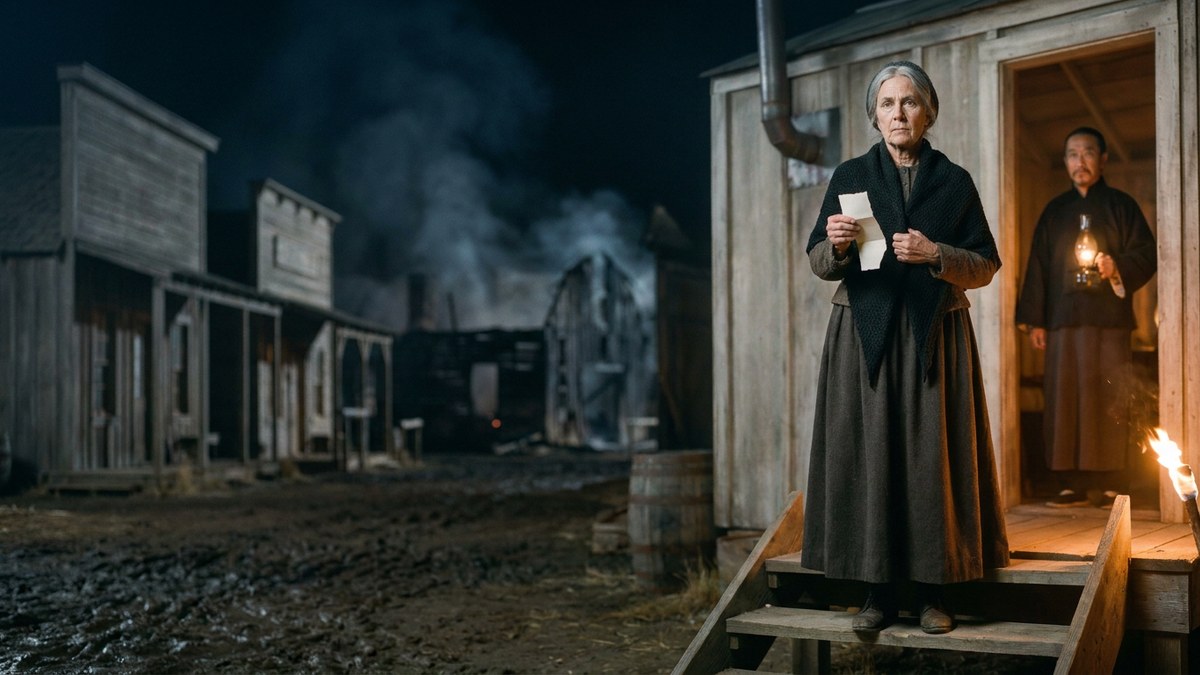
Mr. Yee came out onto the top step.
He had a lamp in one hand and his long paper book under his arm. He was in his shirtsleeves. Cora saw that his hands were steady and his face was gray.
He did not stand behind her. He stood beside her, one step to her left, where the torchlight fell on him as much as on her.
"Marshal," he said. "You have a paper. Please show me."
His English was careful and slow, the English of a man who had learned it across a counter, one customer at a time.
Someone in the crowd shouted. Ammon took his boot off the step, then put it back.
"Let him see it, Emmett," the marshal said. "Let him see it."
The marshal came up the steps and held out the wet strip. Mr. Yee set the lamp on the rail and looked at it without touching it.
"Four hundred twelve," he said.
"So you admit it's yours," Pete said.
"I admit I wrote it." Mr. Yee turned to the marshal. "I write every ticket two times. Same number, same words, top and bottom. Then I tear it. One half goes on the bundle. One half goes in the customer's pocket. My half never leaves my shop."
He pushed the door wide behind him. Cora saw the long shelves inside, the bundles in brown paper tied with string, each with its pale strip pinned on top, row after row in the lamplight.
"Come in, Marshal. Bring two men you trust. Not men with torches."
The marshal chose Hollis Brandt from the hardware store and old Sam Tuttle, the assayer. Cora went in too. Nobody stopped her.
The laundry smelled of starch and wet wood and the yellow soap Mr. Yee cut himself. It was warmer than the street.
Mr. Yee went to the third shelf and ran one finger along the strips, the way Cora found a jar in her own pantry in the dark. He took down a bundle. Two good shirts and a pair of trousers, tied with string.
He held the wet strip from the fire against the strip pinned on the bundle, under the lamp.
The torn edges met like the two halves of a broken plate.
Sam Tuttle took his spectacles off and put them back on. "That's a match," he said. "I'd swear to it."
"Whose bundle?" the marshal asked.
Mr. Yee opened his book. Each page was a column of numbers in his brushwork, with a date and an hour beside each one, and a few more characters.
"Four hundred twelve. Thursday. Six o'clock in the evening." He looked up. "Pete Varner. Two shirts. One pair trousers."
"And the other word?" Cora asked. She could not stop herself. "The one you write for each person."
"Angry," Mr. Yee said. "He came in angry. So I wrote angry."
When they came back out, the crowd was quieter. Men had watched through the window.
The marshal held the two halves together in the lamplight so the front rows could see.
"This half is the customer's half," he said. "It went into Pete Varner's pocket at six o'clock last night. Emmett, what time did you put Pete out of your barn?"
Ammon's face had changed. "Four o'clock."
"Did he come back in before the fire?"
"I told him I'd break his arm if he did."
"Then there's one way this paper got to your back wall," the marshal said. "Pete carried it there, sometime after six."
Pete laughed. It was not a good laugh. "I lost that ticket days ago."
"You took it from me at six," Mr. Yee said. "You put it in your vest pocket. I watched you do it, because you were angry, and angry men lose tickets. Then they come back and call me a thief."
Cora looked down at Pete, still holding his torch.
She was not going to speak for Mr. Yee. He had spoken for himself, and better than she could have. But one thing was hers to say.
"Pete," she said. "My third stair squealed at twenty minutes to twelve. Then my back door." She glanced at Mr. Yee, who came up to her shoulder. "And I told the marshal I saw a tall man. I said tall."
Pete dropped the torch in the mud. Somebody stepped on it.
"Six years," he said. His voice came out thin. "I curried his horses six years. He never once paid me on time. He put me out in October with two days' wages, in front of the whole street. Where does a man go in October?"
Nobody answered him.
The marshal went down the steps and took Pete by the arm, not roughly, and walked him toward the jail.
The torches went out one by one. Men went home in twos and threes. Some of them did not look at the laundry as they passed. Some of them did.
Emmett Ammon stayed at the bottom of the steps. His singed beard looked worse in the lamplight.
He took off his hat and held it in front of him with both hands, the way a man holds his hat in church.
"Mrs. Bellamy," he said. Then he looked at Mr. Yee, and that took him longer. "Mr. Yee."
He put his hat back on and walked home through the ashes.
On Saturday morning the stage left at six without Pete Varner.
At seven, Mr. Yee washed and ironed Pete's two shirts and sent them over to the jail, folded, with no ticket. The marshal told Cora about it later. He said he didn't know what to make of it. Cora said she did.
By Monday, the Blue Jay miners had promised Ammon two days' work each to raise a new barn.
Cora went next door at seven that morning, as she always did.
There was a man ahead of her at the counter. It was Emmett Ammon, with a bundle of shirts under his arm that still smelled of smoke.
Mr. Yee wrote the ticket twice with his brush. He tore it across the middle, pinned one half to the bundle, and held out the other.
Ammon took it carefully, the way a man takes a hymnbook from a stranger. He put it in his vest pocket and buttoned the pocket.
When he had gone, Cora set her own bundle on the counter.
"I wasn't first," she said.
Mr. Yee wrote her number, and then her word, the same as always. He tore the ticket and handed her the half that walks around town.
"Still early," he said.
> What really happened: Chinese immigrants came to Idaho with the gold rush of the 1860s, and by the 1870 census they made up about 28.5 percent of the territory's people, working as miners and running laundries, stores, and restaurants in the camps. In 1885 and 1886, anti-Chinese anger swept the West; a large anti-Chinese convention met in Boise in 1886, and Chinese residents were driven out of many Idaho towns. Chinese laundries ran on a matched-ticket system marked in Chinese: one half went on the bundle, and the customer had to bring back the other half to claim the clothes. Sources: Idaho State Historical Society; University of Idaho Asian American Comparative Collection.