The men at Haney's store bet a dollar apiece that Gideon Shaw would quit his claim inside a year.
Gideon heard every word. It was April 1873, the store in Willow Fork, Nebraska, was only one room, and he was standing at the counter buying a sack of seed oats.
"A dollar says he's gone by Christmas," said Ike Haney, behind the counter.
"A dollar says Thanksgiving," said somebody by the cracker barrel.
"Two good legs didn't keep my Tom on his place," said a woman by the stove. "One won't keep this man on his."
That was the widow Nan Burrell. She laughed when she said it, and she laughed the loudest. She was about forty-five, in a man's hat, with a face burned dark by two summers of working a claim alone.
Gideon paid for his oats. Then he went out to his wagon and lifted his wooden leg up onto the step with both hands, the way he had every day since Franklin, Tennessee, in November 1864.
He was fifty-six. He had farmed in Ohio until the war, and at forty-five he had been the oldest private in his company. He came home in 1865 with his left leg gone below the knee. His son-in-law gave him a chair on the porch, and Gideon sat in it for seven years.
Then he took his discharge paper out of the tin box where he kept it, read the new law Congress had passed for old soldiers, and came west to claim his own hundred and sixty acres.
The paper said three years' enlistment. It said discharged for wounds. He read it again on the train, and once more in the land office, and put it back in the tin box with his filing receipt.
The first trouble was the sod.
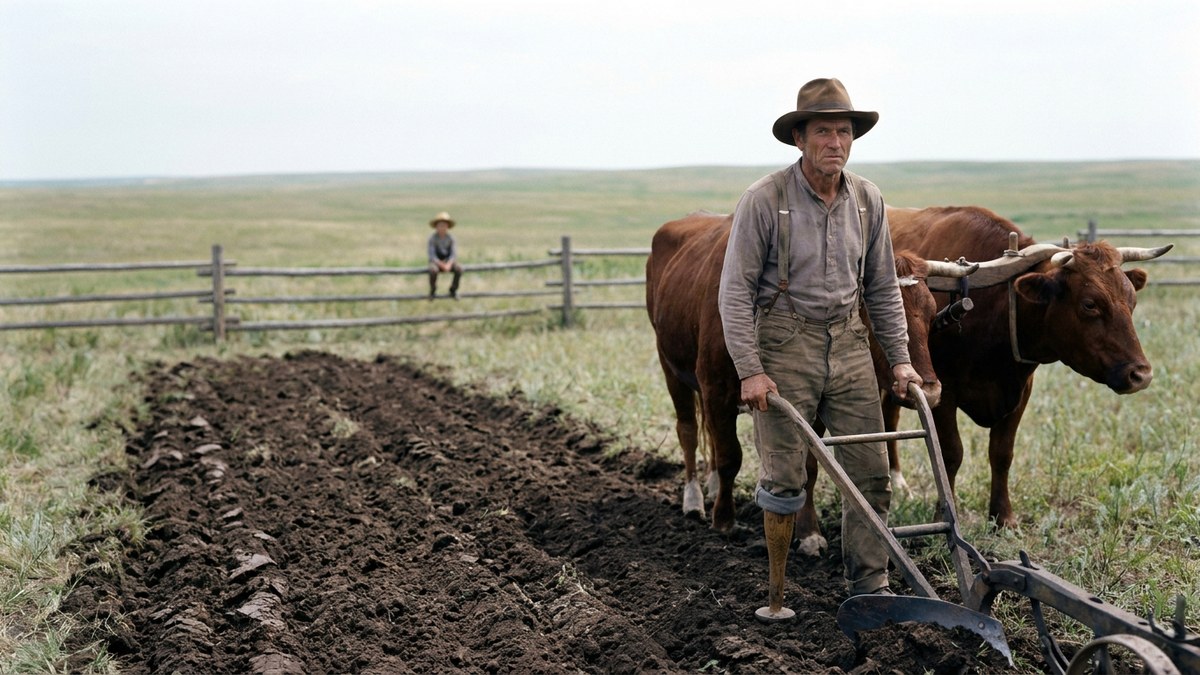
Prairie sod was a mat of roots as tough as an old rug. You broke it with a breaking plow behind a yoke of oxen, and you walked in the fresh furrow behind the plow. Gideon borrowed oxen from a Swede named Lindqvist, a mile east.
On the first morning, his peg sank into the turned earth like a fence post going into mud.
He went down hard. The plow handles tore out of his hands, and the oxen went on twenty yards dragging the plow on its side before they stopped.
Ike Haney and two other men were at the road fence. One of them laughed. Gideon heard Nan Burrell's laugh among them, high and sharp.
He sat in the furrow and looked at the hole his peg had made. It was round and narrow and deep.
That night he sat by his lantern in the claim shanty and carved. In the morning, the bottom of his peg wore a round oak foot as wide as a saucer, held on with an iron strap and three screws.
It did not sink.
He broke four acres by the end of June. It was slow work. Lindqvist said he had never seen straighter furrows in his life.
The Burrell boy started coming by in July.
Davy was thirteen, all wrists and questions. He sat on Gideon's fence and watched the oak foot go up and down the field.
"Can I drive the oxen for you?"
"No," Gideon said. "I'll do my own work."
He said it more sharply than he meant to. The boy went home. He came back the next day anyway and sat on the fence again.
In September, Gideon plowed the broken sod a second time, deeper. Backsetting, his father had called it in Ohio. The men who stopped at the fence said he was wasting his time on ground he'd never get to sow.
"Ma says a man has to stick five years to prove up," Davy told him.
"Your ma's right about most men," Gideon said.
"Why not you?"
Gideon tapped the tin box on his shanty shelf. "Read the law sometime. It's a good law."
Winter was long. Gideon burned twisted hay in his stove, and some weeks he did not see another soul but the boy on the fence.
By April 1874, every bet at Haney's store had been lost. The men made new ones. He'd never get a crop.
On March 20, with frost still white on the grass in the mornings, Gideon sowed five acres of spring wheat on his backset ground. Nobody else in the township had a seed in yet.
"Frost will take it," Ike Haney said at the store.
"The man who sows first, cuts first," Gideon said. His father had said it in Ohio for forty years.
In late April a hard frost came down. Gideon walked his rows at dawn and saw the leaves gone brown at the tips, and he did not sleep that night. By the end of the week the wheat was green again.
By the middle of July, Gideon's wheat stood gold and heavy while the neighbors' was still green.
He cut it with a grain cradle, a long scythe with wooden fingers that caught the stalks and laid them down in a row. A man with two good legs swung a cradle from his hips and could cut two acres in a day. Gideon braced his oak foot and swung from the shoulders, and cut a little less than one.
It was dead ripe. One hot wind and the heads would start to shatter.
On the afternoon of July 20, he had two acres cut and three standing. His shirt was soaked through, and the cradle handle had gone dark where his hands gripped it.
That was when Davy came running up the road.
"Mister Shaw," the boy shouted. "Ma's corn is gone."
Gideon turned. Away to the northwest, the sky had gone white. It glittered in the sun like a snowstorm in July.
Then he heard it. A sound like hail on the shanty roof, coming closer across the prairie.
Something landed on his sleeve, and then on his hat, and then on the wheat all around him by the thousands.
Grasshoppers.
One settled on the cradle handle, right where his sweat had darkened the wood, and began to chew.