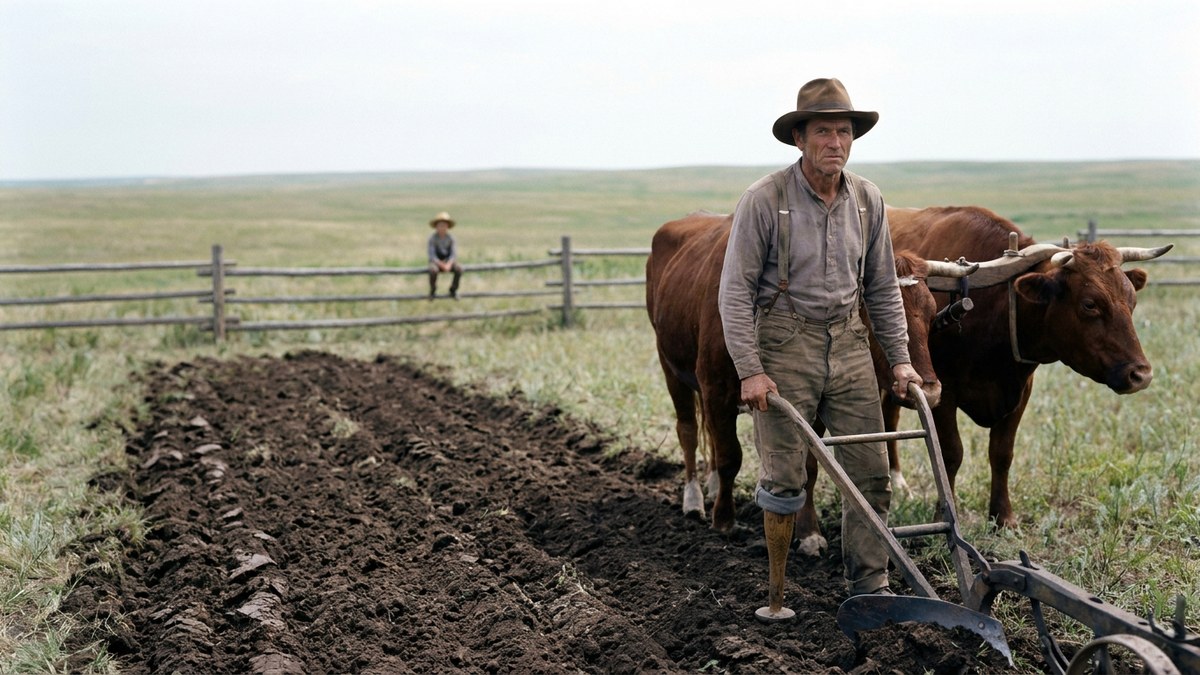
Gideon brushed it off and kept cutting.
The grasshoppers came down like a gray, living rain. They struck his face and crawled inside his collar. They covered the standing wheat so thickly that the gold went brown and moving. Under it all ran a sound he would remember the rest of his life, like a prairie fire, like a million pairs of scissors.
They went for the handle of the cradle again, after the salt of his hands. He tore his bandanna in half and tied it around the grip.
Then he swung. And swung.
Davy stood at the edge of the field with his arms around himself.
"Go home, son," Gideon said.
The boy did not move.
Gideon looked at the three acres still standing. He looked at the two acres already down in rows on the stubble, waiting to be bound into bundles before the hoppers got into them. One man could cut, or one man could bind. One man could not do both before dark.
He had been wrong to say no in July. He knew it now. His pride would cost him the whole field.
"Can you bind?" he asked.
"Ma taught me."
"Then bind."
The boy could bind. He gathered an armful of cut stalks, pulled a few long straws from it, twisted them into a band, and tied the bundle tight with a quick tuck. He did it again. And again.
They worked until dark.
At dark, the grasshoppers settled. They sat thick on every stalk and fence rail, still, waiting for morning. Gideon lit his lantern and hung it on the cradle's top, and he kept cutting. Davy set the bundles up in shocks, heads together, the way his mother had shown him.
Nan Burrell came at midnight. Gideon saw her at the edge of the lantern light, with her man's hat in her hand.
He thought she had come to take the boy home. Instead she knelt in the stubble beside her son and began to bind.
By sunrise they had cut four acres and shocked them all.
The grasshoppers rose with the heat and ate the last acre standing, down to bare stalks, in one morning. They chewed at the shocks too, but the dry bundles were not to their taste, and most of the grain held. For two more days the swarm stayed. Then the wind changed, and it went.
Nan's corn was gone. So was her garden. The hoppers had eaten holes in the curtains of her soddy and in Tom's old coat on the line.
Gideon threshed in August, when the machine came through the township. Sixty-two bushels of good wheat. Nobody else within ten miles had any.
At the end of August, he heard Nan was going back to Illinois.
The relief committee in town would give a family flour and clothes for the winter. But first you had to swear you had no money and nothing left to sell, not a cow, not a bushel of seed. Nan Burrell would not swear to that. She had a brother near Peoria. She was loading her wagon.
Gideon drove over with thirty bushels in sacks.
She was standing by her wagon when he pulled up. She looked at the sacks and then at him, and her chin came up.
"I don't take charity, Mr. Shaw."
"It isn't charity. It's Davy's wages," Gideon said. "He bound every sheaf I cut. That's his half, near enough. Sow it in the spring, or sell it. Either way, the boy earned it."
She looked down at her hands. They were cut across the knuckles from the binding straw.
"Tom had two good legs and a strong back," she said, "and this country killed him in one winter. I laughed at you because if a one-legged man could make it here, then what was wrong with us?"
"Nothing was wrong with you," Gideon said. "It was a hard winter."
She stood there a long time. Then she called Davy over, and the two of them began taking the trunk back down off the wagon.
In April 1875, Gideon drove to the land office to prove up.
The clerk read his discharge paper twice. "Three years' enlistment. Discharged for wounds."
"The law says the whole term counts," Gideon said. "Three years off the five. I owe two years on the land, and I've given two."
"You'll need two witnesses to swear you've lived on it and worked it."
The first was Ike Haney, who had lost a dollar in April 1873 and another in April 1874. He swore to it in a loud, steady voice.
The second was Nan Burrell. She took her hat off to swear. She had driven fourteen miles to do it.
Outside, on the land office step, she held out a silver dollar.
"I bet you'd be gone by Christmas," she said. "I pay my debts."
Gideon looked at it. Then he took it, and turned it over once in his fingers, and handed it to Davy.
"Your wages," he said. "For that first day."
The mud on the road home was soft from the spring rain. Behind the wagon, where Gideon had walked beside the oxen up the last hill, two kinds of tracks ran side by side: one boot, and one round oak foot as wide as a saucer.
On the rise above Willow Fork, his wheat was already up. So was the wheat in the Burrell field next to it.
> What really happened: An 1872 act of Congress let honorably discharged Union veterans subtract their time in service from the five years a homestead required, and a man discharged for wounds could subtract his whole term of enlistment, though every claimant still had to live on and farm the land at least one year. Final proof also required two witnesses who swore the settler had lived on and cultivated the claim. On July 20 to 22, 1874, Rocky Mountain locusts swept over Nebraska in numbers never seen again, eating crops, curtains, clothing, and even sweat-stained tool handles. Relief that winter came with strict rules, and many families had to swear they had nothing left to sell. Sources: Nebraska State Historical Society; U.S. Statutes at Large.