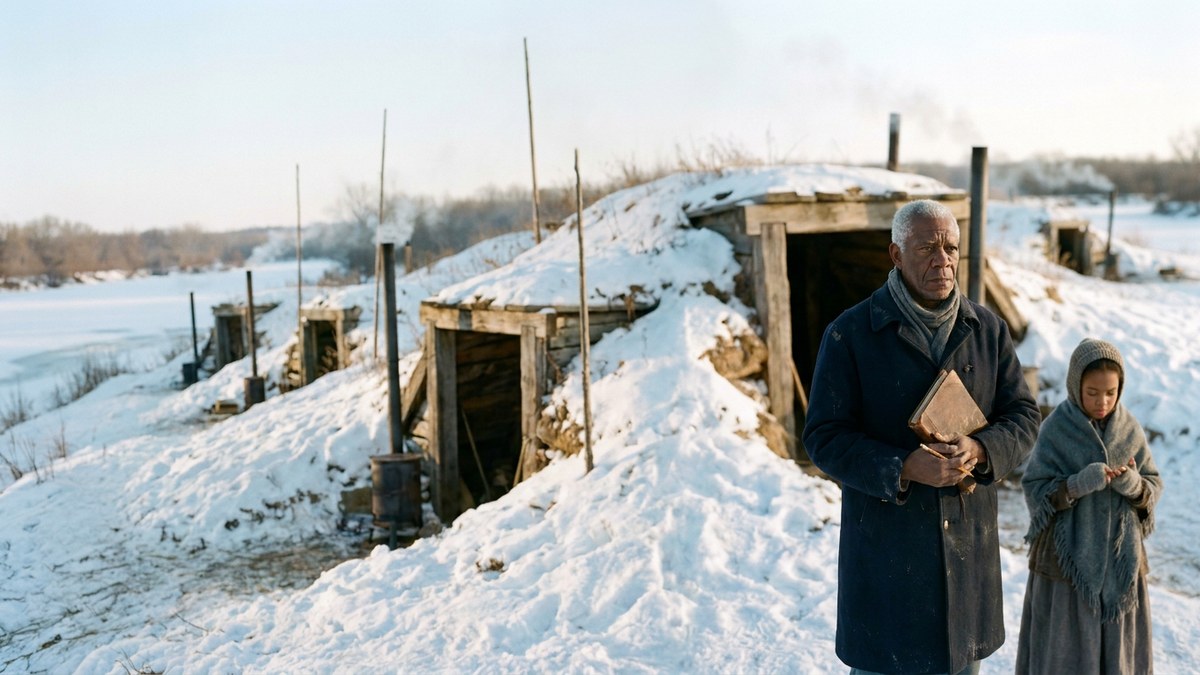
The first thing the families saw of Nicodemus, Kansas, was smoke coming out of the ground.
It was September 1877. They had ridden the cars from Kentucky to Ellis, Kansas, and then walked two days north across the open grass with everything they owned on their backs. Now they stood on a rise above the Solomon River and looked down at the town in the handbills.
There was no town. There were holes dug into the side of a hill, with stovepipes poking up through the grass and smoke curling out of them.
Somewhere behind Isom Price, a woman began to cry.
Isom was sixty-one. He had been born on a hemp farm in Scott County, Kentucky. In 1864, at forty-eight, he had walked to Camp Nelson and put his mark on the paper to join the U.S. Colored Troops. He came out a first sergeant, after a year of guard duty in Texas, and he still wore the coat.
He stood in it now and looked at the hillside the way he had once looked at a winter camp on the Rio Grande. Water. Wood. Wind.
Water was the river. Wood was nearly nothing, a few cottonwoods on the bank. Wind was everything.
"Some of them will turn back tomorrow," said his granddaughter, Delia. She was ten, and she said out loud the things grown people only thought.
"Some will," Isom said. "We won't."
Some did. The next morning, a string of families started back south toward Ellis. Thirty stayed.
That night, Isom asked the ones who stayed to come to a fire by the river. He had a pencil stub and the back of a handbill.
"Snow can come in this country in October," he said. "Before it does, we need four things. Every family dug in deep, with the door turned away from the north wind. Every chimney raised two feet above the bank, with a pole stuck beside it, so a drift can't bury it and we can find it if one does. Fuel stacked for every family, enough for a hundred days. And a roll call every morning."
"A roll call," said Jesse Oldham.
Jesse was about thirty-eight, with a fine strong voice and the straightest back in the colony. He had spent his whole life as a groom on a horse farm outside Lexington, and he could gentle a colt that nobody else could touch.
"Every morning at sunup I walk the line and count the smoke," Isom said. "No smoke, I knock."
Jesse laughed. "Sergeant, I've been bossed by one man or another for thirty-eight years. I didn't walk to Kansas to be bossed by you."
A few people laughed with him. Most did not. Isom wrote "chimneys" on the back of the handbill anyway.
There was no wood to speak of, so they burned what the buffalo had left.
The old herds had been gone from that valley for years, but the dry chips still lay thick in the grass. They were flat and light as pie tins and burned hot and quick. Isom set the children to gathering them in sacks. He showed the women how to cut dry sunflower stalks along the river and how to twist long prairie grass into hard sticks of hay that burned nearly like wood.
Delia could twist faster than anybody. She kept count of the stacks in her head.
Jesse would not gather. "Playing soldier," he called it.
His wife, Mattie, gathered for him. She did it at dawn, before he was up.
In November, most of the strong men went south to look for wages.
There was no money in the colony and no work in a town of holes. The men walked back to the railroad and the towns along it, where a man could earn a dollar laying track or cutting ice. They would come home when they could, with flour.
Jesse stayed. He said he would not take orders from a section boss either.
So in the coldest part of that winter, the camp on the Solomon was women and children and old people, and Isom, and Jesse.
Every morning at sunup, Isom walked the line with Delia beside him and counted smoke out loud.
"Twenty-eight. Twenty-nine. Thirty."
He knocked on no doors. Every chimney stood up out of the bank with its pole beside it, the way he had asked. Every one but Jesse Oldham's. His came up barely a hand's width above the grass. Mattie had asked him twice to raise it. Isom had heard her.
Isom had said nothing to Jesse about it. He had not wanted to be the man Jesse said he was.
Flour was the clock.
Isom kept the colony's flour in his own dugout, in barrels, and he wrote down every cup that went out in a ration book he had made from a ledger. If every family held to the measure, there was flour until the first of March. The men had promised to be back by then.
Jesse would not have his name in the book.
In the middle of December, Mattie came to Isom's door after dark with an empty sack and her eyes on the ground. He filled it from his own share and wrote nothing down.
The storm came in the last week of December, out of the northwest, at night.
Isom woke to a sound like a train going over the dugout roof. Snow came in fine as flour around the edges of the door. Delia sat up in her blankets and did not ask what it was.
It blew all that night and all the next day. Isom kept the stove fed with chips and twisted hay, a handful at a time, and listened.
On the second morning the wind dropped enough to stand in.
Isom pushed his door open against the drift, wrapped his coat close, and climbed out with Delia behind him. The whole valley was white and strange. Every dugout was gone under the snow. Only the chimneys showed, each one with its pole beside it, each one smoking.
Isom counted out loud.
"Twenty-eight," he said. "Twenty-nine."
Delia counted with him, and she got there first.
"Grandpa," she said. "Twenty-nine."
Isom looked down the line to the place where Jesse Oldham's chimney should have been.
There was only a long, smooth drift. No smoke. No pole. Nothing to show there had ever been a door.