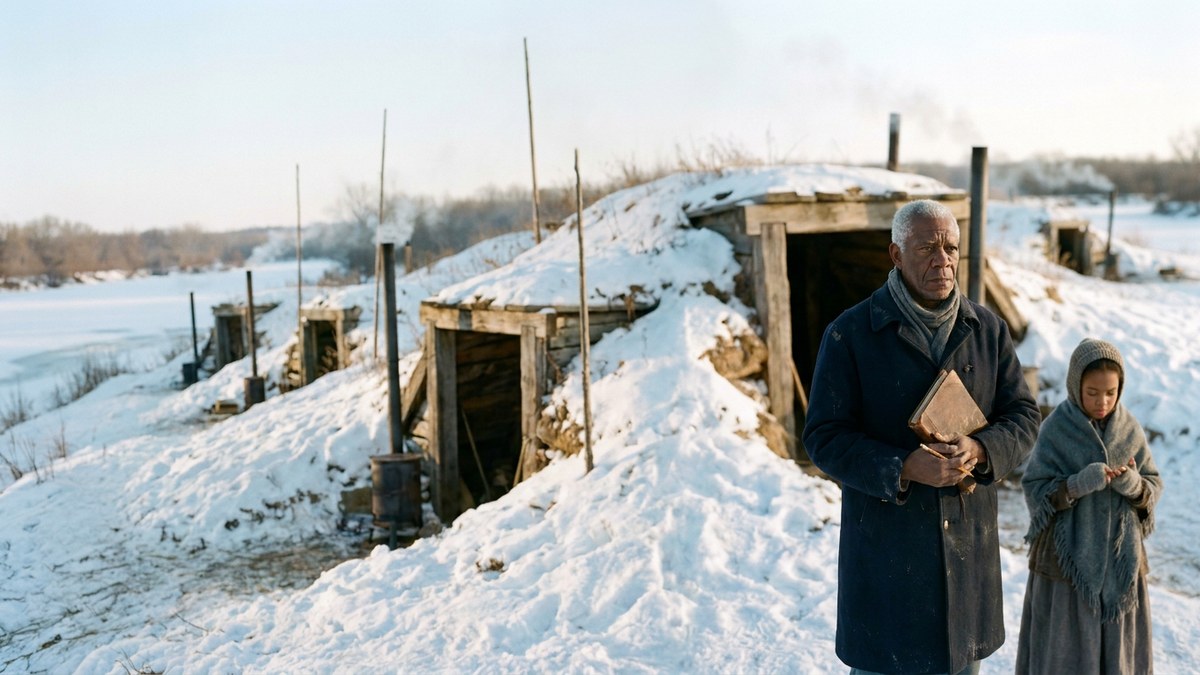
"Get the shovels," Isom said. "And get Aunt Polly and the Dorsey girls."
Delia was already running.
Isom waded to the drift. The snow came up past his knees, then to his waist. His knees had been bad since Texas, and the cold went into them like nails.
He had kept count of every dugout in that line for three months. He knew Jesse's door was six long paces past the Dorseys' pole and a little to the left. He paced it off. He pushed the shovel handle down into the snow, and on the third try it struck wood.
Five women and a ten-year-old girl dug out the Oldham door.
Isom dug too, as long as his knees would let him, and then he knelt and dug with his hands. Polly Dorsey, who was nearly seventy, threw snow over her shoulder like a man pitching hay.
When the door came free, Isom pulled it open.
Smoke rolled out at him, low and thick and bitter. The chimney had drifted shut in the night, and the stove had filled the dugout with its own bad air.
Mattie lay across the doorway, as if she had tried to reach it. The three children were in the bed. Jesse was on the floor beside the stove with one hand still on the stove door.
"Out," Isom said. "All of them. Into the cold. Now."
They dragged them out into the snow, one by one. Polly Dorsey rubbed the children's faces with snow and slapped their hands. Isom held Mattie up so the wind could get into her.
The youngest boy came around first. He began to cry, loud and angry, and Polly said it was the best sound she had heard all winter.
Then Mattie. Then the girls.
Jesse was the last.
He lay on his back in the snow and looked up at the gray sky for a long time before he seemed to know where he was. When he did, he turned his head and looked at his children, and then at Isom kneeling beside him.
He did not say anything. He reached out and took a handful of Isom's coat sleeve and held on to it.
The Oldhams moved into Isom's dugout for the rest of the storm. Nine people in a room dug for two. Delia slept sitting up against the flour barrels and said she liked it.
That first evening, Isom took the ration book down from its nail and wrote a new line at the bottom of the page. OLDHAM. FIVE. Jesse watched him do it from across the stove. He did not say a word against it.
On the second night, when the children were asleep, Jesse sat by the stove and spoke to the fire, not to Isom.
"On that horse farm," he said, "a man told me when to get up and when to eat and when I could see my own wife. Thirty-eight years. When you stood up at that fire and said roll call, all I heard was him."
"I know it," Isom said.
"You should have made me raise that chimney."
"I should have," Isom said. "I let one word keep me from it. That's mine to carry, not yours."
The next morning the storm was over. The sky was hard and blue, and the cold was the kind that made the snow squeak.
When Isom climbed out at sunup with Delia, Jesse was already out.
He had dug his own chimney clear. He had cut sod blocks from under the drift and built the chimney up, two feet above the bank and a little more, and packed it tight. Beside it he had set a long cottonwood pole with a strip of Mattie's red flannel tied to the top.
He did not look over. He went on packing sod.
Mattie came up out of the dugout behind them with a pan of hot water for his hands. She stood holding it, watching her husband work, and Isom saw her lips move once, the way Delia's did when she was keeping a count.
Isom counted.
"Twenty-eight. Twenty-nine. Thirty."
In January, a party of Osage hunters came along the river on their way home from the buffalo country and camped near the dugouts. They left meat and dried corn and would not take anything for it. Isom wrote it in the ration book in his slow capitals: OSAGE. MEAT. CORN. A KINDNESS OWED.
The flour lasted until the third of March.
On the fourth, the first of the men came walking up from the south with flour on their backs. Two weeks later, a new party of families arrived from Kentucky, and stood on the rise above the Solomon River, and looked down at smoke coming out of the ground.
Isom's knees did not come back that spring. Some mornings he could not climb the steps out of his own dugout before the sun was up.
On the first warm morning in April, he called Jesse over and held out the ration book and the pencil stub.
"Somebody has to count next winter," he said. "There'll be more of us. A lot more."
Jesse turned the book over once in his hands. Then he put the pencil behind his ear.
"Sunup," he said. "Every morning."
"Every morning," Isom said.
The next day, Isom sat in his doorway in the old army coat with Delia beside him and watched Jesse Oldham walk the line, slow and straight-backed, counting smoke out loud.
> What really happened: Nicodemus was founded in 1877 in Graham County, Kansas, and the first large party of settlers, mostly from Scott and Fayette counties in Kentucky, rode the railroad to Ellis and walked two days north to the townsite. They found people living in dugouts cut into the hillside, and some families turned back almost at once. That first winter, many men went to work on the railroads and in towns to the east, and local histories record that Osage hunters passing through shared food with the settlers. Nicodemus is the oldest remaining Black settlement west of the Mississippi founded after the Civil War and is now a National Historic Site. Sources: National Park Service; Kansas Historical Society.