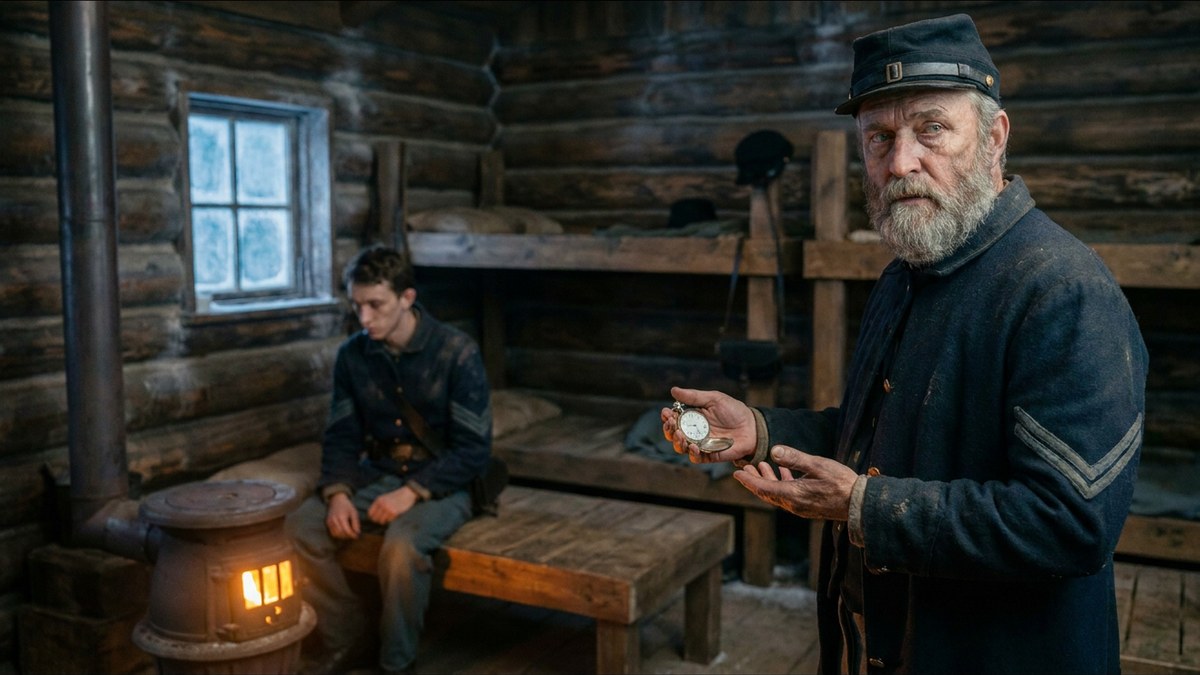
Sergeant Jonas Kell heard his dead brother's watch before he ever saw it.
It was evening roll call in January 1865, at a log fort on the upper Missouri River in Dakota Territory. Somewhere down the line of men in blue, a key turned in a watch. At the end of each turn came a little double click, like a cricket stepping twice.
Only one watch in the world clicked like that. Will had dropped it on the stone hearth at home in Iowa in 1859, and the ratchet had never been right since.
Jonas turned his head.
The man winding it was Private Asa Coker, Company C, United States Volunteers. Twenty-two years old. Tennessee.
There were two companies of them at Fort Clement that winter. They had been Confederate soldiers. They had been captured and sent to a Union prison camp in Maryland, and there they had sworn the oath of allegiance and enlisted in the Union army, on the promise that they would be sent west to guard the frontier and never made to fight their own people.
The Iowa men called them Galvanized Yankees. Like iron dipped in zinc. Union on the outside.
Jonas was fifty-six. In 1861 he had told the recruiter he was forty-four, and the recruiter had looked at his gray beard and written it down anyway. He had enlisted for one reason. Will was the youngest of eleven, twenty-two years behind Jonas, and Jonas had half raised him after their father died. When Will signed up, Jonas signed up.
On the morning of April 6, 1862, at a place in Tennessee called Shiloh, Jonas had been back with the wagons, detailed as a teamster because of his age. Will's company was in the line at the front.
Jonas never saw him again. They never found his body. And the last thing Jonas had said to him, the night before, over a letter Will would not write to their mother, was, "Then do as you please. You always have."
That night Jonas found Coker in the barracks, sitting on his bunk by the stove.
"Where did you get that watch?"
Coker looked up. He had a thin, careful face and a burn scar across the back of one hand. He closed his fingers around the watch.
"It was give to me, Sergeant."
"Who gives a Rebel a Union man's watch?"
Coker said nothing. Twenty men in the barracks had gone still to listen. Coker looked at them, and then at the floor, and said nothing more at all.
Captain Ames heard Jonas out in his quarters the next morning.
Ames was a Union officer from Ohio who commanded the two companies of Volunteers. He was tired and fair and he did not like trouble.
"Sergeant, these men swore the same oath you did. I'll not take a soldier's property because you know the sound of it."
"There'll be a W and a K scratched inside the back case, sir. I scratched them myself, the night Ma gave us the watches."
"Did you see the letters?"
"No, sir."
"Then bring me proof," Ames said. "Not a sound."
Jonas went out. He took his own watch out of his pocket, the twin of Will's, silver with a hunting case, a round paper inside the back that their mother had cut from the flyleaf of her hymnal. He wound it with its key, the way he did every night. It clicked once at the end of every turn. Only once.
Jonas ran the post's wood detail that winter, cutting cottonwood on the river bottoms for the stoves.
He had Coker put on it.
The thermometer at the surgeon's quarters went to forty below in the second week of February. The men cut and hauled with rags tied over their faces. Jonas gave Coker the heaviest end of every log and the farthest trees, and watched him for one word of complaint.
Coker never gave one.
By the middle of February, he was moving slowly. His gums had begun to bleed. So had half the men's in the fort. There had been no fresh vegetables since the last steamboat in October, and there would be none until the river opened in the spring.
Scurvy. The surgeon said the word in a low voice, as if saying it louder would bring more of it.
On the last day of February, Coker went down in the snow on the river bottom and did not get up.
Jonas loaded him on the wood sled and hauled him to the hospital himself. It took most of an hour. The young man weighed almost nothing.
The surgeon looked at Coker's mouth and at the dark marks on his legs and shook his head.
"Salt pork and hardtack," the surgeon said. "That's all I have to give him. Potatoes would save him. Onions. Anything green. There isn't a potato in this fort except what the sutler's got locked up for the officers' mess."
Coker opened his eyes. He saw Jonas, and he tried to sit up and could not.
He pressed the watch into Jonas's hand.
"Open the back," he said. "I never could read it."
Jonas sat down on the stool by the cot. His fingers were stiff from the cold. He found the edge of the back case with his thumbnail and pried it open.
There were the letters. W.K., scratched crooked into the silver. There was their mother's round paper from the hymnal.
And under it, folded small, was a second paper that Jonas had never seen. It was soft and brown with age. It was written in pencil, in a hand he would have known anywhere.
The first line said: Jonas. Don't you take this from him.