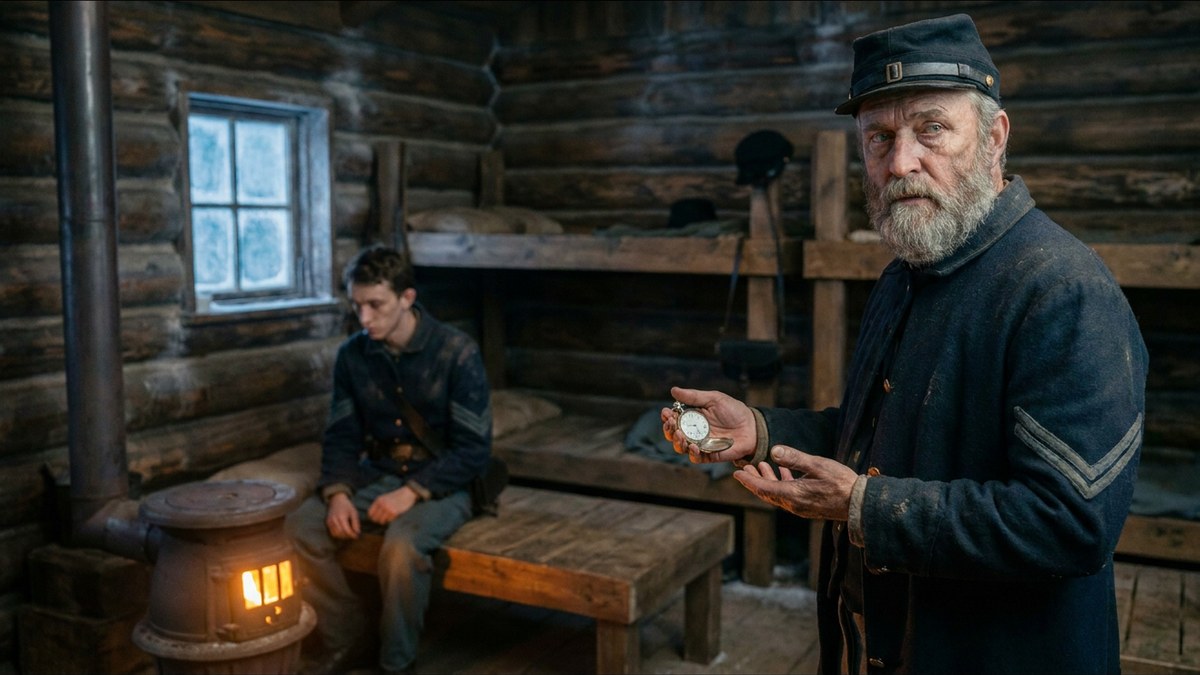
Jonas unfolded the rest of it. The pencil had faded, but not much. Will had always pressed too hard.
Jonas. Don't you take this from him. He brought me water when my own side was gone. I gave it to him. Tell Ma I was not afraid. Tell Jonas I was not mad.
That was all.
Jonas read it three times. Then he folded it the way it had been folded, small and square, and put it back under their mother's paper, and closed the case.
Coker was watching him.
"He asked my name," Coker said. His voice was a rasp. "Then he wrote that. It got dark. I sat with him. He said, keep it running till it gets home. He said his brother was a great one for keeping time." Coker shut his eyes. "I been winding it every night since."
"Why didn't you tell me?" Jonas said. "The first night. In the barracks."
"In front of all them?" Coker said. "With you calling me a thief? It was for you, Sergeant. Not for them."
The sutler's store stood just inside the fort gate. The sutler was a civilian named Brannock who had a license to sell to the soldiers, and in the back room, behind a padlock, he had a barrel of potatoes and a crock of onions packed in sawdust.
"Officers' mess," Brannock said. "Four dollars a peck. And I don't sell on credit."
Jonas had six dollars and forty cents.
He took his own watch out of his pocket, the twin with the single click, and set it on the counter beside the money.
Brannock picked it up and turned it over. "Silver. Good movement."
"My mother gave it to me," Jonas said. "Give me what it's worth in potatoes. And the onions."
Brannock looked at him a while. Then he went to the back room and unlocked it.
On his way back to the hospital with the sack, Jonas stopped at Captain Ames's door.
"I found the letters, sir," he said. "The W and the K. Inside the back case, like I said."
Ames looked up from his desk. "Then you'll want the watch returned to you."
"No, sir. My brother gave it to that boy. I have it in his own hand." Jonas shifted the sack of potatoes on his shoulder. "I was wrong about him, Captain. I'd like that written down somewhere."
Ames looked at the sack, and then at Jonas's empty watch pocket. He picked up his pen.
Jonas sat by Coker's cot for nine days.
He sliced raw potato thin as paper and soaked it in vinegar from the cookhouse. The surgeon said it had to be raw, the cooking killed the good in it. Jonas fed it to him one slice at a time. He boiled the onions into a broth and spooned that into him too.
At night, when the hospital was quiet but for the stove and the coughing, Coker talked.
He was from a hill county in Tennessee where most people had voted against leaving the Union. He had enlisted anyway at eighteen, in the fall of 1861, because his two older brothers did. He had been at Shiloh. Later his regiment was sent east, and he was captured in Virginia and sent to the prison camp in Maryland.
"Fourteen months, Sergeant. Men died every night of the cold and the flux. They said, put on the blue coat and go west, and you'll live. So I put it on." He looked up at the log ceiling. "I put on this coat to live. That's all it ever was."
Jonas did not argue with him. There was nothing to argue.
On the tenth morning, Coker sat up on his own and asked for coffee.
Jonas went out into the cold to get it. He stood on the hospital step in the gray light and found he had to hold on to the rail.
He had come west to get away from April 6, 1862. He had carried it to the end of the world in a log fort on a frozen river. Will had been out ahead of him all along, the way Will always was, waiting for him to catch up.
Tell Jonas I was not mad.
He held on to the rail until he could let go of it. Then he went and got the coffee.
The river opened late in April. Word came by courier that General Lee had surrendered in Virginia three weeks before. Some of the Volunteers cheered and some of them sat down on their bunks and cried, and some did both.
In the middle of May, the first steamboat came up the Missouri with flour and potatoes and onions and the paymaster. The scurvy went out of the fort almost as fast as it had come.
Asa Coker drew his pay with everyone else. Sixteen dollars a month for four months.
The next evening at roll call, he stepped out of line, walked up to Jonas, and held out a silver watch on its chain.
It was not Will's. It was the twin. One click.
"Brannock wanted forty dollars for it," Coker said. "I told him it was a mother's watch and it oughtn't to be in a store. He came down to thirty."
Jonas took it. It was warm from Coker's pocket.
"That was most of your pay."
"Yes, Sergeant," Coker said. "I reckon it was."
That summer, at every evening roll call on the parade ground at Fort Clement, two keys turned in two silver watches at nearly the same time.
One clicked once at the end of every turn. The other clicked twice.
Jonas never turned his head to look again. He did not need to. He knew exactly where it was.
> What really happened: About 6,000 Confederate prisoners of war took the oath of allegiance and enlisted in six regiments of U.S. Volunteers between 1864 and 1866 to serve on the western frontier, and they were nicknamed Galvanized Yankees. Six companies of the 1st U.S. Volunteer Infantry, mostly men recruited at the Point Lookout prison camp in Maryland, reached Fort Rice in Dakota Territory in October 1864. With the river frozen and no steamboat until spring, the garrison lived on salt meat and hardtack, and in the fort's first year 81 men died, 37 of them from scurvy. Sources: National Archives; State Historical Society of North Dakota.