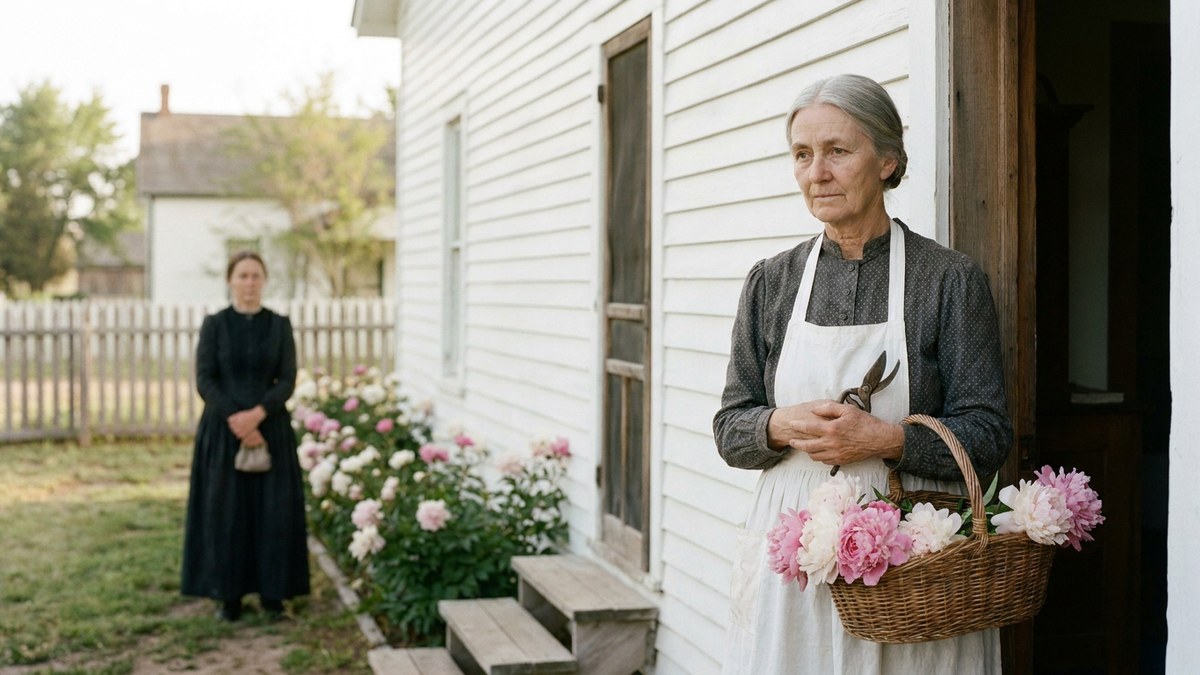
On Tuesday night, the Decoration Day committee in Cottonwood Ford, Kansas, voted to leave the five graves in the south corner bare.
Ruth Calder raised her hand with all the others.
It was May 1876, the nation's hundredth year, and the meeting was in the Methodist church with the windows open to the frogs in the creek. Major Thaddeus Pickering, who commanded the Grand Army post, stood at the front in his old blue coat with the brass buttons he polished every Sunday.
"Decoration Day is for the men who died to save the Union," he said. "That's what General Logan meant by it, and that's what it means in this town."
Nobody argued. The five men in the south corner had worn the other uniform. They had come up from Missouri and Kentucky after the war, the way a good many had, for the cheap land. They had lived in Cottonwood Ford, and died there, and been buried a little apart.
The newest grave was Silas Ralls, the blacksmith. He had died of pneumonia in March.
"My boy starved to death at Andersonville," the Major said, more quietly. "I'll not lay a flower on a man who wore that coat. Not in my lifetime."
Ruth was sixty-four. She had come to Kansas in 1857 with a husband, a son, and a sack of peony roots from her mother's garden in Ohio.
The husband was gone now. So was the son.
Daniel had been nineteen. He went with the First Kansas Infantry, and on August 10, 1861, at Wilson's Creek in Missouri, he was shot on the hill where the worst of the fighting was. The Union army fell back and left its dead on the field.
In September, a letter came. It was written in pencil by a soldier on the other side.
He had found Daniel, it said. He had taken the name from a letter in Daniel's pocket. He had buried him alone, under a walnut tree beside the Wire Road, and marked the place with a board so his mother could find it. It was signed only with two letters. S.R.
In 1866, Ruth went to Missouri with a wagon. The walnut tree was there. So was the board.
She brought Daniel home.
The board stood now in her parlor, against the wall under his picture. The letters of his name had been burned into the walnut with a hot iron, square and deep, and the D had a little curl at its foot, as if the man who made it could not help making a thing a little better than it had to be.
Every Decoration Day since 1868, Ruth's peonies had gone on the Union graves.
The bushes stood all along the south side of her house, taller than the fence, heavy with pink and white blooms that smelled like spice and rain. On Thursday morning she went out at dawn with her husband's old shears and began to cut. Seven baskets this year. She lined them up in the cool of the cellar.
At ten o'clock there was a knock at the kitchen door.
It was Lettie Ralls, the blacksmith's widow, in a black dress gone brown at the seams. She had a coin purse in her hand.
"Mrs. Calder. I wondered if I might buy some peonies. Just a few stems. For Silas."
Ruth thought of the committee. She thought of the Major's face when he said Andersonville.
"I'm sorry," she said. "They're all promised."
Lettie looked past her at the cellar door, where the cool smell of seven baskets came up the steps.
"I understand, Mrs. Calder," she said, and went away.
Ruth stood at the door a while after she had gone. She did not like the feel of her own mouth.
Silas Ralls had shod Ruth's mare for seven years.
He was a big, quiet man who said what the work would cost and never a penny more. She had paid him and thanked him and said very little else. Once, in 1872, he came to her door to return a bridle she had left at the shop. He stood on the porch a long time, looking past her into the parlor, until she grew cross and said good day.
She had thought it rude at the time.
That same year, the town put up an iron fence around the cemetery with an arch over the gate. Silas made the letters for the arch at his forge, COTTONWOOD FORD CEMETERY, and the schoolchildren liked to stand on the bottom rail and trace them with their fingers.
Ruth walked under those letters every week of her life. She had never once looked up at them.
On the evening before Decoration Day, Ruth carried two buckets of water to the cemetery to fill the jars for the morning.
On her way out, she passed the south corner.
Lettie's children had planted a wild rose on their father's grave. Ruth had seen it there on Sunday, small and green, with a few early buds.
It was lying in the path now. Someone had pulled it out by the roots. The dirt was still damp on them. In the soft ground beside the grave there were boot prints, a boy's, with a nail missing from the left heel.
Ruth picked it up and wrapped the roots in her apron, and carried it home without knowing why.
Lettie Ralls knocked again at dusk.
This time she did not have a coin purse. She had a folded paper, worn soft at the creases.
"I'm not here about the flowers," she said. "I was going through Silas's Bible to write his date in the front. This was in the back. I think it belongs to you."
Ruth unfolded it under the porch lamp.
It was a letter. It was dated June 1866. It was addressed: To S.R., the soldier who buried my son. In care of the postmaster, Springfield, Missouri.
Ruth knew the handwriting at once.
It was her own.